Description
DJI Matrice 4TD Aircraft Only (Demo Unit): IP55 Thermal Drone With 47-Minute Flight Time and Dock 3 Compatibility
The DJI Matrice 4TD is DJI’s purpose-built dock-ready thermal aircraft within the Matrice 4D Series: a fixed-arm, IP55-rated enterprise platform engineered for autonomous 24/7 operations via DJI Dock 3 and for demanding standalone deployments where weather resistance, integrated RTK, and multi-sensor thermal imaging are program baseline requirements.
Its imaging system consolidates six modules onto a single 3-axis stabilized gimbal—a 48 MP wide-angle camera at f/1.7, a 48 MP medium telephoto at 70 mm equivalent, a 48 MP telephoto at 168 mm equivalent with 112× hybrid zoom, a 640 × 512 uncooled VOx thermal imager with UHR resolution up to 1,280 × 1,024, a 1,800 m (5,905 ft) laser rangefinder, and a built-in NIR auxiliary light with 100 m illumination range.
The gimbal tilts from -90° to 80° upward, and the aircraft operates across -20°C to 50°C (-4°F to 122°F) with 1364F foldable low-noise anti-ice propellers installed.
Key Features and Benefits
• IP55 protection: operates in rain, dust, and temperatures from -4°F to 122°F (-20°C to 50°C) without covers.
• Dock 3 compatible: supports fully autonomous 24/7 missions with 27-minute dock-based battery charging.
• Thermal imaging: 640 × 512 uncooled VOx sensor with UHR mode delivering up to 1,280 × 1,024 resolution.
• Integrated RTK: onboard module provides ±0.1 m horizontal positioning accuracy in RTK mode.
• O4+ Enterprise transmission: upgraded system delivers 25 km range (FCC) for extended remote operations.
• Upward gimbal tilt: -90° to 80° range covers under-bridge, overhead, and cross-member inspection angles.
• Anti-ice propellers: 1364F foldable low-noise anti-ice propellers sustain flight performance in cold conditions.
• Hybrid zoom: 112× zoom on 48 MP telephoto resolves structural details from extended standoff distances.
• NIR auxiliary light: integrated 100 m near-infrared illuminator supports low-light and nighttime operations.
• Standalone capable: pairs with DJI RC Plus 2 Enterprise for manual piloted operations independent of Dock 3.
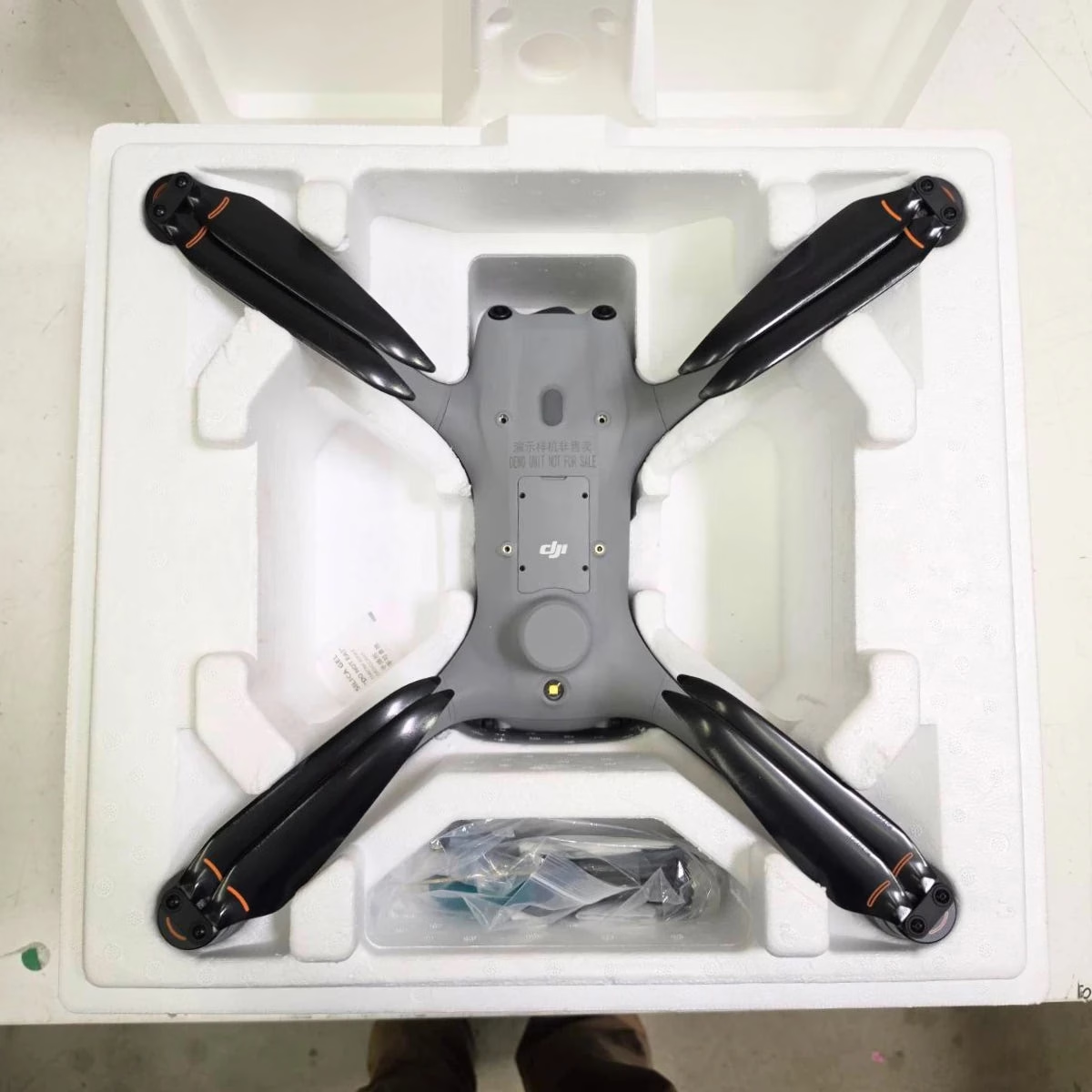
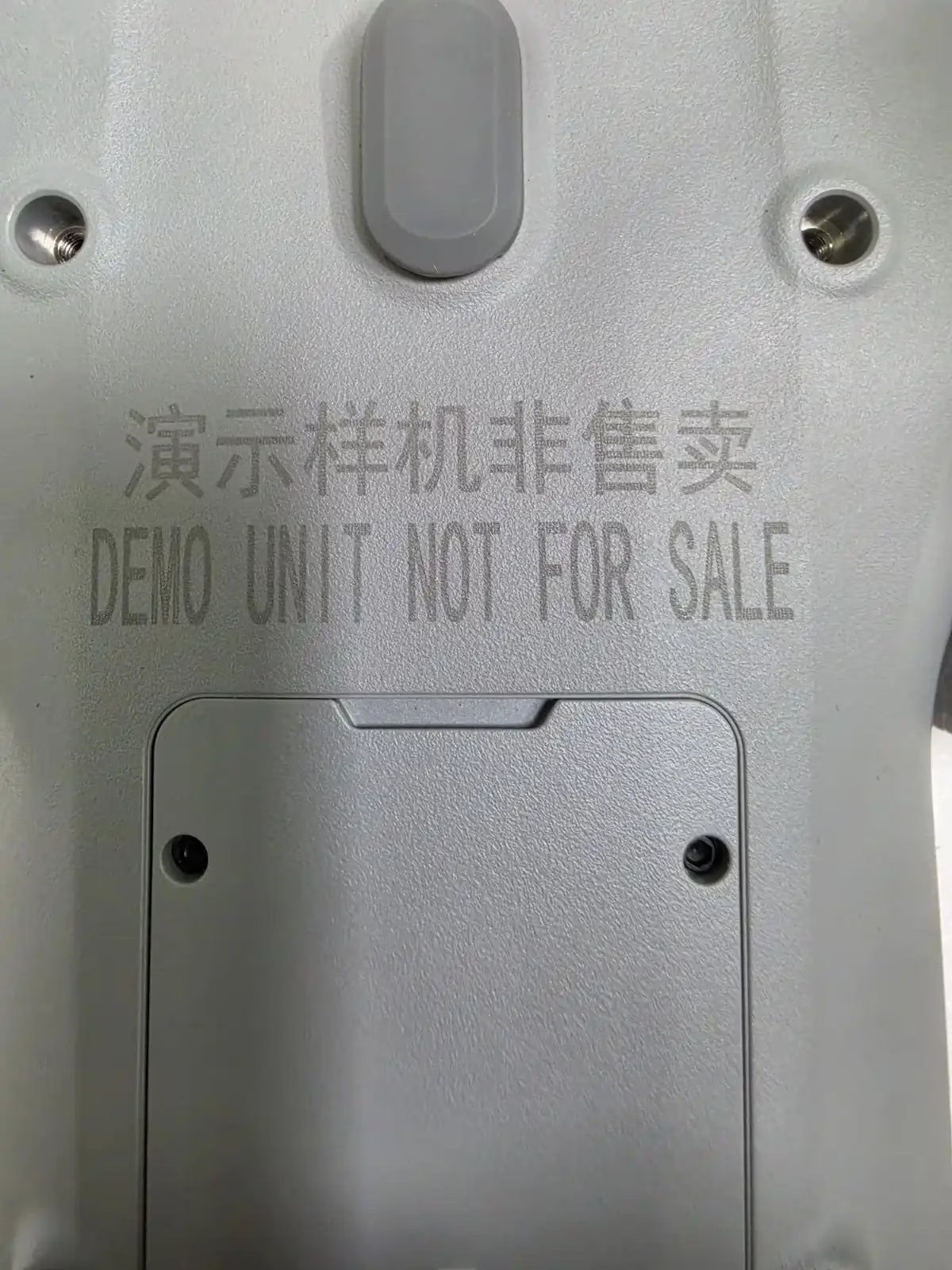
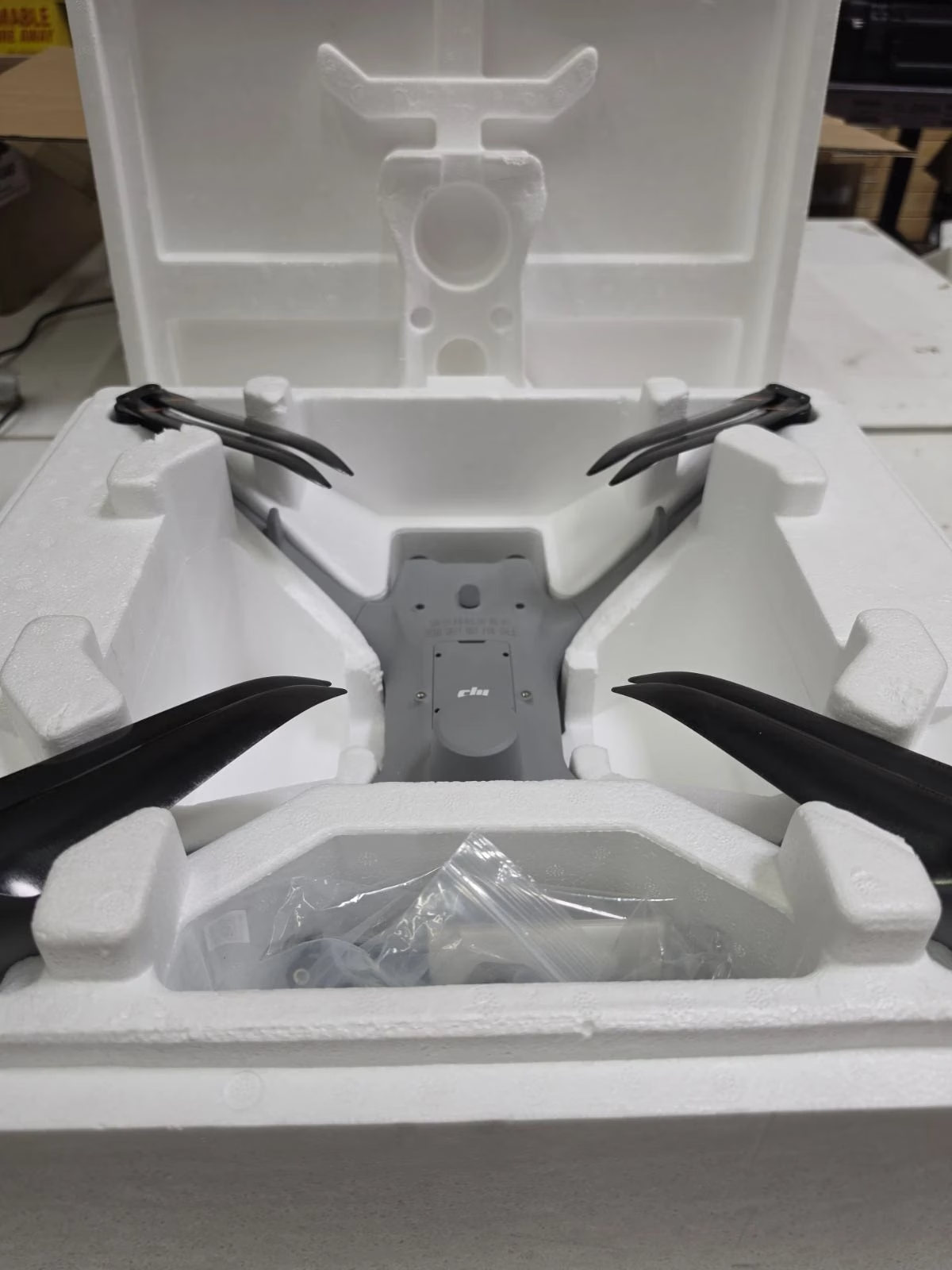
This listing is for the aircraft only. This is a like-new factory demo unit with “DEMO UNIT NOT FOR SALE” permanently engraved on the aircraft body top panel in English and Chinese. The marking is cosmetic only and carries no effect on any flight system, imaging sensor, RTK module, thermal camera, or software capability.
The aircraft is mechanically and electronically identical to a standard production M4TD. A flight battery and DJI RC Plus 2 Enterprise controller are not included and must be procured separately. DJI Dock 3, required for autonomous dock-based operations, is also sold separately.
The Matrice 4 Obstacle Sensing Module, which adds LiDAR and millimeter-wave wire detection capability, is a separate accessory not included with this listing.
An IP55 Thermal Platform Configured for Program-Level Autonomy
Fleet integrators and program managers evaluating the M4TD are evaluating a system defined by two operational tiers. In standalone mode with the RC Plus 2 Enterprise controller, it functions as a manually piloted thermal and inspection aircraft with the same imaging stack as the M4T but with IP55 protection, an 80° upward gimbal tilt, anti-ice propellers, and a wider operating temperature range.
In dock mode with DJI Dock 3, it becomes a fully autonomous asset managed remotely through DJI FlightHub 2 — launching, executing pre-programmed missions, returning, and recharging without ground crew involvement. Dock-based charging brings the battery from 15% to 95% in 27 minutes, enabling rapid turn cycles for repeat-pass inspection schedules.
The O4+ Enterprise transmission system and integrated RTK module ensure that autonomous missions maintain positioning accuracy and reliable link integrity across the full operational envelope. For programs scaling toward vehicle-mounted or fixed-site drone-in-a-box deployments, the M4TD is the aircraft the system is built around.
Compatibility and System Integration
• DJI Dock 3: IP56-rated autonomous dock enabling 24/7 scheduled missions, remote launch, and dock-based charging.
• DJI RC Plus 2 Enterprise: pairs with M4TD for manual standalone operations without Dock 3 infrastructure.
• Matrice 4 Obstacle Sensing Module: LiDAR and five-direction mmWave radar; detects 12 mm wires at ≤15 m/s.
• DJI FlightHub 2: cloud-based fleet management for autonomous mission scheduling, live view, and remote oversight.
• DJI Pilot 2: manual flight operations and mission planning app for RC Plus 2-based standalone deployments.
• DJI AL1 Spotlight: IP55-rated gimbal-following visible-light accessory for nighttime scene illumination.
• DJI AS1 Speaker: real-time voice broadcast accessory for ground interaction during active flight operations.
• D-RTK 3 Multifunctional Station: base station, rover, and relay modes for precision field RTK correction.
Applications and Use Cases
• Autonomous inspection programs: Dock 3 integration enables scheduled, unattended repeat-pass infrastructure monitoring.
• Thermal overwatch and public safety: UHR thermal imaging supports nighttime surveillance and wildfire perimeter tracking.
• Cold-weather and adverse-condition operations: IP55 rating and anti-ice propellers extend mission windows into winter environments.
• Power line and tower inspection: optional Obstacle Sensing Module adds 12 mm wire detection at operational flight speeds.
• Vehicle-mounted rapid deployment: Dock 3 mobile mounting support enables repositionable drone-in-a-box configurations.
• Multi-tier program deployment: standalone and dock modes allow the same aircraft to serve both piloted and automated workflows.
The Matrice 4TD is configured for programs that require a single thermal aircraft to operate across two distinct deployment tiers—manual piloted missions today and fully automated dock-based operations as the program scales. Its IP55 airframe, integrated RTK, anti-ice propellers, and O4+ Enterprise transmission remove the environmental and infrastructure constraints that limit lighter thermal platforms from serving as long-term program assets.
Dronefly’s enterprise team works directly with fleet integrators, program managers, and infrastructure operators to configure M4TD deployments around specific operational requirements, Dock 3 site planning, controller selection, and accessory loadouts. This like-new demo unit provides access to DJI’s dock-ready thermal aircraft at a reduced entry cost with no reduction in capability.
Order now or contact Dronefly today to discuss battery, controller, Dock 3, and Obstacle Sensing Module options that complete your M4TD system.
Aircraft specifications
• Weight: 1850 g (includes battery, propellers, microSD; excludes third-party payloads)
• Max takeoff weight: 2090 g
• Dimensions: 377.7 × 416.2 × 212.5 mm (without propellers)
• Wheelbase: diagonal 498.5 mm
• Max ascent speed: 6 m/s (Normal), 10 m/s (Sport)
• Max descent speed: 6 m/s (Normal), 8 m/s (Sport)
• Max horizontal speed (sea level, no wind): 15 m/s forward (Normal, obstacle sensing on); 21 m/s forward (Sport)
• Max wind resistance: 12 m/s (operation and takeoff/landing)
• Max takeoff altitude: 6500 m
• Max flight time: up to 54 minutes
• Max hovering time: up to 47 minutes
• Max operating radius: 10 km
• Max flight distance: 43 km
• Max pitch angle: 25° (Normal), 30° (Sport)
• Max angular velocity: 200°/s
• GNSS: GPS + BeiDou + Galileo + QZSS + GLONASS (QZSS/GLONASS with RTK enabled)
• Hover accuracy: ±0.1 m (RTK vertical), ±0.1 m (RTK horizontal)
• Operating temperature: -20° to 50° C (-4° to 122° F)
• Ingress protection: IP55
• Motor model: 2611
• Propellers: 1364F foldable low-noise anti-ice
• RTK module: integrated
• Beacon: integrated
Camera system
• Matrice 4D sensors: wide 4/3 CMOS 20 MP; medium tele 1/1.3″ CMOS 48 MP; tele 1/1.5″ CMOS 48 MP
• Matrice 4TD sensors: wide 1/1.3″ CMOS 48 MP; medium tele 1/1.3″ CMOS 48 MP; tele 1/1.5″ CMOS 48 MP
• Lens (wide): 4D FOV 84°, 24 mm equiv., f/2.8–f/11; 4TD FOV 82°, 24 mm equiv., f/1.7
• Lens (medium tele): FOV 35°, 70 mm equiv., f/2.8
• Lens (tele): FOV 15°, 168 mm equiv., f/2.8
• Lens defogging: supported on wide, medium tele, and tele cameras
• ISO (Normal): ISO 100–25600
• Max photo size: 4D wide 5280×3956; 4D medium tele 8064×6048; 4D tele 8192×6144
• Max photo size: 4TD wide 8064×6048; 4TD medium tele 8064×6048; 4TD tele 8192×6144
• Minimum photo interval: 4D 0.5 s; 4TD 0.7 s
• Video codec: H.264 / H.265
• Video resolution: 4K 3840×2160@30fps; FHD 1920×1080@30fps
• Video bitrate: H.264 60 Mbps; H.265 40 Mbps
• Supported file system: exFAT
• Photo format: 4D wide JPEG/DNG (RAW); 4D medium tele JPEG; 4D tele JPEG; 4TD JPEG
• Video format: MP4 (MPEG-4 AVC/H.264)
• Digital zoom: tele 16× (112× hybrid zoom)
Laser rangefinding (aircraft laser module)
• Normal incidence range: 1800 m (1 Hz) @ 20% reflectivity
• Oblique incidence range: 600 m (1 Hz) (1:5 oblique distance)
• Blind zone: 1 m
• Accuracy (1–3 m): system error <0.3 m; random error <0.1 m @ 1σ
• Accuracy (other distances): ±(0.2 + 0.0015D), D in meters
Thermal imaging (Matrice 4TD only)
• Thermal imager: uncooled VOx microbolometer
• Resolution: 640×512 (standard); up to 1280×1024 with UHR infrared image function enabled
• Pixel pitch: 12 μm
• Frame rate: 30 Hz
• Lens: DFOV 45°, 53 mm equiv., f/1.0, focus 5 m to ∞
• Sensitivity: ≤50 mK@f/1.0
• Temperature measurement: spot and area
• Range (high gain): -40° to 150° C (-40° to 320° F)
• Range (low gain): 0° to 500° C (32° to 932° F)
• Accuracy: high gain ±2°C or ±2%; low gain ±5°C or ±3%
• Photo format: JPEG (8-bit), R-JPEG (16-bit)
• Video format: MP4
• Digital zoom: 28×
• Infrared wavelength: 8–14 μm
NIR auxiliary light (Matrice 4TD only)
• Infrared illumination FOV: 5.7° ± 0.3°
Gimbal specifications
• Stabilization: 3-axis mechanical gimbal (tilt, roll, pan)
• Matrice 4D mechanical range: tilt -140° to +50°, roll -52° to +52°, pan -65° to +65°
• Matrice 4TD mechanical range: tilt -140° to +113°, roll -52° to +52°, pan -65° to +65°
• Matrice 4D controllable tilt: -90° to +35°
• Matrice 4TD controllable tilt: -90° to +90° (upward tilt may obstruct cameras at +70° to +90°)
• Max control speed (tilt): 100°/s
• Angular vibration range: ±0.005°
Obstacle sensing
• Sensing type: omnidirectional binocular vision system + 3D infrared sensor (bottom)
• Forward: 0.5–20 m measurement; up to 200 m detection; FOV 95° (H) / 90° (V)
• Backward: 0.5–20 m measurement; FOV 95° (H) / 90° (V)
• Lateral: 0.5–16 m measurement; FOV 90° (H) / 90° (V)
• Upward: 0.5–20 m measurement; FOV 95° (front/back) / 90° (left/right)
• Downward: 0.5–16 m measurement; FOV 90° (front/back) / 95° (left/right)
Video transmission
• Video transmission system: DJI O4+ Enterprise
• Live view: up to 1080p/30fps (with DJI RC Plus 2 Enterprise)
• Operating frequency: 2.4 GHz, 5.1 GHz, 5.8 GHz (availability varies by region)
• Max transmission distance (unobstructed): 25 km (FCC), 12 km (CE/SRRC/MIC)
• Max download speed: 20 MB/s (DJI Dock 3 or DJI RC Plus 2 Enterprise)
• Lowest latency (aircraft to dock): approx. 100 ms
• Antenna: 8 antennas, 2T4R
• Supports DJI Cellular Dongle 2 (sold separately; region dependent)
Storage and memory card support
• Memory card requirement: U3 / Class10 / V30 or above
• Recommended microSD cards: Lexar 1066x (64/128/256/512GB), Kingston Canvas Go! Plus (64/128/256/512GB)
Battery specifications
• Capacity: 6768 mAh
• Voltage: 22.14 V
• Max charging voltage: 25.5 V
• Cell type: Li-ion 6S
• Chemical system: LiNiMnCoO2
• Energy: 149.9 Wh
• Weight: 640 g
• Cycle count: 400
• Charging temperature: 5° to 45° C (41° to 113° F)
• Discharge rate: 4C
• Max charging power: 1.8C
• Low-temperature charging: supports self-heating charging
Power adapter specifications
• Input: 100–240 V AC, 50/60 Hz, 3 A
• Total output: 240 W max
• USB-C output: 65 W max
• Dual-port charging: USB-C max output is 45 W when both ports are used


Reviews
There are no reviews yet.