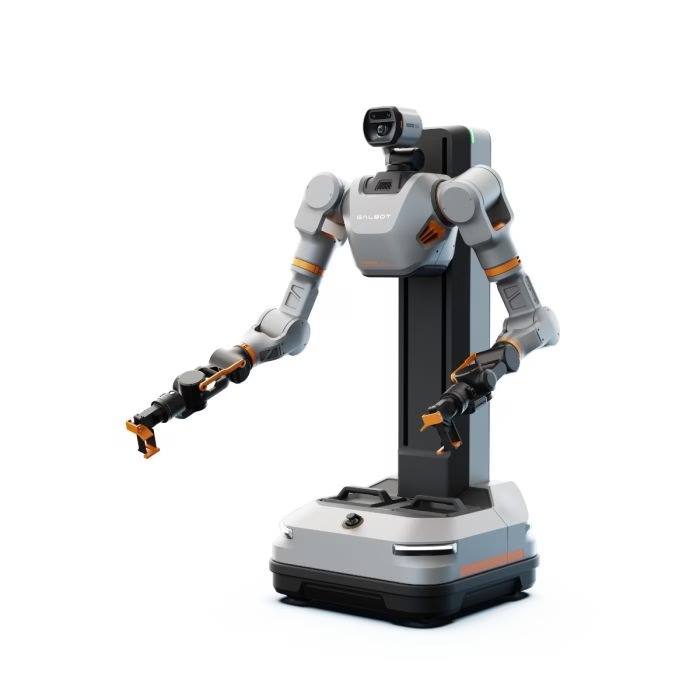
Galbot S1 Heavy Duty Wheeled Humanoid Robot
$105,000.00
Galbot S1 combines two seven-axis arms, a lifting column and an omnidirectional wheeled base for industrial handling and picking. Manufacturer sources publish different payload ratings, so the supplied hardware revision and applicable load specification must be confirmed. Battery exchange supports operation planning without establishing uninterrupted runtime.
Explore Related
Related products, categories and research.
Galbot S1 industrial handling robot
Galbot S1 is a wheeled industrial robot intended for handling, loading, unloading and picking. Two seven-axis arms work from a lifting column on an omnidirectional chassis. The arrangement combines mobile access with vertical adjustment, allowing a task designer to consider both low pick positions and higher transfer points.
Galbot S1 specifications
| Model | Galbot S1 |
|---|---|
| Maximum body height | 1793mm |
| Body weight | 320kg |
| Arm length | 920mm, shoulder center to wrist center |
| Lift stroke | 750mm |
| Articulation | Two 7-DOF arms, 2-DOF neck and one lift axis; excludes chassis and end effectors |
| Base footprint | 730 × 730mm |
| Chassis | Four-wheel omnidirectional mobile base |
| Compute platform | NVIDIA AGX Orin 64GB, 275TOPS |
Payload ratings require revision matching
Galbot’s developer documentation version 2.0.0 lists 15kg per arm and 30kg combined. The current S1 product page advertises a maximum dual-arm load of 50kg. These figures should not be merged or treated as interchangeable ratings for this offered unit.
Ask for the hardware revision and its applicable load documentation before choosing a workpiece or tool. Establish how the rating applies to the intended arm position, grip and motion. A headline combined load does not by itself describe every single-arm or extended-reach condition. The quotation should identify the revision and supported task envelope explicitly.
Galbot S1 dual-arm robot: workspace and transfer geometry
The manufacturer’s workspace is defined at the wrist center, with horizontal coverage stated as 0–2400mm and vertical reach as 2390mm. A gripper or suction tool changes the relationship between the wrist and the handled object. Use the actual end-effector geometry when checking whether a shelf, bin or machine-loading point can be reached.
For a handling cycle, define the object’s starting pose, pick point and destination. Include the base position and lift motion in that sequence. Check clearance for the carried object and both arms, especially when moving between a low collection point and a higher placement position.
Omnidirectional chassis and site layout
The wheeled base can reposition the arm assembly without relying on bipedal walking. The published maximum travel speed is 1.5m/s; it is a platform value rather than a required operating speed for a customer’s site. Route design must account for the load, stopping space, floor conditions and nearby equipment.
The 730mm square base dimension is only one part of the clearance assessment. The arm posture and object can extend beyond that footprint. Evaluate the complete robot-and-load envelope along the intended route, including turns and workstation approaches.
Hot-swap batteries and operating sessions
Galbot documents two 48V 30Ah batteries and battery hot-swap support. Its eight-hour operating figure is based on laboratory testing at an average speed of 60%; charging is specified as approximately two hours per battery using an adapter. These values do not establish uninterrupted operation of the offered robot.
Plan the battery inventory, charging arrangement and exchange procedure around the actual handling cycle. Confirm the charger and spare battery scope in the offer. Battery exchange capability, an automatic exchange installation and a complete continuous-operation workflow must be specified separately.
Galbot S1 picking robot: software and integration
Galbot publishes S1 development interfaces for motion, end-effector control and sensor access. Match the required functions to the installed software and firmware version. Gripper selection, perception setup and task implementation remain part of the application rather than a consequence of the model name.
For acceptance, use representative objects and transfer locations. Define what happens after a missed grasp, an obstructed route or an interrupted cycle. This listing does not report measured cycle times, completed integration work or hands-on test results for the offered unit.
Buyer questions
Is the offered Galbot S1 rated for 50kg?
That is not established. Manufacturer sources publish different ratings; the supplied revision and its load documentation must be confirmed.
Does the eight-hour figure guarantee a full shift?
No. It describes a stated laboratory test. The actual task, battery condition and exchange plan determine the operating schedule.
What should the package identify?
List the robot revision, end effectors, batteries, charging equipment, controllers, software access and any integration work. Reference images do not establish inclusion or condition.
Manufacturer references
Compare the current Galbot S1 product information with the versioned S1 developer specifications. Browse other platforms in Humanoid Robots.
Related products
Recently viewed
Add AI Robot Supplier as a preferred source on Google.