Menu

Inspire Dexterous Left Hand (RH56F1-E2L)

Original price was: $4,500.Current price is: $2,700.

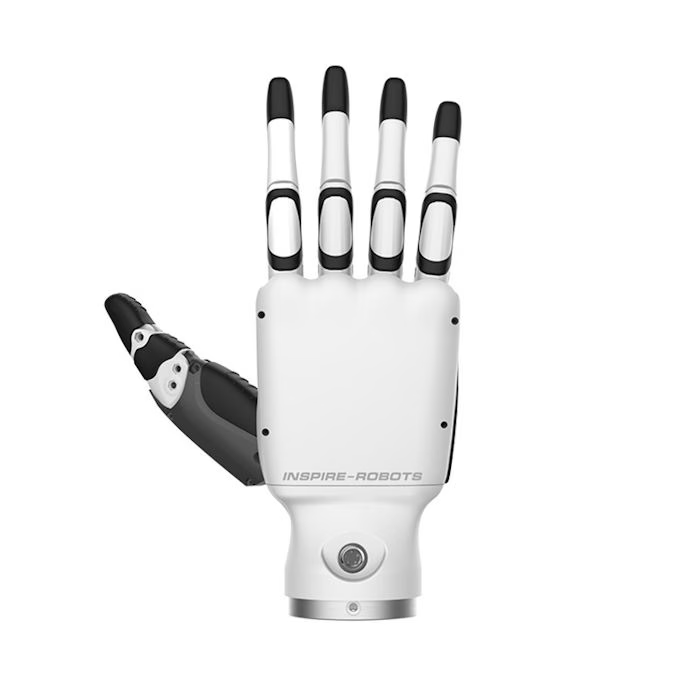
The Inspire Dexterous Left Hand (RH56F1-E2L) is a five-finger, anthropomorphic robotic end-effector designed for dexterous manipulation in robotics research and advanced automation. It belongs to the RH56-series “dexterous hand” family produced by Beijing Inspire-Robots Technology Co., Ltd., a manufacturer known for compact servo-actuated motion components and robotic hands.

Brand INSPIRE ROBOTSSKU Inspire-RH56F1-E2LCategory ,
  • Genuine, brand-new units
  • Worldwide insured shipping
  • 12-month warranty support
  • Dedicated account manager

Description

Inspire Dexterous Left Hand (RH56F1-E2L) + Free Shipping
In typical deployments, RH56F1-series hands are used as a left/right matched pair on humanoid robots, mobile manipulators, or robotic arms to enable human-like grasping, in-hand adjustment, and task-specific tool handling. The RH56 family is commonly described as using multiple actuators and embedded sensing to support hybrid position/force control for stable grasps across objects with different stiffness.
Design and Features
Anthropomorphic mechanical layout
RH56-series hands are built around a compact palm with five articulated digits (thumb + four fingers). A commonly published configuration for RH56 hands lists 6 degrees of freedom (DOF) and 12 joints (often described as “motor joints”), reflecting a design that emphasizes practical grasp patterns rather than fully independent motion for every finger segment.
Structural rigidity and integration considerations
Public RH56F1-series descriptions emphasize an integrated metal structure (all-metal skeleton) intended to improve rigidity and durability for repeated manipulation cycles and integration on robots where cable routing and mechanical robustness matter.
In addition, RH56F1-series product writeups commonly highlight concealed or internalized routing for wiring and a compact form factor suited to humanoid platforms and robotic arms.
Sensing and control modes
The RH56 family is generally described as including built-in pressure/force sensing, enabling users to set thresholds to grip objects of varying hardness.
For the RH56F1 variant specifically, some distributors describe a multi-sensor suite (tactile/force/position/temperature) and real-time responsiveness aimed at multi-mode manipulation (for example, switching between position-dominant and force-limited behaviors during contact).
Technology and Specifications
Because “RH56” is a family name and RH56F1 is a specific variant, published specifications can differ by model revision, sensing configuration (e.g., tactile versions), and interface options. The values below reflect commonly cited parameters for RH56F1 and RH56-series documentation.
Core kinematics and actuation
Degrees of freedom (DOF): commonly listed as 6
Number of joints: commonly listed as 12
Actuation concept (family-level): RH56 documentation describes a hand integrating multiple compact servo actuators and providing concise command interfaces for manipulation.
Accuracy and speed (commonly published)
A widely circulated RH56F1 specification set lists:
Repeatability: ±0.2 mm
Hand closing time: ≤ 0.8 s
Thumb lateral rotation range: 60–180°
Force capability and sensing
Published RH56F1 distributor specifications commonly include:
Fingertip force: ≥ 15 N
Thumb force: ≥ 10 N
Tactile sensor range (when equipped): 30 N
Separately, RH56-series manual data (family-level) lists force-sensor characteristics and a 0.2 mm fingertip positioning accuracy figure, reflecting a broadly similar precision target, but not necessarily identical to every RH56F1 sub-variant.
Electrical and communications interfaces
Interface support depends on variant and configuration:
RH56-series documentation: lists RS485 as a standard communication interface, with RS232/CAN referenced as customized options in some cases.
RH56F1 distributor listings: often state EtherCAT + RS485 as control interfaces for RH56F1.
Default serial parameters (manual): RS485 commonly described with 115200 bps, 8 data bits, 1 stop bit, no parity.
Multi-device bus scaling (manual): documentation notes that, with suitable conversion circuitry, many hands can share a bus (example: up to 254 on a single RS485 bus).
Applications and Use Cases
Humanoid robots and mobile manipulators
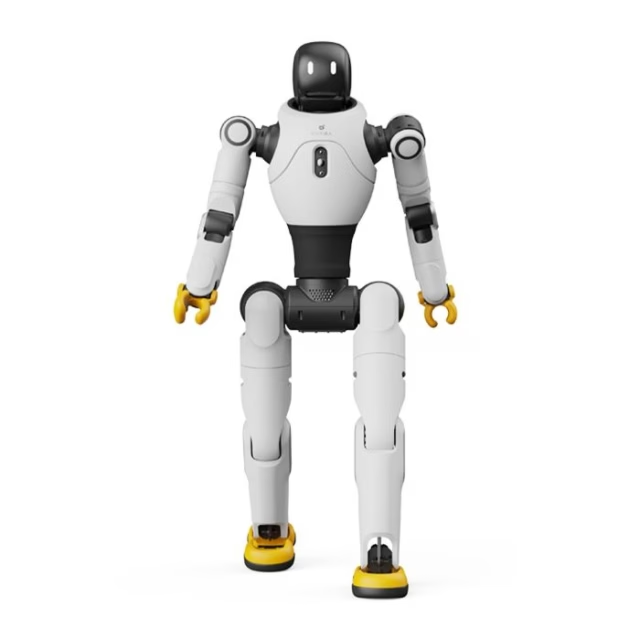
A left-hand variant such as RH56F1-E2L is typically used on humanoid or wheeled humanoid platforms to provide two-handed interaction—object handoffs, tool use, bimanual stabilization, and coordinated grasping tasks.
Research and education
RH56-series documentation explicitly points to use in service robots, teaching aids, and prosthetics-related research, reflecting a common pathway for dexterous hands: lab experimentation in grasp planning, tactile exploration, and human-robot interaction.
Industrial prototyping and light assembly R&D
Distributors frequently position RH56F1 as suitable for advanced manipulation experiments (e.g., lab-scale assembly research), where a dexterous hand can be used to evaluate small-part handling, fixture interaction, and contact-rich manipulation—tasks that are difficult with standard two-finger grippers.
Advantages / Benefits
More human-like grasp patterns than parallel grippers
A five-finger hand can form power grasps, pinch grasps, and more nuanced contact strategies than typical two-jaw grippers, which can improve task coverage for mixed-object environments (research labs, demonstrations, pilot deployments).
Sensor-informed grip stability
RH56 documentation emphasizes built-in sensing and threshold-based gripping to accommodate object hardness and help reduce crushing or slipping.
Integration-friendly control options
Support for commonly referenced industrial/robotics interfaces (e.g., RS485 and, in some RH56F1 listings, EtherCAT) is intended to simplify integration into real-time robot controllers and research stacks.
FAQ Section
What is the Inspire Dexterous Left Hand (RH56F1-E2L)?
The RH56F1-E2L is a left-hand, five-finger robotic dexterous hand in the RH56F1 series, designed to provide human-like grasping and sensor-informed manipulation for robots and research platforms.
How does the RH56F1-E2L work?
RH56-family documentation describes a hand that uses multiple compact actuators and built-in sensing (including pressure/force sensing) to control finger motion and grip force. The system is typically controlled over interfaces such as RS485 (and, for RH56F1 listings, sometimes EtherCAT), using command/register-based communication.
Why is a dexterous robotic hand important?
Dexterous hands enable multi-contact grasping and more human-like manipulation than simple grippers, supporting tasks like tool handling, object reorientation, and delicate grasping where contact force and finger placement matter.
What are the benefits of the RH56F1-E2L?
Commonly cited benefits include a six-DOF, 12-joint dexterous configuration, published ±0.2 mm repeatability, and sensor-driven grip control intended to improve stability across varied objects—features that support advanced manipulation research and integration on humanoid or mobile manipulation platforms.
Summary
The Inspire Dexterous Left Hand (RH56F1-E2L) is a research- and integration-oriented robotic hand designed to bring human-like grasping to humanoids and manipulators through a compact, multi-joint architecture and sensor-informed control. With widely published RH56F1-series parameters such as 6 DOF, 12 joints, and precision-focused repeatability, it is positioned as a practical dexterous end-effector for advanced manipulation development, experimentation, and platform prototyping.

Additional information

Brand

INSPIRE ROBOTS

Origin

China

Availability

SUBJECT TO AVAILABILITY

Reviews

There are no reviews yet.

Be the first to review “Inspire Dexterous Left Hand (RH56F1-E2L)”

Your email address will not be published. Required fields are marked *

Recently viewed