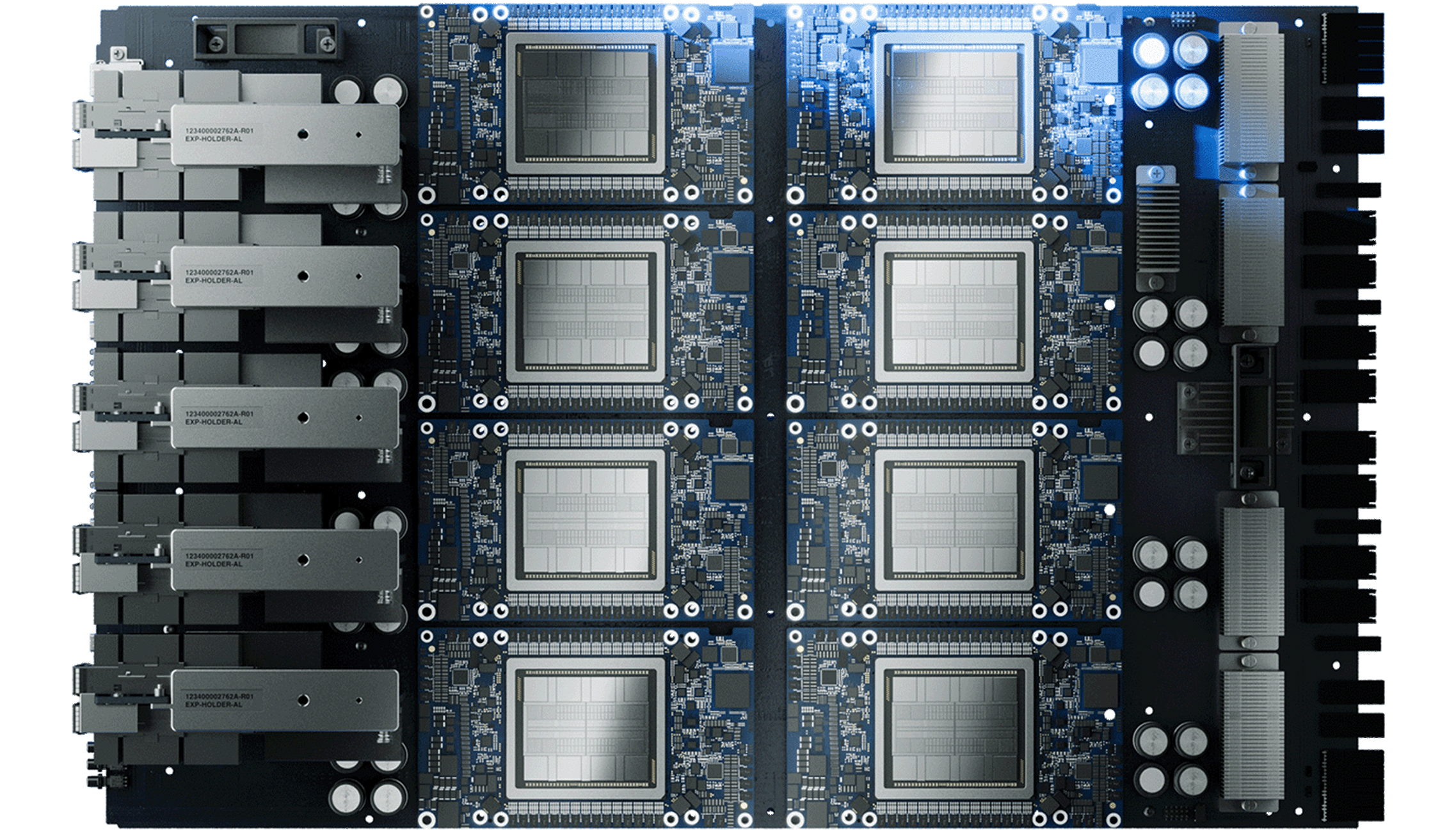
Intel Gaudi 3 8x HL-325L OAM Baseboard 1TB HBM2e
$131,116.03
Gaudi 3 8x HL-325L identifies the listed baseboard assembly with eight Intel OAM accelerators and 8 × 128GB HBM2e, marketed as 1TB aggregate accelerator memory.
Confirm the baseboard and integrated-subsystem part numbers, cooling hardware, host-server support and supplied accessories. Aggregate HBM is distributed across the accelerators; this listing does not establish a complete server package.
Explore Related
Related products, categories and research.
Gaudi 3 8x HL-325L identifies this eight-accelerator baseboard listing. Each HL-325L module has 128GB HBM2e; the eight-module capacity is marketed as 1TB aggregate accelerator memory. The memory is distributed across eight devices, so model placement and software parallelism still determine how an application uses it.
The listing SKU is ARS-AI-GAUDI3-HL325L-8X. Intel uses three distinct references: HL-325L for an accelerator module, HLB-325 for the baseboard, and HLFB-325L for its integrated eight-module subsystem. Match those manufacturer references to the quoted assembly. The catalogue title alone does not prove an Intel factory-integrated subsystem, its test history or a complete server.
Gaudi 3 8x HL-325L assembly and specifications
The modules use Intel’s 5nm Gaudi 3 architecture. Their host interface is PCIe Gen5 x16, while the baseboard combines eight modules into a server subsystem. OAM describes the accelerator module format; it does not mean the assembly can be fitted into an ordinary desktop graphics-card slot.
| Item | Manufacturer platform specification |
|---|---|
| Accelerator reference | Eight HL-325L modules in this listing |
| Module memory | 128GB HBM2e and 96MB SRAM per accelerator |
| Compute resources | 64 Tensor Processor Cores and eight matrix multiplication engines per accelerator |
| Module format | OAM 2.0 |
| Module power | Up to 900W card-level TDP |
| Baseboard reference | HLB-325; verify the actual supplied board |
| Integrated Intel subsystem | HLFB-325L; identification must be confirmed |
HBM2e capacity and workload planning
Accelerator memory and host system RAM serve different roles. The advertised aggregate HBM does not specify CPU memory, storage capacity or the amount available to a single unpartitioned model. Plan the model’s weights, working data and runtime overhead for the intended numerical precision and parallel execution scheme.
The platform targets deep-learning training and inference. A deployment decision should use the actual model, framework version and batch or concurrency requirements. No throughput, training duration or comparison with another accelerator has been measured for the offered assembly here. Arrange a representative workload evaluation if an application result is part of the purchase decision.
HLB-325 topology and RoCE v2
Intel’s baseboard brief describes direct all-to-all communication between eight accelerators without a separate switching IC. It specifies 4.2TB/s bidirectional connectivity within the subsystem and an additional 1.2TB/s bidirectional scale-out path through six OSFP connectors. Those are topology specifications, not measured application throughput or a guarantee of the surrounding cluster’s performance.
The module brief describes integrated 200Gb Ethernet connections using RoCE v2. The board routes some links internally and others toward scale-out connectors. Do not count every module interface as a separate externally accessible server port. Confirm the actual connector mapping, cable assemblies and network configuration with the system integrator.
For a cluster, list the required switches, optics or cables and management connections separately. A compatible electrical connection is only one part of integration; the software configuration and network design also need to match the intended communication pattern.
OAM 2.0 server integration
Intel specifies a 417 × 585mm baseboard, primarily powered by a 54V input with a separate 12V standby supply. Its brief lists 7.6kW for the subsystem including eight modules. That figure covers the referenced subsystem, not the entire server’s wall consumption or a facility circuit specification.
- Mechanical fit: confirm the exact chassis, mounting arrangement, connector access and board revision against the server design.
- Cooling: identify the supplied thermal hardware and the server’s validated airflow or liquid-cooling arrangement. A passive heatsink requires an engineered system air path.
- Power: have the server integrator verify input rails, distribution and transient requirements for the selected configuration.
- Host connections: document PCIe routing and the supported CPU platform, firmware and BIOS combination.
- Software: confirm the supported Gaudi software release, operating system and framework environment before deployment.
The package boundary should identify the baseboard, all eight modules and any heatsinks, power hardware, cables or management components. Host CPUs, DIMMs, SSDs, enclosure and power supplies are not established as included by this listing’s assembly name.
Buyer questions
Is this the price for a single accelerator?
The listing names an eight-module baseboard assembly. Verify that quantity and the manufacturer part numbers on the quotation; do not compare it directly with a loose module or a complete rack server without aligning the equipment scope.
Does the aggregate memory behave like one device’s memory?
The capacity belongs to eight accelerators. Application memory use depends on the framework and how the workload is divided among them. Confirm the supported execution approach for the target model.
What evidence should accompany the assembly?
Request identification of the supplied board and modules, a packing inventory and any agreed functional-test record. Keep condition, warranty entitlement, software licences and integration services explicit in the commercial offer. This page does not establish those terms or claim that the offered unit has passed Intel factory subsystem testing.
Official technical references
See Intel’s HL-325L module brief and HLB-325 baseboard brief for the distinction between modules, board and integrated subsystem. Compare related Networking & AI Infrastructure equipment using the same package boundary.
Related products
Recently viewed
Add AI Robot Supplier as a preferred source on Google.