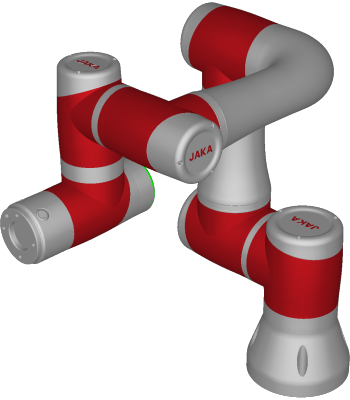
JAKA Zu 3 Collaborative Robot
$16,560.00
JAKA Zu 3 — The JAKA Zu 3 is a compact 6-axis collaborative robot sized for light, precision-oriented automation where workspace is limited. JAKA lists a 3 kg payload, 626 mm reach, 12 kg robot weight including cables, ±0.02 mm repeatability, 350W typical consumption and IP54 robot protection. Its small footprint and mobile/graphical programming make it particularly relevant to screwdriving, inspection, gluing and small-part handling. This page is structured for buyers comparing JAKA Zu 3 specifications, price, compatibility and the exact configuration required before a B2B order.
Explore Related
Related products, categories and research.
JAKA Zu 3: premium buying summary
The JAKA Zu 3 is a compact 6-axis collaborative robot sized for light, precision-oriented automation where workspace is limited. JAKA lists a 3 kg payload, 626 mm reach, 12 kg robot weight including cables, ±0.02 mm repeatability, 350W typical consumption and IP54 robot protection. Its small footprint and mobile/graphical programming make it particularly relevant to screwdriving, inspection, gluing and small-part handling.
Key specification highlights
- 3 kg rated payload.
- 626 mm reach.
- 12 kg robot weight including cables.
- ±0.02 mm repeatability.
- 350W typical consumption.
- IP54 robot body; control cabinet information on JAKA’s page lists IP44.
- Graphical and freedrive programming using a computer, tablet or mobile device.
Product overview
Zu 3 is the compact member of the JAKA Zu family, and its main buying advantage is not payload. It is the combination of short reach, low robot mass and small base footprint for stations where a larger cobot creates unnecessary interference. The product should therefore be selected around actual tool weight, part weight, center of gravity, required reach and cycle time. A nominal 3 kg payload does not mean every 3 kg end-effector-plus-part combination is valid at every pose.
JAKA Zu 3 price, cost and quotation considerations
JAKA Zu 3 price should be compared as a complete cell, not only as an arm. End effector, tool flange hardware, controller, safety devices, vision, pedestal, cabling, software integration, commissioning and guarding/risk-reduction measures can materially change project cost. The written quotation should separate the robot package from application engineering.
Core features and capabilities
- Integrated joint design aimed at compact deployment.
- Graphical programming and freedrive/hand-guided teaching.
- Programming from supported computer/tablet/mobile interfaces.
- Robot-side I/O listed by JAKA as 2 digital inputs, 2 digital outputs and 2 analog inputs.
- Controller I/O listed as 16 digital inputs, 16 digital outputs and 2 analog inputs/outputs.
- Communications listed by JAKA include TCP/IP, Modbus TCP, Modbus RTU, PROFINET and EtherNet/IP.
- Mounting and cell integration can be adapted to small workspaces, but the risk assessment determines collaborative operation.
Detailed JAKA Zu 3 technical specifications
| Robot type | 6-axis collaborative robot |
|---|---|
| Payload | 3 kg |
| Reach | 626 mm |
| Robot weight including cables | 12 kg |
| Repeatability | ±0.02 mm |
| Typical consumption | 350W |
| Robot protection | IP54 |
| Base footprint | 158 mm |
| Programming | Graphical programming and freedrive programming; mobile terminal support |
| Robot I/O | 2 digital inputs, 2 digital outputs, 2 analog inputs listed on current JAKA page |
| Controller I/O | 16 digital inputs, 16 digital outputs, 2 analog inputs or outputs |
| Communications | TCP/IP, Modbus TCP, Modbus RTU, PROFINET, EtherNet/IP |
| Controller power | 100–240 VAC, 50–60 Hz |
| Control cabinet | 410 × 307 × 235 mm; JAKA page lists 13.5 kg for the cabinet paired with Zu3 |
Performance and use-case information
The ±0.02 mm repeatability figure makes Zu 3 relevant to repeatable positioning tasks, but repeatability is not the same as absolute accuracy. Application results also depend on fixture quality, tool calibration, payload inertia, TCP definition, part presentation and process forces. For screwdriving or dispensing, the end effector and process-control hardware can be as important as the robot arm.
Compatibility, software, connectivity and site requirements
Integration should start with payload and reach, then verify tool flange, robot I/O, controller I/O, fieldbus protocol, vision or force-control hardware and safety architecture. JAKA’s current page lists common industrial protocols including PROFINET and EtherNet/IP, which can simplify PLC integration. The robot’s collaborative designation does not remove the requirement for a task-specific risk assessment; sharp tools, hot processes, pinch points or high-speed motion can still require guarding or other protective measures.
Applications
- Precision screwdriving
- Adhesive dispensing and gluing
- Small-part flexible grasping
- Inspection and measurement
- Light pick-and-place
- Electronics assembly
- Laboratory/research automation where payload and reach fit
Comparison with closely related models
JAKA Zu 3 versus Zu 5 is a clear compactness-versus-reach decision. Zu 3 is rated for 3 kg, 626 mm reach and 12 kg robot weight. Zu 5 increases payload to 5 kg and reach to 954 mm but weighs 23 kg. Both are listed at ±0.02 mm repeatability and 350W typical consumption. Choose Zu 3 when the work envelope is compact and the payload is light; choose Zu 5 when reach is the limiting constraint.
What is included?
Do not assume grippers, vision systems, force sensors, pedestals or application kits are included. Confirm the robot arm, control cabinet, cables, programming interface, emergency-stop/safety components, mounting hardware and any ordered end effector in the quotation. Software versions and optional process packages should be stated.
Important limitations and buyer considerations
- 3 kg payload is the system limit, not a guarantee for every tool/part center of gravity.
- 626 mm reach is intentionally compact and may be insufficient for larger machine-tending cells.
- IP54 does not make the robot suitable for every wet/dusty environment.
- Collaborative use still requires risk assessment and may require guarding.
- Controller and robot have different protection ratings.
- Warranty duration is not stated universally on the product page; confirm seller/JAKA service terms in writing.
Who should buy this exact model?
The JAKA Zu 3 is best for compact workcells, electronics, laboratory automation and light processes where precision and small physical footprint matter more than long reach or heavy payload.
Authoritative technical and manufacturer resources
For this cobot, verify the current JAKA controller/software revision, end-effector compatibility and local service terms before deployment.
JAKA Zu 3 technical quick answers
What is the JAKA Zu 3 payload?
3 kg.
What is the the Zu 3 cobot reach?
626 mm.
How much does the the Zu 3 cobot weigh?
JAKA lists 12 kg including cables.
What is the the Zu 3 cobot repeatability?
±0.02 mm.
Detailed FAQs
What communications does the Zu 3 cobot support?
JAKA lists TCP/IP, Modbus TCP, Modbus RTU, PROFINET and EtherNet/IP.
Does the Zu 3 cobot need a fence?
Not automatically. A risk assessment must determine whether collaborative operation without guarding is acceptable for the actual tool, speed, process and environment.
What is the main difference from Zu 5?
Zu 5 increases payload to 5 kg and reach to 954 mm, while Zu 3 is smaller and lighter.
Can the Zu 3 cobot be used for screwdriving?
JAKA specifically presents screwdriving as one application; the correct screwdriver, torque process and fixture still need engineering.
What should a quotation include?
Robot arm, controller, cables, safety components, mounting, tool/end effector, software/options, commissioning, support and delivery terms.
Relevant internal links
Request a B2B quotation
For a Zu 3 quotation, provide the tool and part mass, required reach, process, controller/fieldbus needs, destination and commissioning scope so the cell can be configured safely.