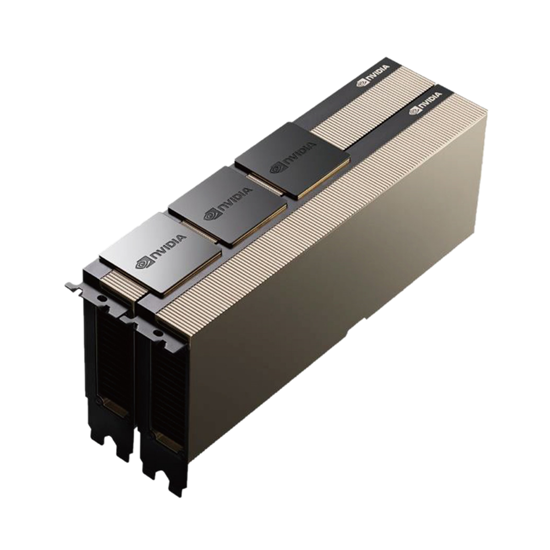
NVIDIA H100 NVL Tensor Core GPU 94GB
$17,999.40
NVIDIA H100 NVL 94GB is a verified exact-model listing researched against current manufacturer documentation. The NVIDIA H100 NVL 94GB is a Hopper PCIe data-center accelerator optimized for large-language-model inference, enterprise AI, analytics and HPC. Unlike consumer RTX cards, it uses passive server cooling, supports NVLink pairing and MIG, and is designed around qualified server airflow and power delivery. Its 94GB HBM3 and roughly 3.9 TB/s bandwidth remain important for organizations with established Hopper infrastructure. Use this page to compare specifications, compatibility, power and deployment requirements before requesting a B2B quotation.
Explore Related
Related products, categories and research.
NVIDIA H100 NVL 94GB: technical buying overview
The NVIDIA H100 NVL 94GB is a Hopper PCIe data-center accelerator optimized for large-language-model inference, enterprise AI, analytics and HPC. Unlike consumer RTX cards, it uses passive server cooling, supports NVLink pairing and MIG, and is designed around qualified server airflow and power delivery. Its 94GB HBM3 and roughly 3.9 TB/s bandwidth remain important for organizations with established Hopper infrastructure.
Key NVIDIA H100 NVL 94GB specification highlights
- 94GB HBM3 with ECC-enabled enterprise accelerator design.
- 3.9 TB/s-class memory bandwidth.
- PCIe Gen5 interface for qualified servers.
- NVLink support between an adjacent pair of H100 NVL cards using the required bridge topology.
- MIG for up to seven isolated GPU instances.
- SR-IOV support documented by NVIDIA for virtualization-oriented deployments.
NVIDIA H100 NVL 94GB product overview
H100 NVL is a dual-slot 10.5-inch PCIe card rather than an SXM module. NVIDIA’s product brief documents a passive thermal solution, 94GB HBM3, PCIe Gen5 support and configurable board power. This architecture gives server builders a way to deploy Hopper acceleration in PCIe systems, including paired configurations using NVLink where the server layout and bridge topology support it.
Core features and capabilities
NVIDIA lists H100 NVL at 3,341 TFLOPS FP8 Tensor Core performance with sparsity, 1,671 TFLOPS FP16/BF16 Tensor Core with sparsity, 835 TFLOPS TF32 Tensor Core with sparsity and 30 TFLOPS FP32. Performance depends heavily on model, precision, framework and software optimization, so these figures should be used as architecture-level reference points rather than guaranteed application throughput.
Detailed technical specifications
| Architecture | NVIDIA Hopper |
|---|---|
| Memory | 94GB HBM3 |
| Peak memory bandwidth | 3,938 GB/s in NVIDIA product brief; rounded to 3.9 TB/s on product page |
| Form factor | FHFL 10.5-inch, dual-slot PCIe |
| Cooling | Passive heatsink; requires system airflow |
| Power | 350-400W configurable; product brief lists 400W maximum default mode |
| PCIe | PCI Express Gen5 x16 / Gen5 x8 / Gen4 x16 supported |
| NVLink | Up to 600 GB/s bidirectional with supported paired-card bridge topology |
| MIG | Up to 7 instances |
| Board weight | 1,214 g excluding bracket, extenders and bridges |
Performance and use-case information
NVIDIA lists H100 NVL at 3,341 TFLOPS FP8 Tensor Core performance with sparsity, 1,671 TFLOPS FP16/BF16 Tensor Core with sparsity, 835 TFLOPS TF32 Tensor Core with sparsity and 30 TFLOPS FP32. Performance depends heavily on model, precision, framework and software optimization, so these figures should be used as architecture-level reference points rather than guaranteed application throughput.
Compatibility, software and connectivity
A normal desktop chassis is not the target environment. The H100 NVL uses a passive heatsink and relies on forced server airflow. NVIDIA’s product brief specifies PCIe Gen5 x16/x8 or Gen4 x16 support, one 16-pin auxiliary power connector, CUDA 12.2 or later for the documented x86 software baseline and driver support beginning with the R535 branch. Server BIOS, power, airflow and NVLink topology must still be validated by the system vendor.
Applications
- LLM inference
- Model fine-tuning and training workloads
- Enterprise AI services
- HPC and scientific applications
- Data analytics
- Virtualized or partitioned accelerated compute
NVIDIA H100 NVL 94GB comparison with related models
H100 NVL versus H200 NVL is mainly a memory decision within the Hopper generation. H200 NVL raises memory from 94GB to 141GB and bandwidth from about 3.9 TB/s to 4.8 TB/s, while H100 NVL may remain attractive in validated systems where existing software, budget and availability favor it. B200 is a later Blackwell platform and should be evaluated as a broader infrastructure upgrade rather than a direct card swap.
What is included
NVIDIA’s H100 NVL product brief documents the card, optional extenders and NVLink bridge topology, but it does not mean every sales package contains every component. Confirm card count, bridge hardware, power adapters, brackets/extenders, server integration and software entitlements in the quotation.
Important limitations and buyer considerations
- Passive server cooling is mandatory; desktop-style open-air cooling assumptions are unsafe.
- NVLink requires the correct adjacent-card topology and bridge hardware.
- The board alone is not a complete AI server.
- Power mode and performance depend on supported cable/power configuration.
- Warranty and support route depend on the actual seller/OEM channel.
Who should buy the NVIDIA H100 NVL 94GB?
H100 NVL fits enterprises and technical buyers standardizing on Hopper PCIe servers, especially where 94GB per GPU is sufficient and mature CUDA/Hopper deployment matters more than moving immediately to H200 or B200.
Authoritative technical and manufacturer resources
Manufacturer specifications can be revised. Confirm the exact product code, hardware revision, regional documentation and supplied scope before purchase.
NVIDIA H100 NVL 94GB technical quick answers
How much memory does the NVIDIA H100 NVL 94GB have?
94GB HBM3.
How fast is the memory?
NVIDIA documents 3,938 GB/s peak bandwidth, commonly presented as 3.9 TB/s.
What form factor is H100 NVL?
A full-height, full-length 10.5-inch dual-slot PCIe card with passive cooling.
Does H100 NVL support NVLink?
Yes, NVIDIA documents up to 600 GB/s with the supported paired-card bridge topology.
NVIDIA H100 NVL 94GB FAQ
What is the difference between H100 NVL and H100 SXM?
H100 NVL is a PCIe form factor with 94GB memory, while H100 SXM is an HGX-oriented module with different power, memory capacity and interconnect characteristics.
Can H100 NVL run in any PCIe server?
No. Power, airflow, BIOS, lane topology and physical qualification must be confirmed.
Does it support CUDA?
Yes; NVIDIA's product brief documents CUDA support and a software baseline for the card.
Is a pair of NVLink bridges included?
Do not assume so. The exact supplied hardware must be confirmed in the quotation.
Related products and internal resources
- Shop Graphic Cards
- NVIDIA RTX PRO 6000 Workstation Edition
- NVIDIA RTX PRO 5000 Blackwell 48GB
- ASUS ROG Astral RTX 5090 OC
- ASUS ROG Strix RTX 5070 Ti OC
Request a B2B quotation for NVIDIA H100 NVL 94GB
For business, university, research, data-center or professional procurement, contact AI Robot Supplier with the required quantity, destination country, intended platform or system, and any compatibility requirements. The quotation should confirm the exact model, price, lead time, supplied hardware, shipping terms and applicable warranty/support route before payment.