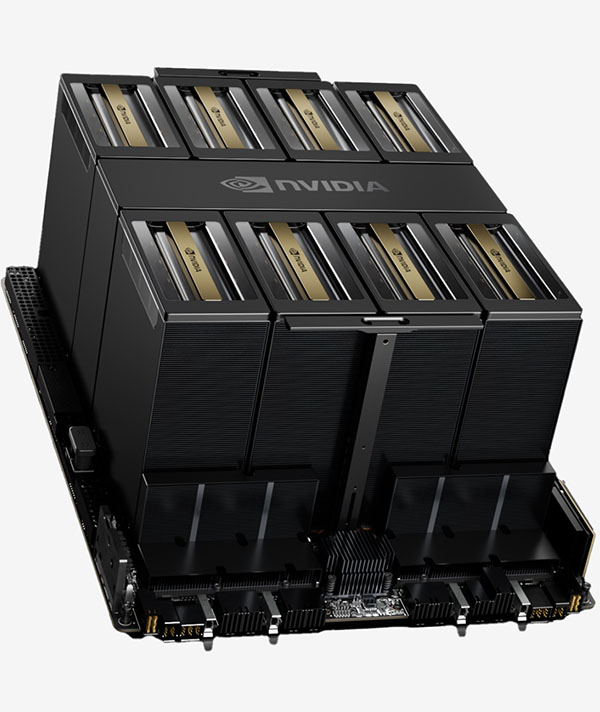
NVIDIA HGX B300 8-GPU Blackwell Ultra Node
$450,400.00
NVIDIA HGX B300 eight-GPU Blackwell Ultra platform with 2.1 TB total GPU memory and fifth-generation NVLink. Confirm the implementing server model, CPU, host memory, storage, network adapters and cooling configuration in the supplied bill of materials.
Explore Related
Related products, categories and research.
NVIDIA HGX B300 8-GPU node overview
NVIDIA HGX B300 8-GPU Blackwell Ultra Node is an eight-GPU HGX platform for large-scale AI training, reasoning inference, model serving, HPC and high-density AI factory infrastructure. Based on Blackwell Ultra, the configured platform provides 8 × Blackwell Ultra GPUs; 2.1TB total fast GPU memory class for a system-level AI deployment.
This NVIDIA HGX B300 node listing identifies an eight-GPU platform. Confirm the implementing server manufacturer, model and supplied bill of materials. NVIDIA’s HGX platform specifications do not establish the chassis, host processors, memory, storage or services included in this particular offer.
Before evaluating a configured node, review workload requirements, power and cooling, host-platform validation, networking, software stack, rack or workstation requirements, quantity, support route and lead time. Request the configured inventory in the written offer before approving procurement.
NVIDIA HGX B300 platform features
- Enterprise AI platform: designed for large-scale AI training, reasoning inference, model serving, HPC and high-density AI factory infrastructure.
- High-capacity accelerator memory: 8 × Blackwell Ultra GPUs; 2.1TB total fast GPU memory class.
- Modern accelerator architecture: Blackwell Ultra.
- System scope: reconcile the eight-GPU platform with the implementing server and its installed components.
- Configuration review: identify part numbers, installed hardware, software entitlement and commercial scope in the offer.
System-level AI performance depends on more than accelerator specifications. CPU architecture, host memory, storage throughput, interconnect topology, Ethernet or InfiniBand fabric, chassis thermal design and framework support can materially change workload throughput. Buyers planning production AI infrastructure should validate the complete system against the intended model sizes and concurrency targets.
NVIDIA HGX B300 workloads and applications
The platform is designed for large-scale AI training, reasoning inference, model serving, HPC and high-density AI factory infrastructure. Typical deployments include private AI infrastructure, enterprise model serving, research clusters, scientific workloads and advanced generative AI development where large accelerator-memory capacity and high-bandwidth compute are important.
AI Training and Inference
Multi-accelerator systems can support large models and higher concurrency than a typical workstation GPU, but actual results depend on precision, framework versions, batch size, model architecture, networking and software optimization. Confirm support for your intended framework and model before procurement.
HPC numerical requirements
NVIDIA’s current eight-GPU HGX B300 table lists 600 TFLOPS FP32 and 10 TFLOPS FP64/FP64 Tensor Core performance. Those figures describe different arithmetic from the low-precision Tensor Core specifications. A scientific application that requires double precision should be evaluated using its actual numerical requirements rather than the largest advertised AI FLOPS figure.
Identify the precision used by the application’s main kernels and any accuracy constraints before comparing accelerator proposals. An AI-oriented platform and a double-precision HPC platform can have very different strengths even when both are described as GPU servers.
NVIDIA HGX B300 specifications
| Brand | NVIDIA |
|---|---|
| Architecture | Blackwell Ultra |
| Memory | 8 × Blackwell Ultra GPUs; 2.1TB total fast GPU memory class |
| Product class | 8-GPU HGX node / enterprise AI server platform |
| GPU Configuration | 8 × NVIDIA Blackwell Ultra GPUs |
| Total Fast Memory | 2.1 TB |
| Aggregate Memory Bandwidth | up to 62 TB/s |
| FP4 Tensor Performance | up to 144 PFLOPS sparse / 108 PFLOPS dense |
| FP8/FP6 Tensor Performance | 72 PFLOPS sparse; 36 PFLOPS dense |
| NVLink Switch Bandwidth | 14.4 TB/s |
| Interconnect | 5th-generation NVIDIA NVLink |
| System Type | HGX B300 8-GPU node |
| Availability | Contact AI Robot Supplier to confirm current commercial availability and lead time. |
Configuration note: specifications above describe the referenced commercial system or baseboard configuration. OEM revisions, cooling options, storage, CPU, networking and accessories can vary. Final order specifications should be confirmed on the quotation or proforma invoice.
NVIDIA HGX B300 architecture and specification scope
NVIDIA HGX B300 uses eight Blackwell Ultra SXM GPUs and fifth-generation NVLink. It is distinct from GB300 NVL72, which combines a 72-GPU domain with Grace CPUs. Do not transfer the rack-scale platform’s processor count, memory total or facility assumptions to an eight-GPU server proposal.
NVIDIA’s current HGX page places B300, B200 and Rubin specifications in separate tables or columns. Check the generation before copying a value into a configuration record. Rubin’s HBM4 and sixth-generation NVLink specifications do not describe HGX B300.
For numerical comparisons, the manufacturer’s HGX B300 FP4 pair is 144 PFLOPS sparse and 108 PFLOPS dense. Its FP8/FP6 figure of 72 PFLOPS is sparse, with the dense value half that figure. These are platform arithmetic specifications, not measurements of the offered node. Keep precision, sparsity, GPU count and software conditions consistent when comparing application evidence.
NVIDIA HGX B300 server deployment
This is enterprise infrastructure and should not be treated as a plug-and-play consumer graphics card. Confirm chassis or rack requirements, accelerator baseboard support, power distribution, cooling, firmware, operating-system support, drivers, management software and network architecture before ordering.
For multi-accelerator systems, also review scale-up and scale-out interconnects, host NUMA topology, storage throughput and cluster orchestration. If integrating into an existing data center, provide the intended rack, power, cooling and network environment for a compatibility review.
NVIDIA HGX B300 configuration and ordering
Reconcile the listed node with the exact equipment offer. Identify the implementing server model and the included GPUs, host components, adapters, storage, cables and software. A platform name or a reference image is not a packing list.
Because high-end AI infrastructure pricing and inventory can change quickly, customers should request confirmation before payment, especially for multiple units. A formal quotation can specify exact configuration, condition, quantity, warranty, delivery destination and estimated lead time.
Explore related products in Networking & AI Infrastructure.
Manufacturer information: NVIDIA product documentation.
Questions about the eight-GPU node
How should an NVIDIA HGX B300 price comparison be made?
Compare the same implementing server, host processors, memory, drives, networking, cooling and software scope. An accelerator baseboard quote and a complete server quote cover different equipment.
How does an NVIDIA HGX B300 node differ from DGX B300?
HGX B300 is an accelerator platform used in OEM server implementations. DGX B300 is NVIDIA’s integrated system offering. Confirm the implementing server and supplied components for this listing.
Is this price for one GPU?
The title identifies an eight-GPU node. Confirm the actual server or assembly and its included components in the written offer; do not infer a loose-GPU package from the platform specification.
Can this system be used for large language models?
It is designed for enterprise AI workloads, including supported LLM training or inference. Practical model capacity and throughput depend on framework, precision, memory usage and system configuration.
Can I order multiple systems?
Request written confirmation of the required quantity, configured inventory and delivery schedule.
What information is needed before ordering?
Provide the required quantity, destination, target workload and any rack, networking, storage or support requirements so the exact configuration can be confirmed.
Why is configuration confirmation important?
Enterprise AI products can have multiple cooling, baseboard, networking and OEM variants. Confirming the exact configuration reduces compatibility and procurement errors.
Related products
Recently viewed
Add AI Robot Supplier as a preferred source on Google.