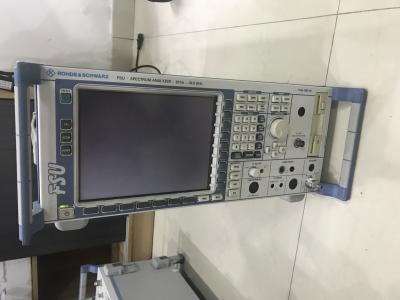
Rohde & Schwarz FSU67 Test & Measurement Instrument
$55,300.00
Rohde & Schwarz FSU67 spectrum analyzer with a direct 20 Hz to 67 GHz frequency range. Fundamental mixing supports measurements without an external harmonic mixer through 67 GHz; frequency extension and measurement applications depend on installed options.
Explore Related
Related products, categories and research.
Rohde & Schwarz FSU67 spectrum analyzer
The FSU67 provides direct spectrum analysis from 20 Hz to 67 GHz. Rohde & Schwarz describes fundamental mixing across its direct frequency range, allowing microwave signals through 67 GHz to be measured without adding an external harmonic mixer. This makes the instrument relevant to RF development, component evaluation and searches for unwanted spectral signals.
Frequency coverage and measurement scope
| Manufacturer and model | Rohde & Schwarz FSU67 |
|---|---|
| Instrument class | Spectrum analyzer |
| Direct frequency range | 20 Hz to 67 GHz |
| Direct microwave analysis | Fundamental mixing; no external harmonic mixer required through 67 GHz |
| Range extension | Optional FSU-B21 LO/IF interface and suitable external mixers; separate from direct coverage |
| Configuration scope | Installed hardware and application options follow the supplied instrument |
The RF coverage describes which input frequencies the analyzer can examine. It should not be interpreted as instantaneous analysis bandwidth, modulation bandwidth or a claim that every application package is installed. Choose the measurement method and settings for the signal being evaluated.
Harmonics and spurious signals
A broad frequency sweep helps locate signals away from the intended carrier, including harmonics and other unwanted products. Once a candidate signal is found, narrow the span and select suitable resolution and detector settings to examine it more closely. Record the conditions used so another measurement can be compared meaningfully.
Input attenuation is part of that process. Excessive signal level can cause the measurement path to produce distortion that resembles a device-under-test problem. Conversely, unnecessary attenuation can make weak signals harder to observe. Check input protection requirements and the expected signal level before connecting a source.
Resolution bandwidth and trace interpretation
Resolution bandwidth affects the ability to distinguish nearby spectral components and the displayed noise level. A narrower setting may reveal detail that is hidden in a broad overview, but it can also change the time needed for a useful measurement. Keep bandwidth, detector and averaging choices with the saved result rather than retaining only a screenshot of the trace.
A peak measurement, an averaged trace and a power measurement answer different questions. Select a detector appropriate to the signal behaviour and the test objective. Comparing results from different settings without recording those differences can make a stable device appear to have changed.
External mixer extension
The manufacturer’s brochure describes extending the platform beyond 67 GHz using the FSU-B21 option and external harmonic mixers. Those accessories create a different measurement arrangement from the direct RF input. Their frequency bands and connections must be matched to the intended test.
Do not assume a 110 GHz measurement capability is included simply because that frequency appears in family documentation. Confirm the required interface, mixer and measurement configuration. External mixing also changes how the operator identifies responses, so the setup and interpretation need to follow the relevant instructions.
RF connections and repeatable measurements
At microwave frequencies, the connecting cable, adapters and transitions become part of the measurement path. Their loss and frequency limits affect the signal that reaches the instrument. Use components rated for the intended range and account for the path between the device and the analyzer when reporting level measurements.
Keep the reference plane explicit. A reading at the analyzer input is not automatically the power at the output connector of a device separated by a lossy cable. Where correction data is used, retain the applicable frequency range and setup details with the result.
Configuration questions
Can it measure noise figure as supplied?
Rohde & Schwarz documents noise-figure measurements with FS-K30 application firmware and an appropriate external test arrangement. The model name does not establish that firmware or the required accessories are present.
Does the listing establish calibration status?
No calibration interval or current certificate is established here. Use the instrument’s actual documentation when a measurement requires traceability or a defined uncertainty budget.
What should be checked before integration?
Identify installed options, firmware and available interfaces. Match remote commands and measurement settings to that configuration before reproducing a test sequence.
Refer to the Rohde & Schwarz FSU brochure, or compare test and measurement equipment.
Related products
Recently viewed
Add AI Robot Supplier as a preferred source on Google.