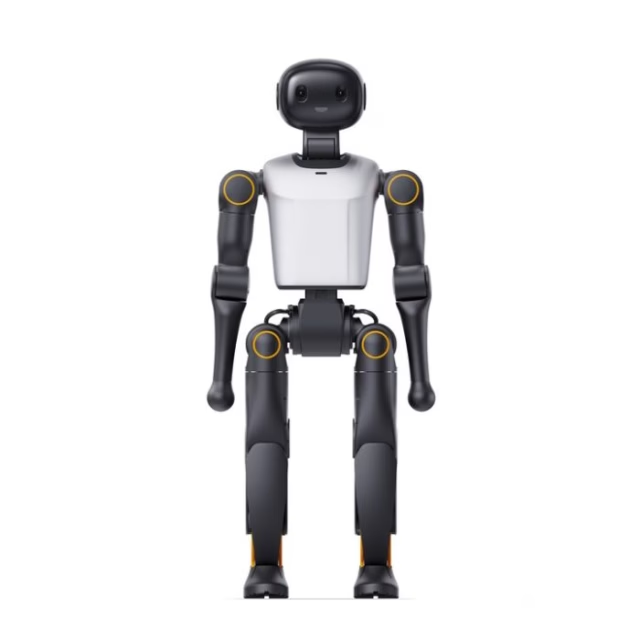
Senad markets cross-belt sorting equipment as suitable for express and e-commerce
Senad markets cross-belt sorting equipment as suitable for express and e-commerce warehousing contexts.

Senad E-Commerce Standard Set is a Robotics Solution from SENAD. Senad markets cross-belt sorting equipment as suitable for express and e-commerce warehousing contexts.
Review the verified model information, technical details, compatibility, included configuration and documentation before requesting a destination-specific B2B quotation.
Related products, categories and research.
Senad E-Commerce Standard Set is a Robotics Solution from SENAD. Senad markets cross-belt sorting equipment as suitable for express and e-commerce warehousing contexts.
Senad E-Commerce Standard Set is a Robotics Solution from SENAD. Senad markets cross-belt sorting equipment as suitable for express and e-commerce warehousing contexts.
Senad’s catalog groups these building blocks under product families such as DWS (2-port/4-port/8-port), automatic logistic sorting systems, belt conveyors, barcode scanning machines, and cross-belt sorting conveyor lines.
For procurement, match the exact model or part number, included accessories, configuration and condition to the written quotation before installation or deployment.
Match model, part number and serial or product-label details to the quotation.
Review system, accessory, software, power and facility requirements that apply to this product.
Confirm condition, included items, warranty, documentation and delivery terms before payment.
Use the product media and final exact-unit photographs to confirm configuration and condition before shipment.
The points below summarize model-specific information supported by manufacturer, regulatory or technical documentation.
Senad markets cross-belt sorting equipment as suitable for express and e-commerce warehousing contexts.
Senad’s catalog groups these building blocks under product families such as DWS (2-port/4-port/8-port), automatic logistic sorting systems, belt conveyors, barcode scanning machines, and cross-belt sorting conveyor lines.
Design and Features Modular line architecture A typical Senad e-commerce line is presented as modular equipment blocks—conveyors, scanners, DWS stations, and sorting modules—so facilities can scale from a basic station to multi-lane, multi-destination sortation.
Senad promotes solutions including automated sorting conveyor systems for e-commerce logistics and cross-belt sorter configurations for e-commerce/express warehouses, describing them as designed to improve sorting efficiency and reduce labor intensity.
By standardizing the core modules used in parcel handling—conveying, identifying, measuring, and sorting—the approach targets faster throughput, better measurement traceability, and scalable deployment across e-commerce and express logistics sites.
Suitability depends on the exact configuration, compatible systems, intended professional use and manufacturer instructions.
Evaluate Senad E-Commerce Standard Set for the documented robotics workflow supported by its exact hardware, payload and software configuration.
Confirm controller, SDK/API, network interfaces, sensors and supported third-party integrations.
Match payload, mobility, reach, runtime, environment and safety requirements to the intended task.
Confirm charging/power, accessories, training, spare parts and acceptance testing before deployment.
The table summarizes confirmed model and technical information confirmed from product specifications and technical documentation. Configuration-sensitive values should be checked against the exact supplied unit.
Use this checklist to reduce configuration, compatibility and acceptance problems.
Manufacturer and regulatory references are prioritized so buyers can verify identity, compatibility and configuration-sensitive information.
Technical or regulatory resource relevant to Senad E-Commerce Standard Set evaluation.
Key questions for evaluating Senad E-Commerce Standard Set before purchase.
Senad markets cross-belt sorting equipment as suitable for express and e-commerce warehousing contexts.
Exact robot model, revision and manufacturer part reference; Payload, reach, mobility, speed or working-envelope requirements relevant to the application; Battery, charging, runtime and power requirements where applicable.
No. Hardware revision, software, accessories, modules, handpieces, probes or other options can vary. The written quotation and exact-unit identification should define the supplied configuration.
Only items explicitly listed in the quotation and packing scope should be treated as included. Reference photographs can show accessories or system components that are not part of the final offer.
International B2B delivery can be arranged for approved destinations subject to product-specific transport requirements, customs rules and the agreed freight, insurance and delivery terms.
Manufacturer names and trademarks are used for product identification. Confirm model-specific instructions, compatibility and regional requirements before use.
Model, label/serial information, condition and supplied configuration can be confirmed before dispatch.
Quotation, packing scope, warranty terms and delivery responsibilities are documented before order approval.
Export packing, freight, insurance and shipment documentation can be coordinated for approved destinations.
Support is available for configuration questions, installation planning and procurement documentation.
Include delivery country, quantity, required configuration and target purchase date for a destination-specific offer.
Tell us what you need — we respond within one business day.