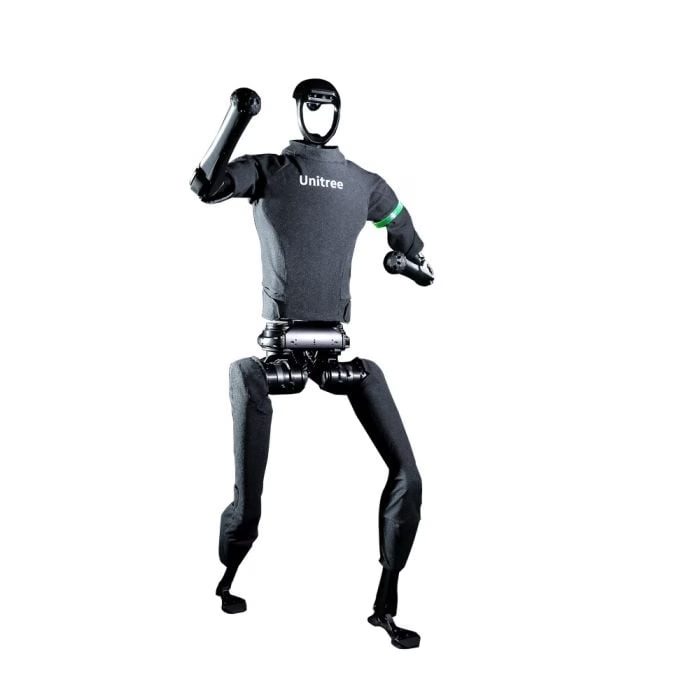
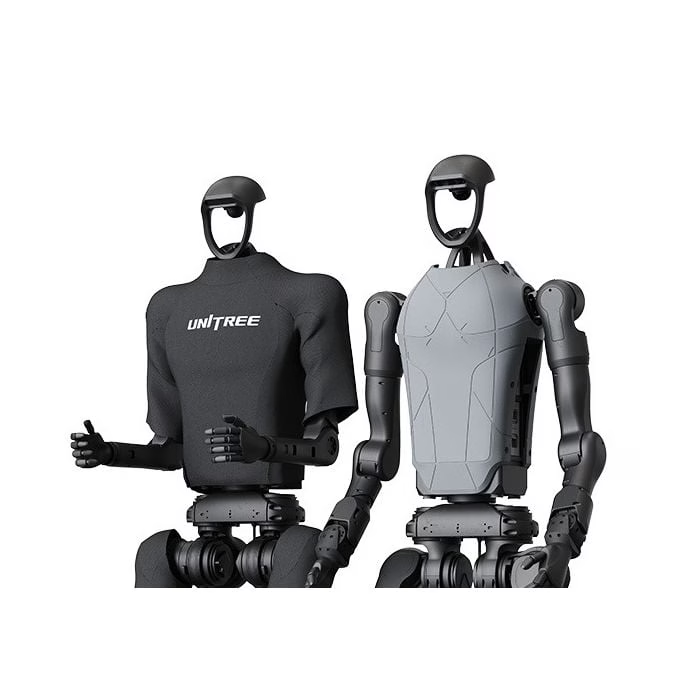
Unitree H1 Humanoid Robot
$56,943.00
Unitree H1 full-size bipedal humanoid robot, approximately 1.8 m tall and 47 kg. Published features include 3D LiDAR, a depth camera and an 864 Wh replaceable battery. Original H1 model, distinct from H1-2; options depend on configuration.
Explore Related
Related products, categories and research.
Unitree H1 humanoid robot
The Unitree H1 is a full-size bipedal robot for locomotion and humanoid robotics development. Unitree lists a height of approximately 1.8 m, a mass of about 47 kg and a moving speed of 3.3 m/s. Its articulated legs, onboard compute and environmental sensors provide a platform for studying movement and developing robot software.
This listing identifies the original H1. It is distinct from the H1-2, which has a different joint layout and higher published mass. The manufacturer describes speed above 5 m/s as potential mobility; that figure is not an established operating speed or a performance guarantee for this product.
Model specifications
| Manufacturer and model | Unitree Robotics H1 |
|---|---|
| Height and mass | Approximately 180 cm and 47 kg |
| Leg articulation | Five degrees of freedom per leg: three hip, one knee and one ankle |
| Arm articulation | Four degrees of freedom per arm in the published base arrangement; expandable |
| Battery specification | 15 Ah / 864 Wh; maximum voltage 67.2 V; replaceable pack |
| Published sensing | 3D LiDAR and depth camera |
| Published computing | Intel Core i5 for platform functions and Core i7 for user development; other configurations are available |
| Dexterous hands | Optional; not established as included by the model name |
Bipedal locomotion development
A human-scale robot lets developers study balance, foot placement and coordinated limb movement using physical hardware. A useful experiment defines the surface, commanded motion and success criteria before changing a control policy. Start with repeatable motions and expand the test conditions only after the previous behaviour is understood.
A published speed describes one aspect of mobility. It does not establish continuous running time, performance on every surface or the ability to navigate an unfamiliar building without additional development. Choose evaluation tasks around the intended environment rather than treating a demonstration as a ready-made deployment capability.
LiDAR and depth perception
The sensing arrangement provides spatial information for perception work. Developers can use sensor observations to investigate obstacles and the relationship between robot motion and its surroundings. The presence of sensors alone does not define a complete navigation application or guarantee avoidance of every object.
Perception work should consider the sensing field of view, calibration and the conditions of the test area. A camera observation and a range measurement describe different aspects of a scene; neither replaces an assessment of the resulting robot behaviour. Keep experiment logs tied to the software version and sensor configuration used for that run.
Intel compute and software integration
The published division between platform computing and user development helps separate robot operation from application experiments. Confirm the actual compute configuration and software interfaces before selecting a development workflow. Optional compute modules should not be assumed to be installed on every unit.
For motion development, match the robot model, joint definitions and command interfaces to the H1. Software or a model intended for H1-2 can describe different arm and ankle articulation. Verify that the physical hardware and the software configuration agree before sending movement commands.
Battery and operating-area planning
Battery energy is not a runtime measurement. Walking, standing, acceleration and onboard processing place different demands on the pack, so a project needs its own representative duty cycle. Plan access for battery replacement and follow the manufacturer instructions for charging and handling.
Allow space for the full moving robot, including arm travel and recovery from a loss of balance. A clear test area, suitable supervision and an accessible stop procedure are part of operating a full-size development platform. Its mass and height matter when planning support, handling and the surrounding workspace.
Questions about the H1
Does this model have six joint axes in each leg?
The published H1 arrangement has five per leg. Six per leg is associated with H1-2 and should not be transferred to this model’s specifications.
Are hands and development accessories included?
Dexterous hands are optional in Unitree’s comparison table. The order should identify the actual hands, compute options, battery equipment and accessories supplied.
See Unitree’s H1 model comparison for the manufacturer parameters, or explore other robots.
Related products
Recently viewed
Add AI Robot Supplier as a preferred source on Google.