AI Picking Robots: What the Teradyne–Sereact Partnership Means for Warehouses
 airobot_admin
•
Workstation Hardware Research
•
Updated October 25, 2026
•
15 min read
Performance intelligence for workstation buyers.
Warehouse automation / 2026 buying guideChoose the right equipment for AI picking robots AI picking robots are becoming an increasingly practical consideration for warehouses handling mixed products, changing packaging and unpredictable returns. A new partnership between Teradyne Robotics and Sereact puts a familiar industrial robot platform…
Warehouse automation / 2026 buying guide
Choose the right equipment for AI picking robots
AI picking robots are becoming an increasingly practical consideration for warehouses handling mixed products, changing packaging and unpredictable returns. A new partnership between Teradyne Robotics and Sereact puts a familiar industrial robot platform at the centre of that discussion—and gives buyers a useful reason to examine what a complete picking system actually requires.
A robot arm is one component. A working application also needs suitable perception, gripping, software, computing, material flow and an agreed way to handle exceptions. Choosing these together is more useful than comparing arm prices in isolation.
Compare 10 product optionsRequest project guidanceSend AI Robot Supplier your product dimensions, weights, packaging types, bin layout and target throughput. Request product and configuration guidance, with sourcing and delivery scope confirmed for your project.
Discuss your picking requirementsWhat did Teradyne Robotics and Sereact announce?
On 21 October 2026, the companies announced a partnership combining Sereact’s Cortex physical AI platform with Universal Robots arms. Their announcement identifies live fashion-returns applications at Zalando facilities operated with CEVA Logistics in Germany and Poland. It also describes a demonstration using two UR12e-1300 arms.
The partners report that hundreds of UR arms have been shipped in dual-arm systems to European customer sites. That is a manufacturer-reported shipment figure, rather than an independently audited measure of station performance. Read the Universal Robots announcement.
For buyers, the relevant development is the combination of adaptable software with an established arm platform. The release does not provide a complete installed price or a throughput guarantee for your warehouse. Those must come from an application-specific proposal and acceptance test.
What are AI picking robots?
An AI picking robot uses perception and decision-making software to help select, grasp and transfer objects. Depending on the system, it may work with product identification, depth data, grasp prediction, motion planning and feedback about whether the grasp succeeded.
Consider a tote containing cartons, bottles and flexible pouches. The system must locate a reachable object, find a suitable contact point, move without striking the tote, retain the item during transfer and confirm that the correct item reached its destination. The next tote may contain a different arrangement.
That variability is the central buying challenge. A demonstration with clean, separated cartons answers fewer questions than a test using your normal assortment, including awkward packaging and partially empty bins.
Choose the warehouse task before choosing the robot
| Task | What the robot handles | What to measure |
|---|---|---|
| Piece picking | Individual items for orders or replenishment | Correctly completed picks, assortment coverage and exception rate |
| Returns handling | Returned goods with changing presentation | Supported handling steps, damage, intervention and downstream processing |
| Sorter induction | Items placed onto a conveyor or sorting system | Singulation, orientation, conveyor synchronisation and double picks |
| Bin picking | Objects randomly arranged in containers | Reachability, bin clearance, remaining unpicked items and recovery |
| Depalletising | Cases or other loads taken from pallets | Load stability, tooling mass, working height and placement accuracy |
These jobs overlap, but their engineering requirements differ. A system that moves shipping cases may not handle loose garments. Returns handling may include inspection, identification or repacking steps beyond the robot’s contracted scope. Define the exact start and finish of the automated task before requesting quotations.
The six parts of an AI picking system
1. A robot arm sized for the complete load
Universal Robots lists the UR12e with a 12.5 kg payload and 1,300 mm reach. These figures make it a relevant reference for the announced demonstration, but the useful payload must account for the gripper, mounting hardware and carried product. Centre-of-gravity limits and acceleration also matter. Check the official UR12e specifications.
For applications requiring a different working envelope, compare the Universal Robots UR20 collaborative robot as a separate sizing option. Its inclusion here does not establish that the listed configuration includes Cortex or matches the demonstrated returns station. Confirm the current arm designation, controller and supported software in the quotation.
Provide drawings showing the deepest bin, highest placement point, conveyor clearance and maintenance access. A nominal reach figure does not prove that the tool can approach every required grasp position.
2. Vision that can see the difficult products
Vision selection starts with the actual assortment. Clear packaging, reflective surfaces, dark objects and overlapping items can change the quality of the available depth and colour data.
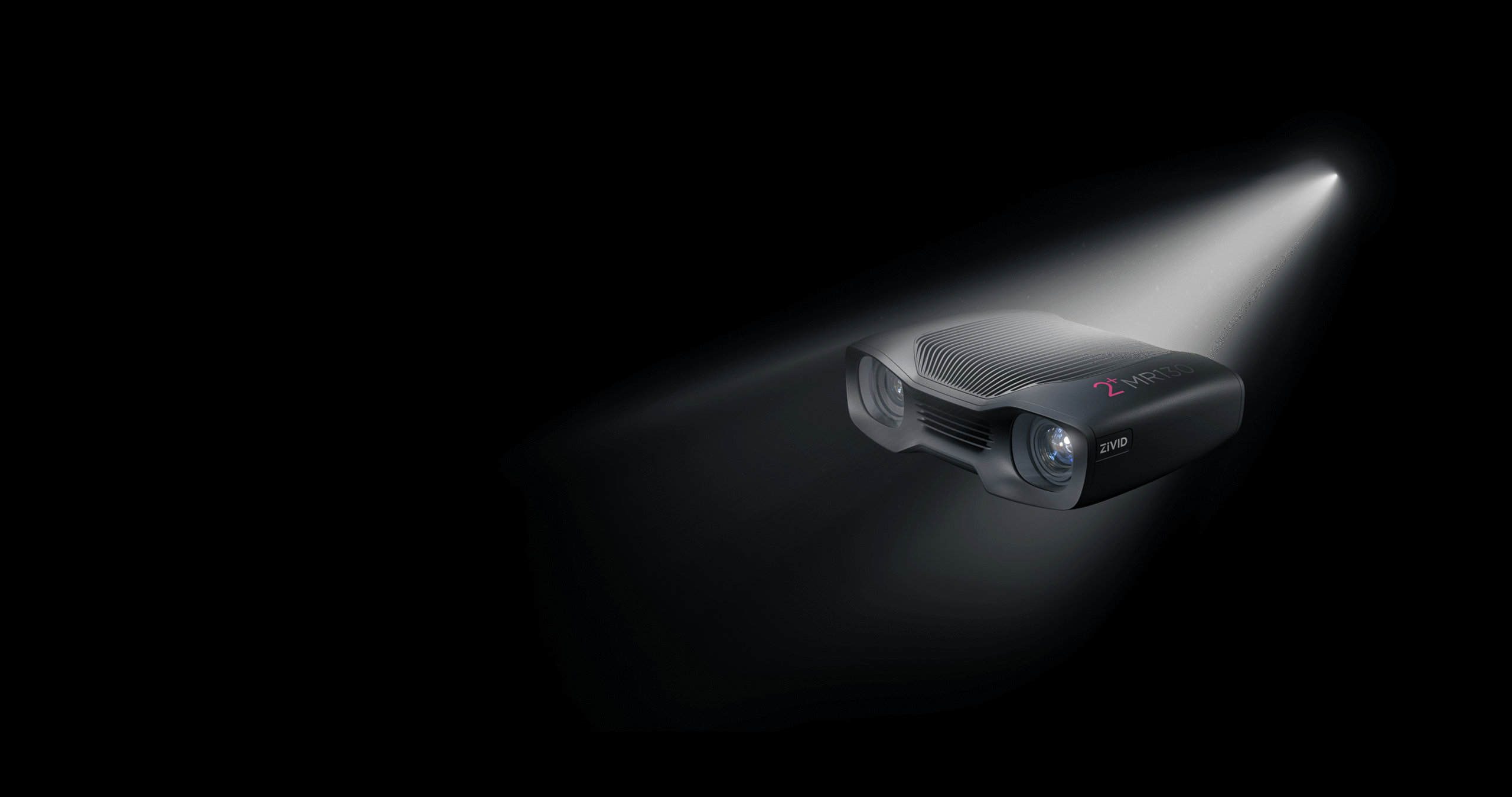
Zivid positions its 2+ MR130 for piece picking, bin picking and parcel handling. Its larger Zivid 3 XL250 targets bigger working volumes, including depalletising and factory bin picking. These are different camera choices, rather than automatic substitutes. Explore Zivid’s R-series applications and Zivid 3.
Ask for point-cloud examples using your hardest products at the proposed mounting distance. Check visibility at the bottom and corners of the bin, capture-to-result latency and the effects of changing warehouse lighting. Camera acquisition speed alone is not the complete pick cycle.
3. A gripper suited to the material
A vacuum tool can suit products with an appropriate suction surface. A finger gripper can suit items that need a mechanical grasp. Flexible bags, porous materials and fragile packaging require specific testing; a successful grasp on a sample carton does not settle those questions.
Robotiq’s EPick uses an electric vacuum pump, while OnRobot’s VGP30 uses an external compressed-air supply and targets demanding material handling, including cardboard boxes. Their infrastructure requirements and intended applications differ. Read the EPick information and VGP30 product information.
Evaluate grip confirmation, release behaviour, double picking, dropped-product recovery and consumable replacement. Tooling must also fit the bin opening without sacrificing access to the remaining items.
4. Software that covers the whole workflow
The software proposal should explain how perception, robot movement, product tracking and error handling work together. Ask which robot and controller versions are supported, what requires a separate licence and who takes responsibility when a third-party interface fails.
Mech-Mind’s Mech-Viz is an example of robot programming software offering motion planning, collision detection and picking strategies. It represents another approach to building an application; it should not be presented as an interchangeable Cortex licence. Review Mech-Viz.
Clarify how the system communicates with your warehouse software. Identify who owns order confirmation, barcode exceptions, destination assignment and recovery after a network interruption. A grasp is useful only when the surrounding process records it correctly.
5. Computing for deployment and development
The partners describe Jetson Thor for cell-level inference and DGX Spark for site-level development, validation and updates. That makes computing directly relevant to this news, while leaving the exact supplied hardware and software configuration to the project specification. See Sereact’s architecture description.
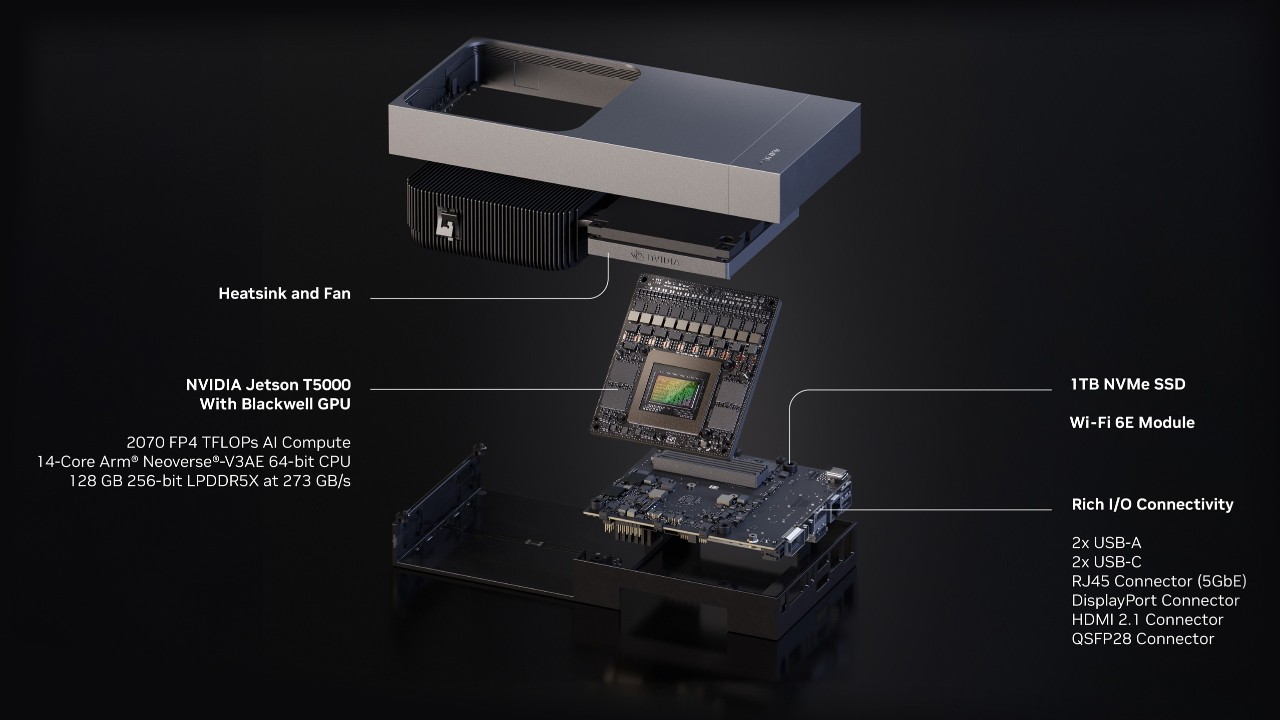
The NVIDIA Jetson AGX Thor Developer Kit is relevant for development. The Jetson T5000 module is an embedded module that requires an appropriate carrier, power, cooling and system design. Neither is a conventional plug-in desktop graphics card.
NVIDIA distinguishes developer kits from production deployment products and states that developer kits are warranted for development use. Confirm the intended deployment route before choosing hardware. Read NVIDIA’s Jetson FAQ.
For a local robotics development environment, review the NVIDIA DGX Spark 128GB 4TB. NVIDIA publishes an Isaac Sim and Isaac Lab setup workflow for Spark. Validate your application’s supported versions, architecture and memory requirements before purchasing. See NVIDIA’s robotics workflow.
6. Integration, safeguarding and support
A picking cell needs coordinated material presentation and removal. Check tote supply, conveyor timing, completed-order handling and the route for products that the robot cannot process. Otherwise, a fast picking motion can still leave the wider process waiting.
Include application-specific safeguarding, stopping behaviour and maintenance access in the system design. A collaborative arm does not, by itself, establish that every tool, load and operating speed is suitable for people to approach.
Ask for a written support boundary: remote diagnostics, site attendance, spare tooling, camera replacement, software maintenance and escalation ownership. Record which party restores service when the arm works but the overall application does not.
10 products to evaluate for AI picking robots
The following shortlist separates arm hardware, perception, tooling and application software. It is a set of alternatives and supporting components, not a validated ten-item system. Select one coherent architecture with your integrator before ordering individual products.
| Product | Role in the project | Buying decision |
|---|---|---|
| Universal Robots UR12e-1300 | Six-axis arm; 12.5 kg rated payload and 1300 mm reach. | Enquire about the exact controller package. Include tooling in the load calculation. |
| Sereact Cortex-powered solution | Project-specific AI picking software and integration scope. | Request a Cortex project assessment. Confirm the contracting party and authorised supply route. |
| Zivid 2+ MR130 3D camera | Colour and depth data for compact piece-picking volumes. | Check the grasp surface and bin coverage at the actual mounting distance. |
| Mech-Eye PRO M-GL Color 2000 | Medium-range industrial vision candidate. | Obtain the exact Color 2000 revision and matching optical specification. |
| Robotiq 2F-85 adaptive gripper | Mechanical finger grasp; 85 mm opening stroke. | The basic unit is different from a complete robot-specific kit. |
| Robotiq TSF-85 Starter Kit | Tactile data for compatible grippers and research workflows. | Plan external computing and signal interpretation; no automatic slip-recovery policy is implied. |
| Robotiq EPick one-cup UR e-Series kit | Electric vacuum gripping without an external compressed-air supply. | Check controller support and validate the single-cup contact arrangement. |
| Mech-Vision and Mech-Viz licence enquiry | Separate perception and robot-motion software products. | Specify each licence, supported release, activation and commissioning scope. |
| Zivid 3 XL250 3D camera | Stationary vision for larger bins and pallet coverage. | Check both the highest load and the lowest remaining layer. |
| OnRobot VGP30 | Pneumatic vacuum tooling for suitable case-handling applications. | Ask about the VGP30 package. Verify air infrastructure, tool mass and robot load. |
A supplier proposal should explain why a component is included. If a project already has a complete perception stack, adding another vision-software licence may duplicate a function. If the proposed task is loose-garment returns handling, a case-handling vacuum pad should not be selected simply because its payload rating is high.
Request a shortlist for your actual assortment
Send a product list with dimensions, weights, packaging and photographs, plus a drawing of the pick and place areas. Ask for a proposed architecture, the excluded items and the evidence needed to confirm the design.
Request an equipment shortlistThree compatibility checks that can change the shopping list
Controller generation comes first
The current UR12e-1300 manufacturer page presents CB7 and TP7 Core. Robotiq’s PolyScope X compatibility page lists EPick as unsupported there. Match the controller, software and end-effector plugin before approving a package. A mechanical flange fit does not settle software compatibility.
Put those versions on the quotation and require a demonstration of activation, grip detection and recovery on the proposed combination. A tutorial recorded on an earlier pendant cannot establish support for a different controller.
Tactile sensing needs an application
TSF-85 is useful when a team has a defined plan for contact data. The manufacturer user guide describes an external-computer arrangement and limits high-frequency tactile control of the gripper through that setup. It is not an automatic upgrade to a closed-loop production grip.
Ask who will collect and interpret the signals, synchronise them with robot state and maintain the application. Keep research capability separate from the acceptance commitments of the production cell.
Camera range and usable detail must be evaluated together
The MR130 datasheet lists an 800–2700 mm working range, while the XL250 datasheet recommends 1500–4000 mm. These ranges describe different optical choices. They do not prove that a small grasp feature is resolved equally well throughout either range.
Measure coverage and useful surface detail at the most demanding bin or pallet positions. Ask the integrator to retain the camera settings, host specification and sample data with the commissioning record.
A practical acceptance test for robotic piece picking
Agree the test before comparing installed quotations. Otherwise, one proposal may count every attempted grasp while another counts only items delivered correctly. Use a shared definition of completed work, then report both productivity and the effort required to maintain it.
| Test area | Include in the trial | Record separately |
|---|---|---|
| Assortment | Common items, difficult packaging, new items and normal variation. | Coverage by SKU and the reason for each exclusion. |
| Presentation | Overlapping goods, bin corners and low fill levels. | Unreachable objects and items left behind. |
| Quality | Destination confirmation, double picks and damage checks. | Incorrect transfers, dropped goods and damaged packaging. |
| Recovery | Failed grasps, blocked paths and normal restarts. | Intervention frequency, duration and required operator skills. |
| Sustained operation | A representative operating window with normal replenishment. | Completed transfers, planned stops and unplanned downtime. |
A useful test includes products the system has not been specially arranged to handle. Keep a holdout set where appropriate, and record any preparation needed before each run. If packaging has to be flattened, labels reoriented or goods manually separated, that work belongs in the operating model.
Ask for the raw event log or a summary with clear definitions. Report attempted picks, first-attempt success, successful retries and operator-assisted completions separately. A single success percentage can hide a system that achieves coverage only after repeated attempts or frequent help.
Include warehouse-system confirmation in the test. An object placed in the right tote but recorded against the wrong order is not a correct completed transfer. Agree which system is the source of truth and how discrepancies are resolved after interrupted communications.
Set expectations for the first weeks of operation
Commissioning should include a named owner for each issue, escalation contacts and a record of accepted software versions. Define how changes to packaging or the product mix are reported. If an update changes behaviour, the team needs a route to validate it before routine operation resumes.
Ask what production staff can recover themselves and what requires an integrator. Keep training practical: replacing a worn cup, clearing an exception, restarting a paused task and checking the result. The required skills affect staffing just as directly as the nominal cycle time.
Official video: understand the gripper installation scope
This Robotiq tutorial shows an EPick installation on a UR robot. Use it to understand the component and connection workflow. It is an earlier manufacturer demonstration, not a video of the Teradyne–Sereact deployment or evidence of current PolyScope X support.
Watch the official Robotiq installation tutorial on YouTube.
How to compare price and return on investment
Compare the installed system cost with the work it can reliably complete. An arm-only price omits cameras, end effectors, licences, controls, safety equipment, integration, training and acceptance testing. Recurring software and service charges can also affect the result.
A useful proposal separates the initial project cost from annual running costs. It states what products the system supports, the working schedule assumed and the level of human assistance expected. Treat unsupported items and changeover time as part of the calculation.
If an installed project costs €150,000 and produces €60,000 in annual net operating savings, simple payback is 2.5 years. At €30,000 in annual net savings, payback becomes five years. Net savings should already account for recurring costs and the remaining human work. Financing, tax and discounting would require a fuller financial model.
Build the calculation from completed, correctly recorded transfers. Do not multiply a short demonstration’s fastest movement by every scheduled hour. Use a measured operating rate that includes normal interruptions and recovery.
Seven checks before ordering AI picking robots
- Define the assortment. Provide dimensions, mass, packaging, fragility and examples of difficult products.
- Define successful completion. Agree identification, destination, damage limits and warehouse-system confirmation.
- Test a representative workload. Include overlapping items, low bin fill, changing lighting and unfamiliar products.
- Measure intervention. Record how often help is required, who provides it and how long recovery takes.
- Confirm hardware and licences. List exact arm, controller, camera, gripper, compute and software versions.
- Agree acceptance conditions. State test duration, throughput, product coverage and permitted exclusions in writing.
- Price the operating lifecycle. Include support, subscriptions, wear parts, training and future assortment changes.
Run the same test definition across competing proposals. Comparing a box-handling demo against a mixed-pouch trial tells you little about their relative suitability. Consistent acceptance criteria make both technical and commercial differences easier to judge.
What if you are building a research prototype?
Teams studying dual-arm manipulation can explore the RealMan DAP-D-65 development platform. Its relevant role is experimentation and development; it should be evaluated against its own documentation and project requirements.
A research platform does not include the performance commitments of a commissioned warehouse application unless those are explicitly contracted. Budget separately for perception, tooling, software development and deployment engineering. Do not infer Cortex compatibility from the presence of two arms.
Frequently asked questions about AI picking robots
Do I need all ten products in the shortlist?
No. Several are alternatives, while others serve specific development or integration needs. Ask the integrator for one coherent bill of materials and avoid duplicating perception or motion-planning functions.
Are Mech-Vision and Mech-Viz one software licence?
They are separate software products. Specify each required licence, supported release, activation and integration scope. The project enquiry is not evidence of a single manufacturer bundle.
Can a tactile sensor automatically fix failed grasps?
No automatic recovery policy is implied. The application must interpret the signals and act within the supported controller and software arrangement. Validate any claimed recovery behaviour in the actual cell.
Can an electric vacuum gripper fit every UR controller?
Check the exact kit, controller, software release and plugin. Robotiq currently lists EPick as unsupported on its PolyScope X page; compatibility should be reconfirmed when ordering.
Can I buy an arm and add AI picking later?
Potentially, but check the intended software, controller, vision and tooling requirements before buying. Retrofitting an unsuitable configuration can require additional hardware or substantial integration work.
Is UR20 the robot used in the Teradyne–Sereact demonstration?
The announcement identifies two UR12e-1300 arms. UR20 is linked here as a separate sizing alternative. Compatibility with a proposed AI system must be confirmed for the exact configuration.
Can AI picking robots handle transparent bags?
Some suppliers offer perception and picking approaches for transparent or translucent products. Performance depends on the exact material, presentation, camera, software and gripper. Test your own packaging before specifying coverage.
Does Jetson Thor include Cortex or a complete picking application?
Buying computing hardware does not automatically include third-party AI software, robot control integration, vision, tooling or warehouse interfaces. Require an itemised scope.
What is the best picking robot for a warehouse?
The best fit is the system that meets your assortment, throughput, reliability and operating-cost requirements in an agreed trial. Arm payload alone cannot establish that fit.
How much does a complete AI picking system cost?
Cost depends on hardware, task complexity, software licensing, safeguarding and integration. Request an installed quotation with recurring costs and acceptance criteria rather than treating an arm-only price as the total project cost.
Plan your AI picking project with a clear equipment scope
The Teradyne–Sereact news is a useful starting point for evaluating adaptable warehouse robotics. The buying decision still comes down to the products you handle, the work you need completed and the evidence a proposed system can provide.
Review the linked computing and robotics products, then send your workflow, delivery country, target purchase date and required configuration. Ask AI Robot Supplier to confirm product scope, sourcing options and delivery terms in writing.
Request product and configuration guidanceResearch checked on 25 October 2026. Manufacturer statements are attributed to their sources. Product links identify catalogue listings; included software, integration, availability and delivery terms require confirmation for the specific offer.
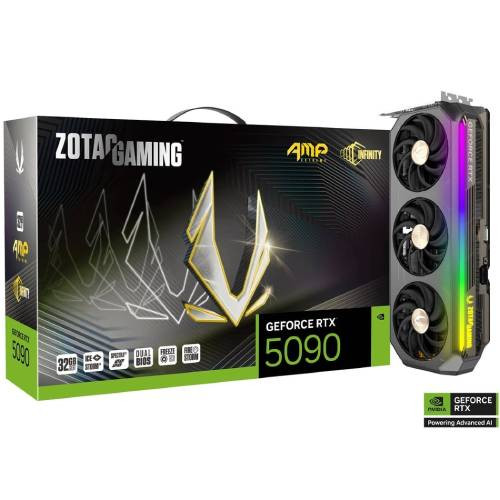 ZOTAC GAMING GeForce RTX 5090 AMP Extreme INFINITY
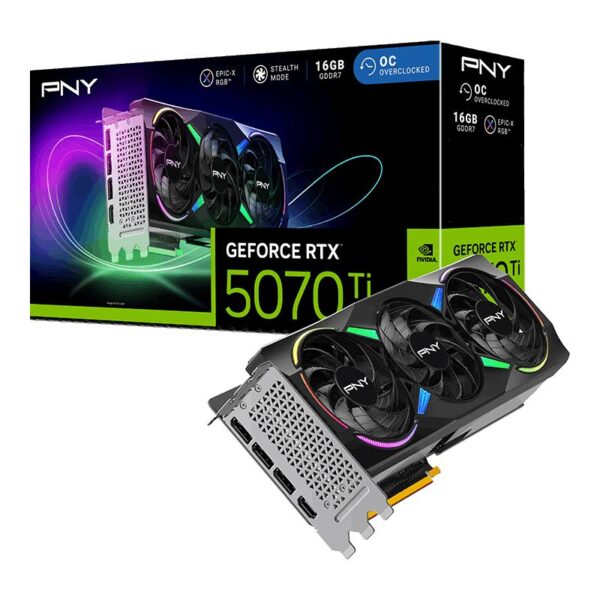 PNY GeForce RTX 5070 Ti 16GB ARGB EPIC-X RGB Overclocked Triple Fan
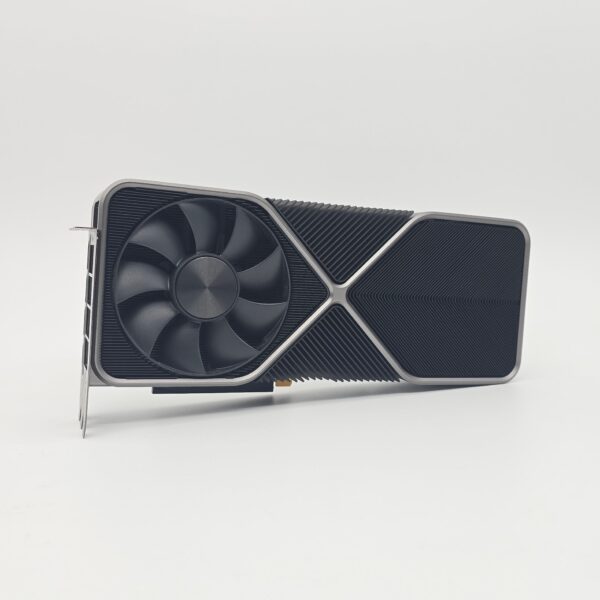 NVIDIA GeForce RTX 3090 Founders Edition 24GB
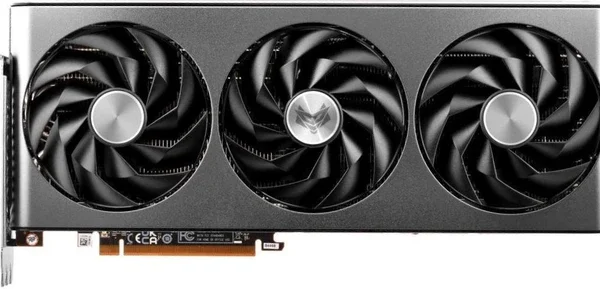 Sapphire NITRO+ Radeon RX 7800 XT 16GB