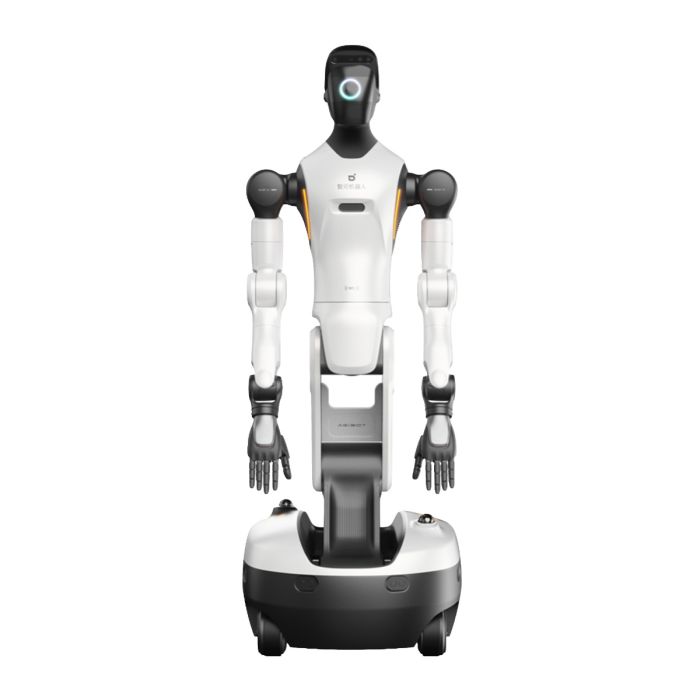
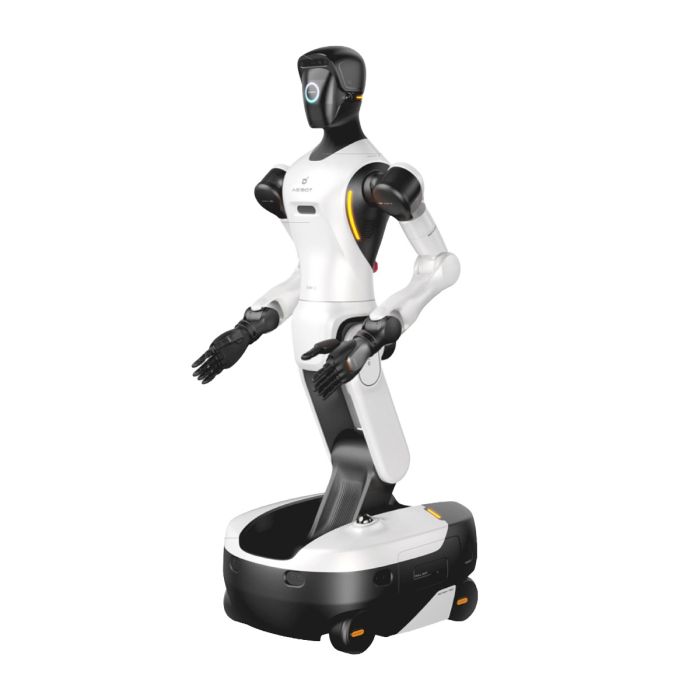
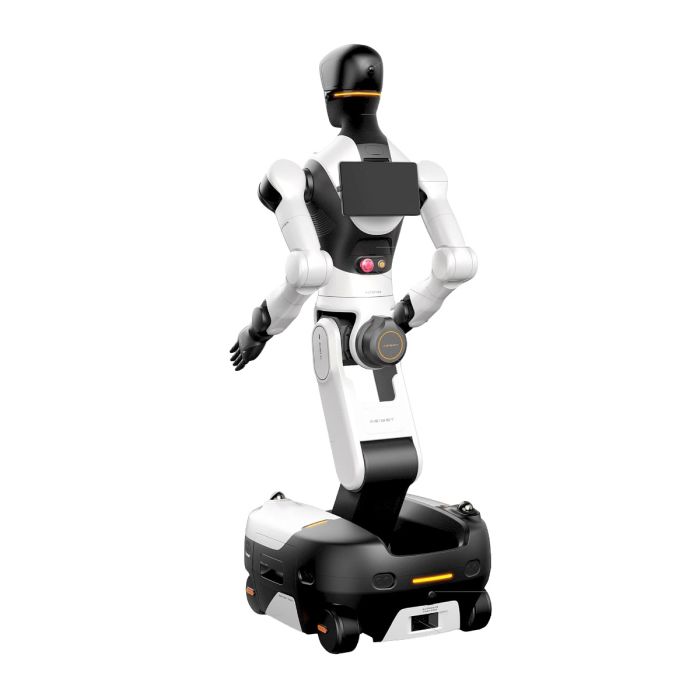
Agibot G2 Industrial Grade Wheeled Humanoid Robot
$122,868.21
AGIBOT G2 is a wheeled humanoid for manipulation and embodied-AI development. Its two force-controlled arms have seven degrees of freedom each and a stated 5kg payload per arm. A four-wheel-steering base supports omnidirectional movement; task integration and optional equipment must match the supplied version.
Explore Related
Related products, categories and research.
AGIBOT G2 wheeled humanoid robot
AGIBOT G2 combines a mobile wheeled base with two articulated arms for manipulation tasks and embodied-AI development. Force feedback helps it interact with a workpiece, while coordinated body movement changes its working posture. This listing concerns the G2 model: G2 Air and G2 Max are separate configurations whose payload and architecture should not be substituted here.
AGIBOT G2 specifications
| Manufacturer / model | AGIBOT G2 |
|---|---|
| Robot form | Wheeled humanoid with two force-controlled arms |
| Arm articulation | 7 degrees of freedom per arm |
| Arm payload | 5kg per arm, according to the G2 user manual |
| Feedback | Joint torque sensors in the arms |
| Body articulation | 3-DOF waist and 2-DOF folding lift mechanism |
| Mobile base | Four-wheel steering with omnidirectional movement |
| Manufacturer maximum travel speed | 1.5m/s |
| Manufacturer maximum obstacle height | 1.5cm |
The specifications describe the manufacturer-documented G2. Confirm hardware revision and installed software against the offered unit. Maximum motion values are not a production-cycle guarantee.
AGIBOT G2 industrial manipulation: force-controlled arms
The manufacturer describes force-controlled hole searching, insertion and surface alignment as example operations. Each application still needs a suitable end effector, workpiece presentation and task implementation. A robot platform specification does not establish that a particular connector, part or assembly has already been validated.
For a proposed manipulation task, define the part geometry, material, required contact behavior and acceptable outcome. Include gripping hardware and any carried tooling in the engineering assessment of the arm’s load. Validate the intended posture and motion sequence rather than interpreting the two arm ratings as an unrestricted combined lifting capacity.
Omnidirectional mobility and workstation access
Four-wheel steering enables the chassis to move forward, backward, turn or travel sideways. Sideways movement can be useful when aligning the robot with a workstation without a large turning maneuver. The folding lift and waist articulation provide additional posture adjustment while the platform remains wheeled.
Route planning should account for floor transitions, clearances and the swept space of the base, arms and carried object. The 1.5cm obstacle specification is relevant to floor preparation; it does not make this a stair-climbing or rough-terrain robot. Select operating speeds around the validated task and environment.
AGIBOT G2 research robot: development and optional equipment
AGIBOT documents SDK interfaces for function expansion and custom development. Data collection and robot teleoperation depend on additional equipment, while autonomous recharging requires the optional charging dock. Their description in platform documentation is not confirmation that they are included in this offer.
Before planning a data-collection project, specify the required observations, controls and recorded outputs. Confirm that the supplied software version exposes the interfaces the project needs and that any external equipment is compatible. Separate the base robot, development access, optional kits and application integration in the project scope.
Applications and acceptance criteria
The platform can be evaluated for industrial manipulation, research and commercial interaction projects. A useful evaluation starts with a defined task: which object is handled, where it begins and ends, how a successful result is detected and what happens when the attempt fails. Those details determine tooling, sensing, task programming and workstation changes.
For production use, agree on a representative acceptance procedure rather than relying on a general demonstration. Test the actual part variations, fixture tolerances and recovery cases relevant to the installation. This page does not claim measured success rates, cycle times or hands-on test results for the offered unit.
Supplied configuration and package
Request the unit’s identification, hardware revision and software inventory. The quotation should list the robot, fitted end effectors, batteries, charger, control equipment and any optional dock or teleoperation kit. Images are references and do not establish accessory inclusion, current condition or service terms.
Buyer questions
Is G2 the same as G2 Max?
No. The model identity matters when comparing payload, articulation and accessories. This listing uses the G2 user manual rather than specifications for other G-series variants.
Does it perform an assembly task immediately after delivery?
A documented platform capability does not establish a completed application. Tooling, task implementation and acceptance criteria must be defined for the intended workpiece and site.
Are the charging dock and teleoperation kit included?
They are described as additional equipment. Inclusion remains subject to the written supplied configuration.
Manufacturer documentation
Use the official AGIBOT G2 user manual for version-dependent operation and integration information, and the G2 product page for the model overview. Explore other platforms in Humanoid Robots.
Related products
Recently viewed
Add AI Robot Supplier as a preferred source on Google.