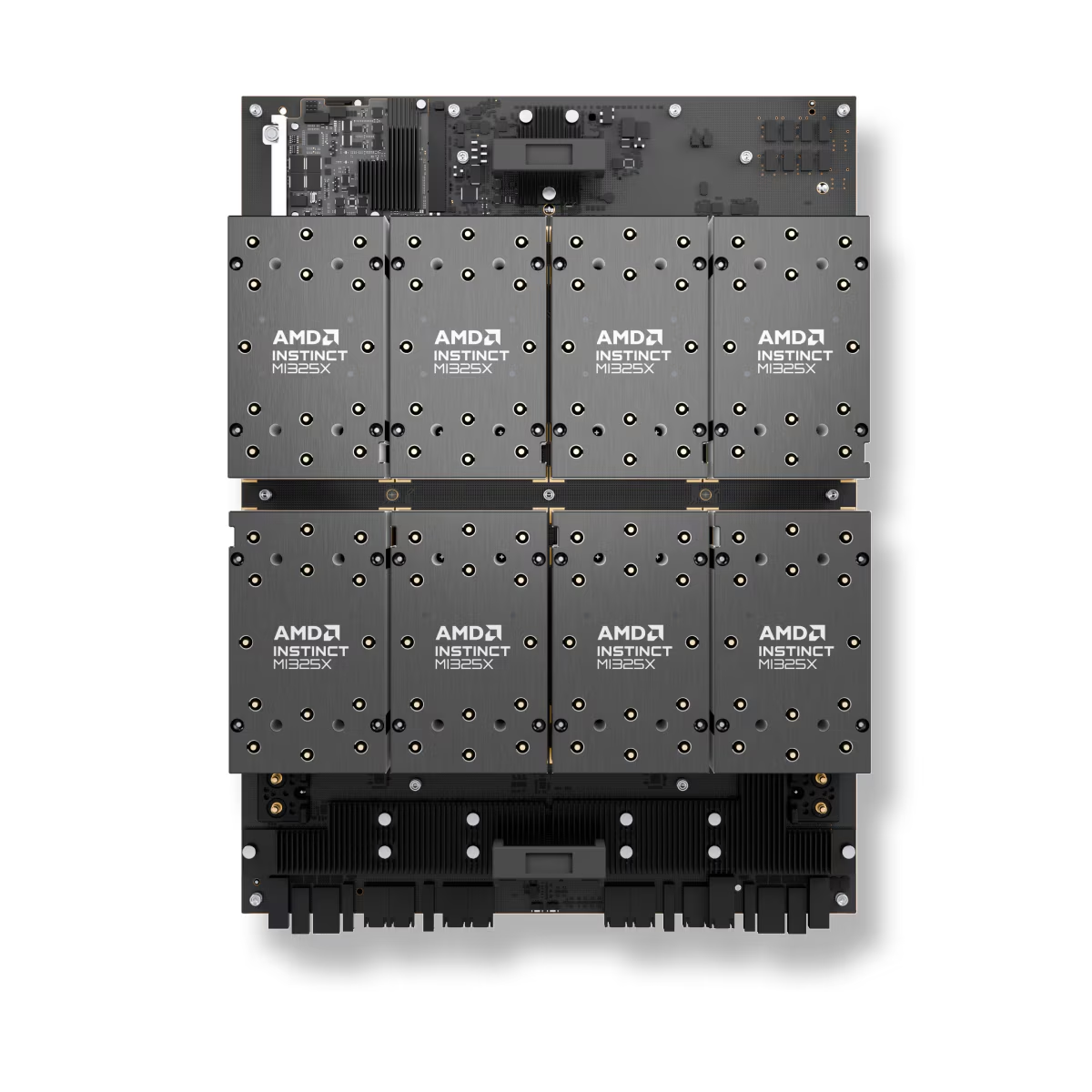
AMD Instinct MI325X 8x OAM UBB8 Assembly 2TB HBM3E
$179,943.74
AMD Instinct MI325X UBB8 is an eight-OAM accelerator assembly with 256GB HBM3E per GPU, totaling 2048GB across the platform. It requires a validated server host, power distribution and cooling. CPU, host memory, storage, networking and chassis inclusion are not established by the assembly title.
Explore Related
Related products, categories and research.
AMD Instinct MI325X UBB8 combines eight OAM accelerators on a UBB 2.0 baseboard for multi-GPU AI and high-performance computing. Each accelerator has 256GB HBM3E. This listing names the accelerator assembly; it does not establish a complete server or workstation with processors, host memory, storage and network hardware.
AMD Instinct MI325X assembly specifications
| Platform | UBB 2.0 with eight OAM accelerators |
|---|---|
| Architecture | AMD CDNA 3 |
| Memory per GPU | 256GB HBM3E with ECC support |
| Aggregate memory | 2048GB across eight devices, marketed as 2TB |
| Memory bandwidth | Up to 6TB/s per GPU, manufacturer peak specification |
| Host interface | Eight PCIe Gen5 x16 host I/O connections at platform level |
| GPU interconnect | AMD Infinity Fabric links |
| Power interface | 54V UBB; manufacturer specifies 1000W peak board power per accelerator |
| Module cooling class | Passive OAM; complete host cooling solution required |
Assembly scope and the host server
A universal baseboard is not a universal drop-in replacement for every server. Mechanical fit, electrical distribution, host connections, firmware and thermal design must all match the specific assembly revision. Obtain the exact manufacturer and OEM part numbers before planning an integration or replacement.
The assembly is distinct from a single loose accelerator and from a fully configured eight-GPU server. The product title does not establish included CPUs, DIMMs, drives, chassis, power supplies or fabric adapters. The commercial bill of materials should identify each supplied item and any required integration work.
Keep photographs and part-number records tied to the offered assembly. A generic eight-module photograph does not identify its hardware revision, cooling provision or service history. Condition, accessories and support responsibilities require unit-specific evidence.
Understanding the 2TB memory figure
The aggregate capacity is eight times the per-device capacity. That sum describes accelerator memory distributed across the platform. It is not host RAM and does not mean every application automatically receives one unpartitioned allocation.
For model inference, identify parameter format, context length, concurrency and runtime overhead. For training, include optimizer state, activation storage and the parallelism strategy. These requirements determine how the workload uses memory across devices and what needs to be validated.
HBM3E bandwidth is also specified per accelerator. Adding individual peak rates does not produce a measured bandwidth for a single application. Data placement and communication affect how much of the available hardware bandwidth a workload can use. No benchmark or model-capacity test is claimed for this offered assembly.
Infinity Fabric and PCIe connections
The platform provides dedicated host I/O connections and a GPU-to-GPU fabric. These serve different purposes. Host transfers move data between the server and accelerators, while local GPU links support communication within the accelerator subsystem.
Check the OEM topology diagram, including CPU affinity and adapter placement. The number of available lanes alone does not establish the data path used by a workload. For a replacement assembly, verify the host connectors, cables and supported system firmware against the exact revision.
Scaling beyond one server introduces another network. Specify the external adapters, switches, cables and network mode for the intended cluster. An internal eight-GPU fabric does not establish a suitable inter-server connection or guarantee distributed scaling.
Power distribution and cooling requirements
The 54V UBB interface is a system integration requirement. It should not be treated as a consumer PCIe power connection. Confirm the host’s power distribution, connectors and supported accelerator power configuration using the OEM documentation.
The 1000W figure is a per-accelerator peak board-power specification, not measured consumption for the complete assembly or server. Host CPUs, memory, storage, networking and cooling contribute separately. Facility sizing needs the actual configured system and its intended operating conditions.
Passive OAM describes the module cooling class; it does not mean that the assembly can operate without a designed thermal solution. Confirm heatsinks or cold plates, airflow or coolant requirements and all included components against the validated host build. No particular cooling hardware is promised by this listing.
ROCm and application compatibility
MI325X belongs to the CDNA 3 family and uses the gfx942 architecture designation in AMD’s hardware tables. Select the ROCm release, operating system, driver and framework combination for the actual host and application. A supported accelerator family does not establish compatibility with every container or framework build.
Record the software image and versions with the acceptance configuration. Validate accelerator discovery, memory visibility, communication and the intended application as separate steps. A successful boot or visible GPU count is different from a successful production workload.
Licenses, subscriptions and application support are separate from the assembly hardware. Obtain explicit entitlement and support details where required. No preinstalled software, tuning service or active support agreement is asserted here.
Integration and procurement questions
Can this replace an MI300X or MI350X assembly directly?
Do not assume interchangeability from a shared form-factor term. Confirm the OEM’s supported assembly revision, power, cooling, firmware and host requirements for the proposed replacement.
Does this include an eight-GPU server?
The title names a UBB8 assembly. A complete host and its components must be itemized separately if supplied.
What should the acceptance record contain?
Keep the assembly and module identifiers, supplied components, host configuration, firmware and software versions together with actual test results. Agree on condition, accessories, warranty or service scope and delivery terms in the transaction documentation.
Manufacturer references
Review AMD’s accelerator specifications, platform overview and system acceptance reference. Compare related Networking & AI Infrastructure for the complete deployment.
Related products
Recently viewed
Add AI Robot Supplier as a preferred source on Google.