Oncology
FDG and other oncology PET workflows are extensively documented on Discovery 710 systems.
$294,000.00
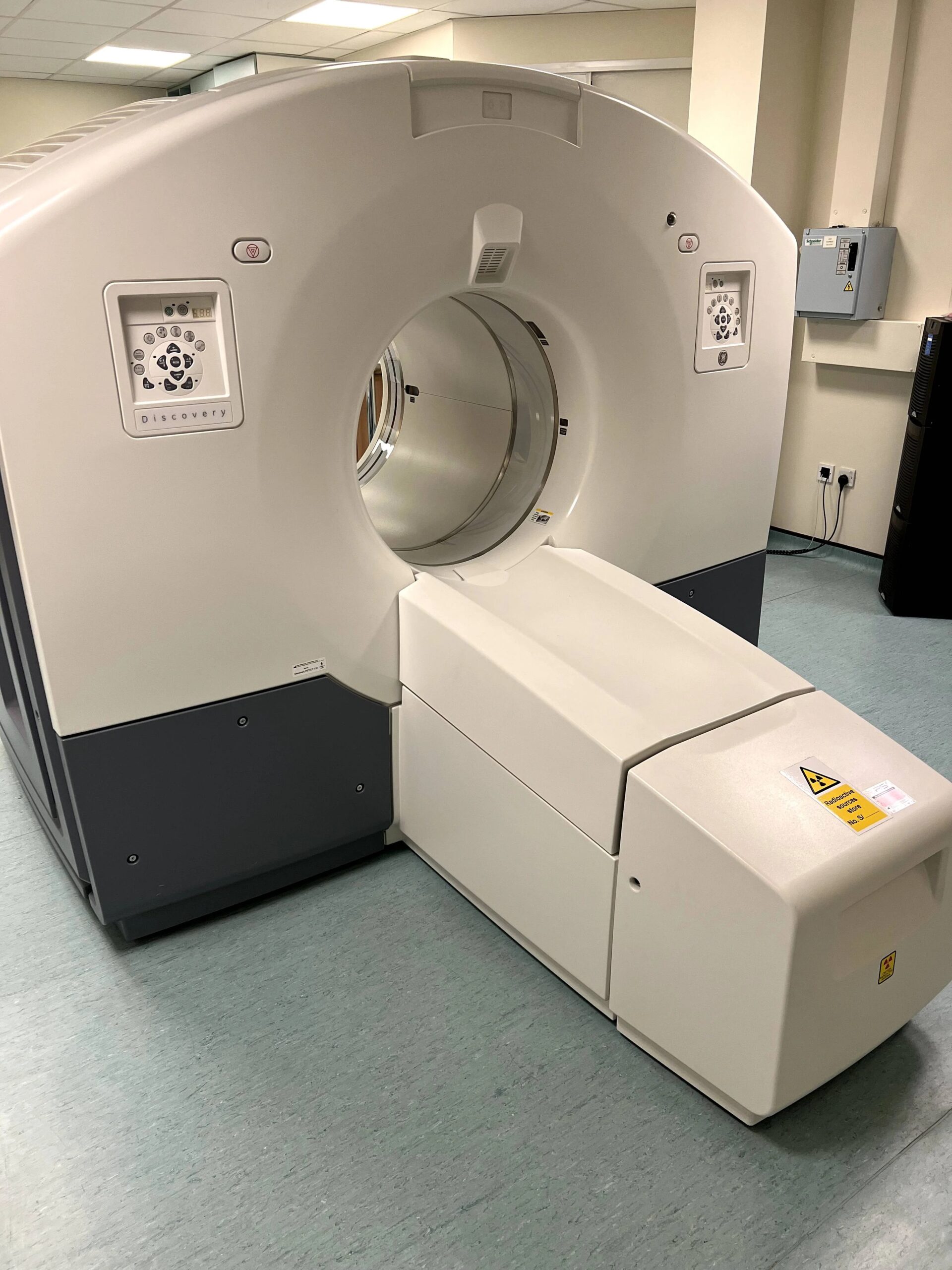
GE Discovery 710 PET/CT 128 is currently available and in stock through AI Robot Supplier. It is catalogued under Medical Equipment.
Related products, categories and research.
GE Discovery 710 PET/CT 128 is currently listed by AI Robot Supplier at $294,000 and shown as in stock. This hybrid PET/CT platform combines time-of-flight PET with a 128-slice CT configuration for oncology, cardiology, neurology and quantitative molecular-imaging workflows. Because used and refurbished PET/CT value depends heavily on year, tube condition, software licences and exact installed options, the final quotation should identify the serial-specific configuration rather than relying only on the model name.
GE Discovery 710 PET/CT 128 is a combined positron-emission tomography and computed-tomography system developed for facilities that need functional PET information and high-resolution anatomical CT in one examination.
The Discovery 710 PET subsystem uses LYSO scintillation detectors, time-of-flight-capable reconstruction and a 15.7 cm axial PET field of view. Published technical evaluations describe 24 detector rings, 13,824 crystals and a 70 cm transaxial field of view. The platform is widely documented with GE’s VUE Point FX time-of-flight reconstruction and SharpIR point-spread-function modelling; Q.Clear/Bayesian penalized-likelihood reconstruction may also be present where the appropriate software licence is installed.
The 128-slice CT configuration has been documented in clinical use with a 40 mm detector and 0.35-second rotation capability. Current specialist equipment data for the 128-slice variant also commonly lists a 70 cm aperture, 80 kW generator class, 10–600 mA tube-current range and up to approximately 227 kg table-load reference.
AI Robot Supplier currently lists this GE Discovery 710 PET/CT 128 at $294,000. That is materially below some current refurbished-market references, including a PrizMed listing starting around $770,000. That price difference should not be treated as a direct like-for-like saving until year of manufacture, tube status, software, detector condition, accessories, installation scope and warranty are confirmed.
For hospital procurement: the most important document is not the generic brochure. It is the serial-number-specific quotation showing the exact scanner, CT tube, PET detector condition, software licences, workstation, accessories, de-installation status, installation responsibilities and acceptance criteria.
The current AI Robot Supplier listing price is $294,000. For a PET/CT scanner, however, the headline price is only useful when the supplied scope is defined.
Current market references vary dramatically. PrizMed currently advertises a GE Discovery 710 PET/CT 128 from approximately $770,000, while its imaging-equipment price sheet places the model around $765,000–$800,000. Scandinavian Medical Solutions currently lists used Discovery 710 systems by year, tube year and software configuration rather than publishing one universal price.
This spread is normal in high-value pre-owned imaging equipment. Two Discovery 710 systems can have very different commercial value even if the front gantry badge is identical.
| Price driver | Why it matters |
|---|---|
| Year of manufacture | Impacts serviceability, remaining lifecycle and resale value. |
| CT tube year / usage | A newer tube can materially increase value; tube usage/service metrics should be documented. |
| PET detector status | Detector performance, calibration history and failed-component history matter for quantitative imaging. |
| Software licences | Q.Clear, oncology, cardiac, respiratory-motion, quantitative and workstation licences can materially affect capability. |
| Workstations | Xeleris/AW configuration and licensed applications should be itemized. |
| Installation scope | De-installation, rigging, freight, installation, calibration and acceptance testing can add substantial cost. |
| Warranty / service | Parts-only, labour, tube, detector and full-service coverage are not equivalent. |
The GE Discovery 710 PET/CT 128 is a hybrid molecular-imaging platform combining PET emission imaging with CT for attenuation correction, anatomical localisation and diagnostic CT workflows where the installed configuration supports them.
The Discovery 710 has been used extensively in oncology and quantitative PET research. Peer-reviewed studies document the system with 3D time-of-flight PET reconstruction using GE VUE Point FX, often with SharpIR resolution recovery. Published work also documents Q.Clear/Bayesian penalized-likelihood reconstructions on Discovery 710 systems where that software capability is installed.
For the 128-slice CT version, clinical publications document a 40 mm detector and 0.35-second CT rotation. The exact CT hardware, reconstruction software and installed licences should still be verified on the serial-number-specific system.
Facilities considering a Discovery 710 today are generally evaluating a pre-owned/refurbished platform rather than a current-generation new GE PET/CT. That makes lifecycle planning, local service coverage, parts support and site compatibility just as important as scanner specifications.
Model family alone is not enough for asset valuation.
Ask for tube year, usage metrics, service history and replacement status.
Confirm PET reconstruction, motion, quantification, oncology/cardiac and workstation licences.
Define rigging, installation, calibration, local regulatory work and acceptance testing in writing.
Specifications below distinguish published Discovery 710 platform data from configuration-sensitive 128-slice commercial data. Serial-specific documentation takes precedence.
| Manufacturer | GE Healthcare / GE HealthCare |
|---|---|
| Model | Discovery 710 PET/CT 128 |
| System type | Hybrid PET/CT |
| CT configuration | 128-slice configuration |
| Patient aperture | 70 cm |
| PET scintillator | LYSO |
| PET detector rings | 24 published for Discovery 710 platform |
| PET crystals | 13,824 published system total |
| PET axial field of view | 15.7 cm |
| PET transaxial field of view | 70 cm |
| PET acquisition | 3D; 4D capability documented on platform |
| TOF reconstruction | VUE Point FX documented on Discovery 710 |
| PSF / resolution recovery | SharpIR documented in clinical/research workflows |
| Q.Clear | Supported/documented on Discovery 710 where licensed; confirm installed licence |
| PET image matrices | 128×128, 192×192, 256×256 documented |
| CT detector coverage | 40 mm documented on 128-slice clinical configuration |
| CT rotation time | 0.35 s documented on 128-slice clinical configuration |
| CT generator reference | 80 kW commonly listed by specialist equipment sources |
| Tube-current range reference | 10–600 mA commonly listed for 128-slice system |
| Table load reference | Approx. 227 kg in current specialist price/spec tables |
| CT reconstruction matrix | 512 × 512 commonly listed |
| Current AI Robot Supplier price | $294,000 |
| Availability | In stock on current listing |
Published platform specifications do not prove that every used Discovery 710 has the same CT tube, software, workstation or licence package. Verify the exact serial-number configuration before purchase.
Peer-reviewed technical work describes the Discovery 710 PET detector as an LYSO-based system with a 15.7 cm axial field of view, 70 cm transaxial field of view and 24 detector rings. A recent technical evaluation reports 13,824 crystals and 47 image planes.
Time-of-flight PET is one of the platform’s defining capabilities. Published clinical studies use GE’s VUE Point FX reconstruction, which incorporates TOF information, and many workflows also use SharpIR point-spread-function modelling.
Q.Clear has also been evaluated extensively on Discovery 710. It is GE’s Bayesian penalized-likelihood reconstruction approach and can alter contrast/noise trade-offs and quantitative PET appearance compared with conventional OSEM/VPFX reconstruction. Whether Q.Clear is available on the exact scanner depends on installed software licensing.
FDG and other oncology PET workflows are extensively documented on Discovery 710 systems.
Discovery 710 appears in published PSMA PET/CT protocols using TOF and advanced reconstruction.
The platform supports quantitative PET research where reconstruction and calibration consistency are controlled.
Cardiac applications depend on installed software, gating and workstation configuration.
Published studies investigate reconstruction settings and SUV recovery on Discovery 710.
Platform literature documents 3D and 4D acquisition capabilities; installed respiratory/cardiac options should be confirmed.
The 128-slice version is intended for buyers that want stronger anatomical CT capability than lower-slice PET/CT configurations. Clinical papers specifically describe a Discovery 710 128-slice PET/CT with 40 mm detector coverage and 0.35-second rotation.
Specialist equipment sources currently list the 128-slice Discovery 710 with a 70 cm gantry aperture, 80 kW generator class, 10–600 mA range and approximately 227 kg patient-table capacity. These are useful procurement references but should be checked against the exact scanner configuration.
For a pre-owned system, the CT tube deserves particular attention because tube replacement cost can materially change the economics of ownership. Ask for the tube year, tube identification, usage metrics, service history and evidence of current functional status.
The same Discovery 710 hardware can have very different clinical value depending on installed software. A serious quotation should itemize active licences rather than simply saying “software included.”
As one current-market example, Scandinavian Medical Solutions lists a 2012 Discovery 710 128 with console software plus OncoQuant and Xeleris. That illustrates why software should be listed individually in a commercial offer rather than assumed from the scanner model.
Whole-body tumour staging, treatment-response and surveillance workflows where local protocols and tracer approvals support use.
The platform is extensively represented in published PSMA and other tracer research.
Potential cardiac PET/CT workflows depend on installed gating, review and quantitative applications.
PET/CT can support neurologic molecular-imaging workflows subject to tracer, protocol and software configuration.
Useful where researchers need a well-characterized TOF PET/CT platform with documented reconstruction literature.
Facilities already operating GE PET/CT may value workflow familiarity, workstation compatibility and service knowledge.
Can be evaluated as a replacement where room, power, shielding and clinical requirements match.
Suitable only after destination regulatory, installation, service and radiation-safety requirements are defined.
Discovery 710 systems appear on the secondary market in multiple CT configurations. A buyer should not assume “Discovery 710” automatically means 128-slice CT.
| Consideration | Discovery 710 128 | Lower-slice Discovery 710 |
|---|---|---|
| CT slice class | 128-slice configuration | Can include 16/64-slice market configurations |
| CT speed/detail | Higher CT configuration potential | Depends on installed CT hardware |
| PET platform | Discovery 710 PET subsystem | Discovery 710 PET subsystem |
| Best fit | Facilities wanting stronger CT capability in the same hybrid system | Sites where attenuation/anatomic localisation and budget matter more than high CT slice count |
The correct comparison is not simply 128 vs 64. Year, tube, software, detector status, workstation licences and serviceability can be more important than nominal slice count on a pre-owned system.
The current AI Robot Supplier page states that the system is in stock, but a buyer should also request the exact condition classification in writing: used, refurbished, reconditioned or as-is.
For high-value imaging equipment, transparency about the exact unit is more persuasive than generic claims such as “fully tested” without evidence.
GE’s official pre-installation manual for Discovery PET/CT 610/710 makes clear that site preparation is a project in its own right. GE requires site-specific review of room planning and applicable local regulations, including radiation protection, structural, electrical, HVAC and communications requirements.
Before buying a system, the destination site should involve a qualified medical-imaging planner, radiation physicist, local engineer and installation/service provider. Do not purchase a PET/CT first and assume the existing room will automatically accept it.
Confirm gantry/table clearances, floor loading, delivery path and equipment access.
Shielding design and radiation licensing must follow destination-country requirements.
Confirm site power, disconnects, grounding and feeder requirements against GE planning documentation.
Heat load, room temperature and humidity control must remain within equipment requirements.
DICOM/PACS, hospital network and remote-service requirements should be planned before commissioning.
Delivery route, gantry handling, crane/rigging requirements and floor protection can materially affect installation cost.
Open GE HealthCare Discovery 610/710 pre-installation manual →
PET/CT logistics are not ordinary freight. A complete project can involve professional de-installation, gantry/table rigging, export packing, climate-controlled storage, insured transport, import clearance, destination rigging, installation, calibration and acceptance testing.
The quotation should make responsibilities explicit:
The Discovery 710 is professional medical imaging equipment. Purchase and installation should be managed by qualified healthcare, nuclear-medicine, radiology, biomedical-engineering, radiation-safety and service professionals.
Before import or clinical use, the buyer should determine whether the exact system, software and refurbishment status can legally be imported, installed and operated in the destination country. Local medical-device registration, radiation licensing, radioactive-material licensing, electrical certification, acceptance testing and quality-control requirements can vary significantly.
This product page is a procurement and technical overview, not a substitute for GE documentation, local regulatory approval or clinical protocol guidance.
Facilities with experienced nuclear-medicine staff, physicists and service infrastructure.
Especially where room planning and GE workflow familiarity already exist.
Sites that need stronger CT capability than lower-slice PET/CT alternatives.
Teams requiring a well-documented TOF PET platform with published reconstruction literature.
Only where local service, licensing, installation and regulatory responsibilities are already planned.
A pre-owned system can be attractive when exact condition, tube and software justify the total lifecycle cost.
Facilities prioritising current-generation digital PET detectors, longer axial fields of view, current OEM lifecycle, or the newest reconstruction/AI platform may be better served by newer systems such as Discovery MI or other contemporary PET/CT platforms. The right choice depends on acquisition budget, service access, tracer mix, throughput, quantitative requirements and expected operating life.
Answers to common high-intent procurement questions.
AI Robot Supplier currently lists the system at $294,000. Final delivered cost depends on exact unit condition, year, CT tube, software, included accessories, freight, installation and destination requirements.
The current AI Robot Supplier listing shows the product as in stock. Buyers should still request exact-unit photographs, serial information and current physical location before payment.
Yes. Discovery 710 is extensively documented with GE VUE Point FX time-of-flight PET reconstruction.
Q.Clear has been used and studied on Discovery 710 systems. Availability on a specific scanner depends on installed software and licensing, so it should be confirmed on the quotation.
Published technical studies identify LYSO scintillator material in the Discovery 710 PET detector.
Published Discovery 710 specifications report a 15.7 cm PET axial field of view.
The listing is for the 128-slice Discovery 710 configuration. Clinical publications specifically describe a Discovery 710 128-slice PET/CT with 40 mm detector coverage and 0.35-second rotation.
Discovery 710 technical references commonly specify a 70 cm patient aperture.
Current specialist 128-slice equipment tables commonly list approximately 227 kg maximum table-load reference. The exact table installed on the quoted system should be verified.
Request the tube manufacturer/model, tube year, usage/service metrics, replacement history and evidence of current functional status. Tube condition can materially change system value.
Ask for a licence list covering VUE Point FX, SharpIR, Q.Clear if applicable, motion/gating tools, oncology/cardiac applications, Xeleris/AW software and DICOM/PACS options.
The product page alone does not establish every included item. The written quotation should itemize scanner, console, workstations, table, accessories, software, de-installation, freight, installation, training and warranty responsibilities.
International B2B shipment can be arranged subject to destination import rules, medical-device requirements, radiation-equipment regulations, packing, freight and local installation planning.
GE provides a Discovery 610/710 pre-installation manual covering structural, HVAC, electrical, communications, radiation-protection and site-readiness requirements. Site-specific professional planning is still required.
The current live listing should be supplemented by a written condition statement for the exact unit. Buyers should not assume condition from the model name or product images.
Serial number, condition, CT tube, software and supplied accessories can be confirmed before order approval.
Destination-specific pricing can define equipment, freight, installation and warranty scope.
Export packing, insured freight and shipment documentation can be coordinated for approved destinations.
Site readiness, service coverage and installation responsibilities can be reviewed before purchase.
Send the delivery country, required installation timeline, clinical use case and facility details to confirm the current $294,000 listing, exact scanner condition, tube status, software package, logistics and support scope.
Tell us what you need — we respond within one business day.