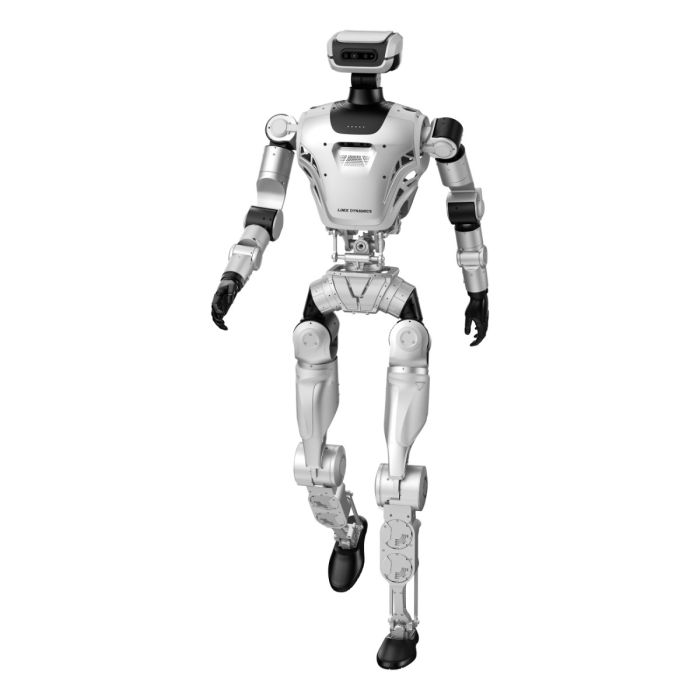
LimX Oli EDU Humanoid Robot
$53,331.92
LimX Oli EDU research humanoid, approximately 165 cm tall and 55 kg including battery. It has 31 body degrees of freedom before end effectors, dedicated motion and development computers, and head/chest depth cameras. Total articulation varies with the fitted hands or grippers.
Explore Related
Related products, categories and research.
LimX Oli EDU humanoid robot
The LimX Oli EDU is a full-size humanoid platform for robotics education, algorithm development and system integration. It stands approximately 165 cm tall and weighs about 55 kg including the battery. Its architecture separates motion control from development computing, while cameras and an IMU provide inputs for perception and movement research.
The EDU designation identifies the research-oriented configuration. This page describes that version rather than transferring specifications from Oli Lite, Oli Super or another LimX humanoid.
LimX Oli EDU humanoid robot specifications
| Model | LimX Oli EDU |
|---|---|
| Height and mass | Approximately 165 cm and 55 kg including battery |
| Body degrees of freedom | 31, excluding end effectors |
| Legs | Six degrees of freedom per leg |
| Arms | Seven degrees of freedom per arm |
| Waist and neck | Three waist axes and two neck axes |
| Arm length | Approximately 70 cm |
| Motion computer | RK3588, 8GB RAM and 64GB storage |
| Development computer | NVIDIA Jetson Orin NX, 16GB RAM and 1TB storage |
| Perception | Head and chest depth cameras; six-axis IMU |
Why body and total joint counts differ
The current manufacturer documentation identifies 31 active body axes. Older EDU material lists 33 total degrees of freedom, which includes a pair of one-axis grippers. Optional hands can change the total further. These numbers describe different end-effector arrangements rather than two extra body joints.
For a manipulation project, identify both the body model and the attached end effectors. A grasping policy needs the correct gripper or hand interface and its available motion, not just a headline total joint count. Keep that configuration consistent between the simulation model and physical robot.
RK3588 and Orin NX workloads
The dedicated motion computer handles the platform-control role, while the development computer provides resources for user applications. That separation helps define where perception code and task logic belong. It does not establish that an arbitrary model will meet a particular latency or memory requirement.
Before deploying an application, check its dependencies, storage requirements and interaction with the supported control interfaces. Log the software version and robot configuration alongside experiment results. A change in the development environment can affect the behaviour of a previously working demonstration.
LimX Oli EDU research robot: SDK and simulation
LimX describes Python development, a modular SDK, open high- and low-level interfaces and a URDF model. Its FAQ names Isaac Sim, MuJoCo and Gazebo as supported simulation platforms. Those tools support development workflows; they do not mean that every hardware design, firmware component or third-party dependency is unrestricted open source.
Choose a control level that matches the research task. High-level movement commands and low-level joint control expose different responsibilities to the developer. Validate the model, joint conventions and end-effector configuration in simulation before evaluating the intended behaviour on hardware.
LimX Oli EDU education robot: perception and manipulation
Head and chest camera positions provide different views of the scene. For manipulation, the relationship between the observed object and the robot’s coordinate frames matters as much as the presence of cameras. Calibration and time alignment should be part of the experiment design when observations are used to guide motion.
The manufacturer lists a maximum load of 3 kg per arm, with actual capacity depending on pose and extension. Treat that as a configuration-sensitive limit rather than a guarantee at every reach. The fitted gripper, payload shape and path all matter when defining a handling task.
LimX Oli EDU battery and operating workflow
The published battery capacity is 9,500 mAh. Manufacturer runtime figures differ between documents and operating descriptions, so a project should measure its own representative duty cycle. Motion, computing load and the interaction sequence can change how long a pack supports useful work.
Plan battery changes and the surrounding work area as part of the session. Follow the current manual for shutdown, handling and startup; a removable pack should not be interpreted as permission to disconnect it during operation.
Configuration questions
Are dexterous hands included?
Five-finger hands are optional in the manufacturer information. The actual hand or gripper arrangement should be identified in the order and matched to the development interface.
Is it a finished autonomous application?
It is a development platform. Navigation, manipulation or data-collection tasks need the application software and validation appropriate to the intended environment.
See the Oli EDU manual and LimX development FAQ, or compare other robots.
Related products
Recently viewed
Add AI Robot Supplier as a preferred source on Google.