117 TOPS AI Compute
The Education configuration uses NVIDIA Jetson Orin NX 8GB with approximately 117 TOPS of AI performance for vision, perception, speech and robotics development.
$5,999.99
BOOSTER ROBOTICS BOOSTER K1 Humanoid Robot is presented for professional procurement with model-specific technical information. For manufacturer information, visit the Booster Robotics official website.
Review specifications, compatibility, images, included configuration and technical documentation before requesting a B2B quotation.
Related products, categories and research.
Compact Embodied AI Development Humanoid
The Booster K1 EDU is the education and research configuration of Booster Robotics’ compact K1 humanoid platform. It combines a lightweight 95 cm, approximately 19.5 kg bipedal body with 22 actuated degrees of freedom, NVIDIA Jetson Orin NX 8GB computing, 117 TOPS of AI performance, stereo depth vision, a 9-axis IMU and full secondary-development support.
For buyers searching for a Booster K1 EDU for sale, the Education version sits between the lower-cost Geek and higher-compute Professional configurations. It retains the same compact 22-DOF mechanical architecture while upgrading the onboard AI computer, battery capacity, runtime, storage and warranty support.
AI Robot Supplier currently lists the Booster K1 EDU price at $6,000. Because current international dealer prices can be materially higher, buyers should confirm that the supplied robot is the genuine Education configuration with Jetson Orin NX 8GB, 117 TOPS compute, 512 GB storage, 5 Ah battery and agreed accessories.
Product overview
The Booster K1 EDU is a compact programmable humanoid designed for university teaching, robotics laboratories, embodied-AI research, developer training, RoboCup-style competition projects and interactive demonstrations.
The robot stands approximately 0.95 m tall and weighs around 19.5 kg, making it substantially easier to transport, store and operate in a classroom than full-size humanoid platforms.
Its 22 actuated body joints are distributed across six degrees of freedom per leg, four per arm and two in the head. This layout supports bipedal walking, lateral movement, turning, gestures, expressive head motion and full-body actions while keeping the hardware relatively accessible for teaching and research.
The defining EDU upgrade is its NVIDIA Jetson Orin NX 8GB controller, which Booster rates at approximately 117 TOPS AI performance. Official technical documentation also lists 8 GB memory and 512 GB storage for the Education version.
Make sure the quotation says K1 Education / K1 EDU rather than Geek or Professional.
Verify Jetson Orin NX 8GB, 117 TOPS and 512 GB storage.
Battery, charger, controller, carrying equipment, warranty and development access should be listed in writing.
Product images
These images are already hosted in the AI Robot Supplier WordPress Media Library. They should remain the main product media rather than being replaced with AI-generated humanoid images.
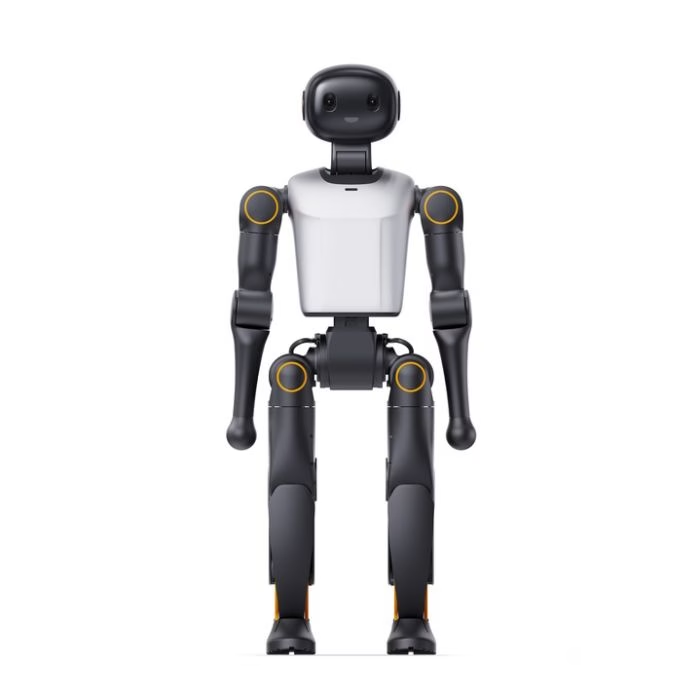
Compact humanoid education and development platform.
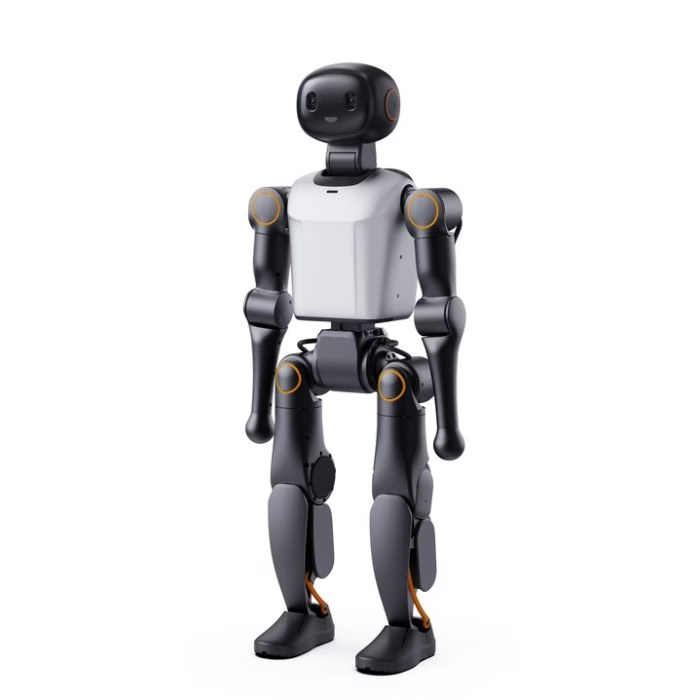
Lightweight 95 cm humanoid chassis.
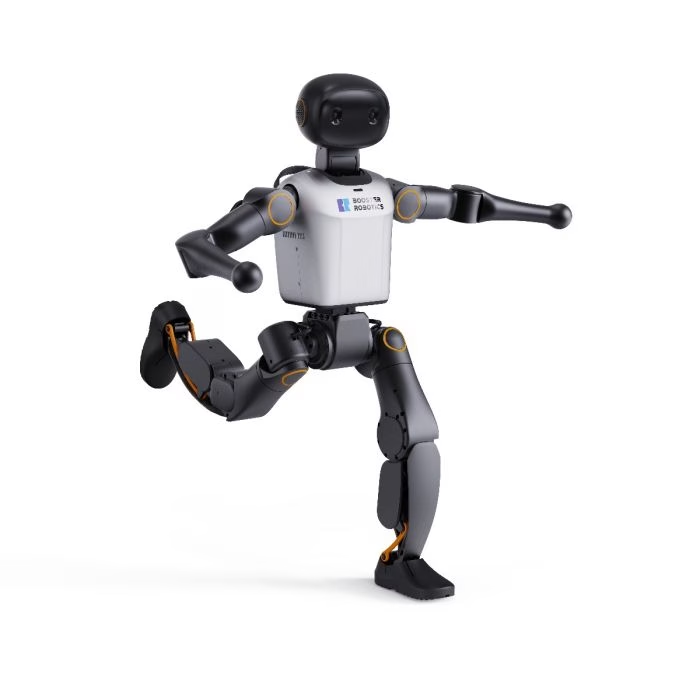
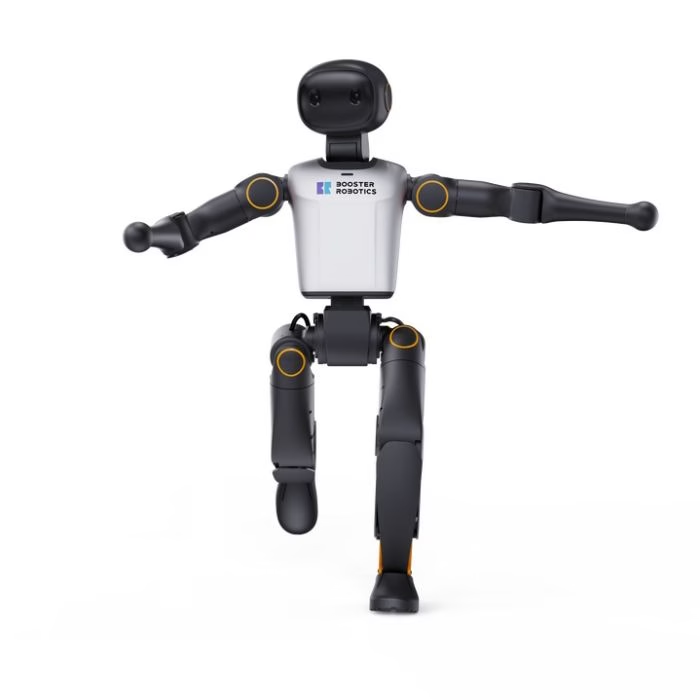
22-DOF architecture for education and development.
Portable humanoid for laboratories and classrooms.
Education configuration
The Education configuration uses NVIDIA Jetson Orin NX 8GB with approximately 117 TOPS of AI performance for vision, perception, speech and robotics development.
K1 provides 22 actuated body DOF: six per leg, four per arm and two in the head.
Booster publishes approximately 60 N·m maximum peak joint torque with dual-encoder joint modules.
The head integrates stereo depth vision for perception, computer vision and interactive robotics applications.
The integrated inertial measurement unit supports body-state estimation, balance and locomotion control.
Booster’s current K1 product page specifies a circular three-microphone array together with an integrated speaker for voice interaction.
Modern wireless connectivity supports software development, robot configuration and interactive applications.
A wired Gigabit Ethernet connection supports reliable laboratory networking and development workflows.
Booster officially supports secondary development through Python, C++, ROS 2 and open-source simulation and deployment resources.
Verified technical specifications
The specifications below follow Booster Robotics’ current official K1 Education product table and technical manual.
Battery & runtime
K1 runtime figures can appear inconsistent online because Booster publishes endurance at different walking speeds.
The Education configuration uses the larger 5 Ah battery rather than the 2 Ah battery used by the entry Geek version.
Booster’s commercial product table lists approximately 80 minutes of walking at 0.4 m/s.
Booster’s technical manual lists approximately 1 hour 10 minutes of continuous walking at the faster 1.1 m/s reference speed.
The approximately 80-minute and 70-minute references are measured at different walking speeds. They should not be treated as contradictory specifications.
Real-world endurance also depends on repeated standing, recovery actions, AI workload, Wi-Fi use, floor resistance, battery condition and the selected motion policy.
Booster’s current technical specification lists charging time at ≤2 hours and battery cycle life at ≥500 cycles.
Onboard AI development
The Education configuration is based on NVIDIA Jetson Orin NX 8GB rather than Booster’s lower-compute Geek controller.
Booster rates the EDU platform at approximately 117 TOPS AI performance for perception, inference and embodied-development workloads.
The official K1 technical specification lists 512 GB storage for the Education configuration.
Python, C++, ROS 2 & simulation
A major reason to choose Booster K1 EDU is the surrounding software ecosystem rather than simply the robot’s hardware specification.
Booster provides an official Python SDK for connecting to physical K1 robots or Booster Studio virtual robots, reading images, IMU data, odometry and joint state, and sending supported motion and trajectory commands.
Booster maintains a C++ SDK supporting higher-level RPC functions and lower-level DDS communication for developers who require more direct robot integration.
Booster’s deployment ecosystem includes ROS 2 interfaces for robot-state information, sensor messages and real-robot policy deployment.
Booster Deploy provides a framework for running trained policies across simulation environments and real robots using supported ROS 2 workflows.
Official K1 resources include 22-DOF URDF and XML models for simulation, training, motion processing and local development.
Booster provides training and deployment resources for policy development, including modern simulation workflows and real-robot deployment tooling.
Configuration comparison
The K1 family shares the same compact 95 cm, 19.5 kg and 22-DOF body. Compute, battery and warranty are the main commercial differences.
| Feature | K1 Geek | K1 EDU | K1 Professional |
|---|---|---|---|
| Height | ~95 cm | ~95 cm | ~95 cm |
| Weight | ~19.5 kg | ~19.5 kg | ~19.5 kg |
| Total DOF | 22 | 22 | 22 |
| Peak torque | 60 N·m | 60 N·m | 60 N·m |
| AI performance | 48 TOPS Dense | 117 TOPS | 200 TOPS |
| Controller | High-performance ARM | Jetson Orin NX 8GB | Jetson AGX Orin 32GB |
| Memory | 8 GB | 8 GB | 32 GB |
| Storage | 128 GB | 512 GB | 512 GB |
| Battery | 2 Ah | 5 Ah | 5 Ah |
| Runtime at 0.4 m/s | ~30 min | ~80 min | ~80 min |
| Secondary development | Yes | Yes | Yes |
| Warranty reference | 3 months | 1 year | 1 year |
| Best fit | Entry experimentation | University teaching & research | Higher-compute onboard AI |
Choose Geek when entry price is more important than onboard compute and longer operating sessions.
Choose EDU for the strongest balance of price, portability, Jetson Orin NX compute, battery life and university development support.
Choose Professional when the 32 GB Jetson AGX Orin and approximately 200 TOPS compute platform justify the additional cost.
Tell us your curriculum, AI workload, number of robots, simulation environment and expected session length.
Locomotion & operating environment
Booster’s current technical manual lists approximately 1.1 m/s walking speed.
The technical reference gives a turning-speed figure of approximately 1.5 rad/s.
The 95 cm body is suited to classrooms, robotics labs, events and controlled indoor development environments.
Booster specifies approximately −10°C to 45°C operating temperature and 5–90% relative humidity, non-condensing.
Walking noise is listed at approximately ≤70 dB.
For large full-body actions and dance routines, Booster recommends hard surfaces such as rubber, cement or tile. High-resistance carpet can increase fall risk.
Education & research applications
Teach Linux, ROS 2, SDK use, robot state, perception, joint control and humanoid locomotion using physical hardware.
Jetson Orin NX provides onboard compute for vision, speech and AI inference experiments.
Booster’s simulation and deployment ecosystem supports policy training, simulation validation and sim-to-real research.
K1 is used in RoboCup-style development and Booster provides official soccer-related development resources.
Stereo vision, microphone array and speaker support controlled interaction, voice and classroom demonstrations.
Small robotics teams can prototype locomotion, perception, voice, gesture and full-body applications on a portable humanoid platform.
Buyer limitations
Price & procurement
AI Robot Supplier currently lists the Booster K1 EDU price at $6,000.
Booster currently advertises the wider K1 family as starting from $5,999, while independent specialist-shop tracking shows current Education-version prices in Europe substantially higher than the AI Robot Supplier listing.
That price gap makes exact configuration verification especially important. When you buy Booster K1 EDU, confirm:
For wider humanoid pricing, see the
Humanoid Robots for Sale & Prices 2026 guide
.
Send your delivery country, university or company, quantity and intended research or teaching use.
Package contents
Package contents can vary between suppliers. Only items listed in the final quotation should be treated as included.
95 cm, 22-DOF humanoid with the Education compute platform.
Education battery supporting the longer EDU runtime profile.
Confirm plug type and destination electrical compatibility.
Confirm the supplied Booster controller and operating functions.
Some professional EDU packages include support or transport equipment. Confirm the exact package contents.
Secondary-development access, SDK documentation and current software resources should be confirmed for the delivered robot.
International procurement
Confirm current import requirements, battery shipping, wireless compliance and warranty handling.
Confirm VAT, customs responsibilities, conformity documentation and institutional procurement requirements.
Confirm import VAT, duties, battery freight and return responsibilities.
Request a delivered quotation covering freight, insurance, customs and local delivery.
Confirm freight routing, lithium-battery documentation, customs and after-sales support.
Confirm destination import requirements, wireless compliance and the exact EDU package supplied.
Warranty & technical support
Booster’s current product table lists a one-year warranty reference for the Education version.
Official technical sources
OFFICIAL
Official Geek, Education and Professional product comparison.
MANUAL
Official technical documentation covering specifications, safety and operation.
SDK
Official Python, C++, simulation and robot-application development documentation.
Official manufacturer video
This official Booster Robotics video demonstrates the wider K1 humanoid platform. Some actions shown may use software or configurations different from your exact Education package.
Procurement checklist
Buyer questions
Common questions from universities, developers and robotics teams evaluating the Education configuration.
AI Robot Supplier currently lists K1 EDU at $6,000. Booster advertises the wider K1 family from $5,999, while independent specialist-shop pricing for the Education configuration can be substantially higher depending on region and package.
AI Robot Supplier lists K1 EDU for direct commercial procurement and international shipping. Confirm the exact Education configuration, accessories and warranty before payment.
K1 EDU has 22 body degrees of freedom: six per leg, four per arm and two in the head.
The Education configuration uses NVIDIA Jetson Orin NX 8GB with approximately 117 TOPS AI performance, 8 GB memory and 512 GB storage.
Booster’s technical documentation lists approximately 1.1 m/s walking speed and 1.5 rad/s turning speed.
Booster lists approximately 80 minutes of walking at 0.4 m/s on its commercial product page and about 1 hour 10 minutes when walking continuously at 1.1 m/s in its technical manual.
Booster’s current technical specification lists charging time at no more than approximately two hours.
Yes. Booster publishes the BoosterOS Python SDK for reading images, IMU, joint-state and odometry data and for sending supported commands.
Yes. Booster maintains an official C++ SDK with higher-level RPC interfaces and lower-level DDS communication.
Yes. Booster’s current development and policy-deployment ecosystem includes ROS 2 interfaces and supported real-robot deployment workflows.
No articulated finger DOF are included in the standard 22-DOF body specification. K1 EDU is not primarily a dexterous-manipulation platform.
Booster does not publish a standard rated arm payload for K1 EDU on the current official specification page. Do not infer a payload figure from demonstration videos.
The mechanical platform is similar, but EDU increases compute from 48 TOPS Dense to 117 TOPS, increases battery capacity from 2 Ah to 5 Ah, increases runtime and carries a one-year warranty reference rather than three months.
Professional upgrades the compute platform to Jetson AGX Orin 32GB with approximately 200 TOPS while keeping the same 22-DOF body and 5 Ah battery family.
Yes. University teaching, robotics research, ROS 2 development, embodied AI and competition robotics are among the strongest use cases for the Education version.
Booster publishes temperature and humidity operating ranges but does not currently publish a general IP rating for K1 EDU. Do not assume rain or weather resistance.
Booster’s current K1 specification lists a one-year warranty reference for the Education configuration.
International procurement can be arranged for supported destinations. Freight, lithium-battery handling, insurance, customs, taxes and local compliance requirements should be confirmed before purchase.
Education & embodied-AI procurement
Request a destination-specific quotation with your country, university or company, quantity and intended teaching or research use. EDU configuration, battery, controller, warranty and international shipping can be confirmed before order approval.
Tell us what you need — we respond within one business day.