100 L capacity
High liquid capacity reduces refill frequency when the mission and application rate can make efficient use of the larger tank.
$17,693.90
DJI Agras T100 Enterprise Drone / Payload is an enterprise drone from DJI, identified by model Agras T100. Review technical information, compatibility, configuration and documentation for professional procurement.
Confirm the exact supplied scope and destination-specific commercial terms before order approval.
Related products, categories and research.
DJI Agras T100 is DJI Agriculture’s high-capacity professional platform for spraying, granular spreading and aerial lifting. The T100 combines a 100 L spraying tank, up to 40 L/min maximum spray flow with the optional four-nozzle configuration, a 150 L spreading tank, up to 100 kg material load, 100 kg standard lifting capability, LiDAR, millimeter-wave radar and advanced vision sensing. AI Robot Supplier supplies the T100 on a configuration-specific quotation basis because batteries, charging equipment, spraying or spreading hardware, regional version and destination can materially change the final package and price.
100 L flagship agricultural drone
DJI Agras T100 is designed specifically for high-capacity agricultural work rather than generic aerial inspection. DJI defines three principal mission families for the aircraft: spraying, spreading and lifting.
In its standard spraying configuration, the T100 uses a 100 L HDPE tank with a 100 kg operating payload, two atomizing centrifugal sprinklers and two magnetic-drive impeller pumps. Standard maximum liquid flow is 30 L/min. The optional four-nozzle configuration raises maximum flow to 40 L/min.
For granular application, Spreading System 4.0 provides a 150 L hopper with a maximum 100 kg material load and published discharge of up to 400 kg/min with compound fertilizer under DJI’s stated test conditions.
The same aircraft can be configured for aerial lifting. DJI specifies up to 100 kg with the standard lifting system and up to 80 kg with the dual-battery lifting configuration.
Buyers should compare the T100 as a complete operating system—not simply an aircraft. Battery quantity, C12000 charging infrastructure, field power, controller, RTK, spreading hardware, lifting hardware, regional compatibility and local agricultural-UAS regulations can all change whether a particular package is commercially appropriate.
AI Robot Supplier currently handles the DJI Agras T100 price on a quotation basis because there is no meaningful universal price without specifying the package.
Current public seller pricing demonstrates why configuration matters. Some listings cover primarily the aircraft, while others package the aircraft with spraying hardware, controller, three DB2160 batteries, C12000 charging equipment and sometimes field power.
| Seller / reference | Observed price | Configuration note |
|---|---|---|
| AI Robot Supplier | Request Quote | Configuration, destination, battery package and mission hardware confirmed before order approval. |
| Drone Nerds | $21,818 | Publicly described as T100 airframe-only configuration. |
| Ares Acres | $34,199.99 | Full Set listing with three batteries, charging equipment, generator and controller according to seller description. |
| Drone Nerds | $39,999 | Ready-to-fly spraying kit with three DB2160 batteries, sprayer and C12000 power supply. |
| MySurveyingDirect | $39,999 | Ready-to-fly package combining aircraft, spraying system, three DB2160 batteries and C12000 power supply. |
The market spread does not mean one seller is necessarily more or less expensive for an identical system. It demonstrates that a buyer should compare the bill of materials, not simply the number shown beside “DJI Agras T100.”
Product overview
DJI positions the T100 as its high-capacity agricultural platform for operations that need substantially more liquid, granular or lifting capacity than smaller Agras aircraft.
Rather than treating spraying, spreading and lifting as unrelated accessories, the aircraft is designed as a modular work platform. Operators can configure the T100 for the mission while removing unnecessary hardware where appropriate.
DJI says the detachable design can reduce unnecessary component exposure when the aircraft is used only for spreading or lifting. This matters because agricultural equipment operates around chemicals, granular abrasion, transport vibration and high-payload flight cycles.
The aircraft uses 62-inch carbon-fiber composite propellers. DJI states that the T100 propulsion upgrade improves full-load power efficiency compared with the T50, supporting the aircraft’s larger payload envelope.
The T100 should therefore be evaluated as a professional agricultural production system—not simply as a larger drone. Farm size, required application rate, refill strategy, battery rotation, available charging power, transport vehicle and regulatory environment determine whether the added capacity creates real operating value.
Define spraying, spreading, lifting or multi-role requirements before choosing package hardware.
Match battery quantity and C12000 / generator infrastructure to the expected daily operating tempo.
Verify activation, radio configuration, support territory, warranty and destination compatibility before shipment.
Product images
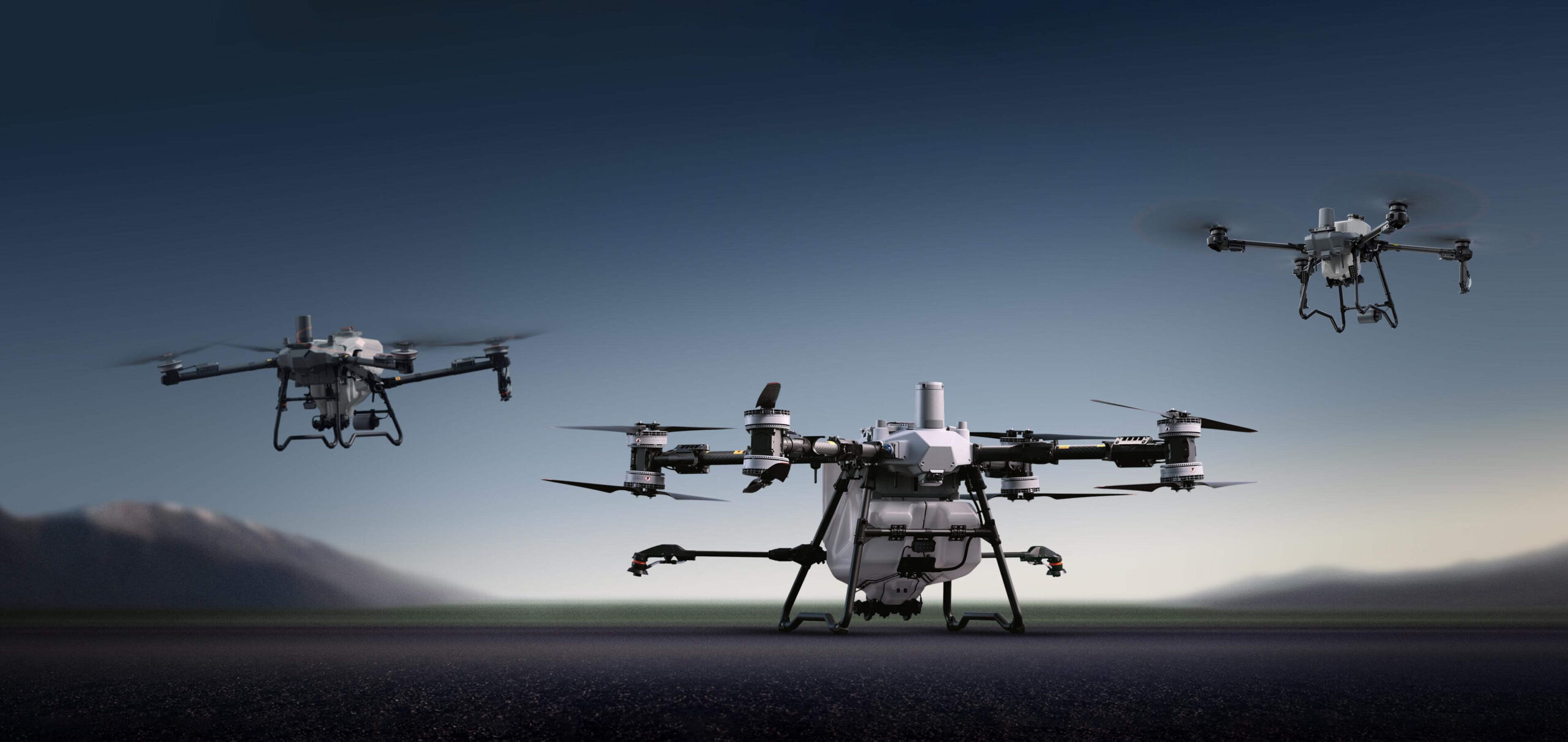
Use exact T100 media and the written quotation to confirm the supplied spraying, spreading or lifting configuration. Product photography may show optional equipment that is not included in every package.

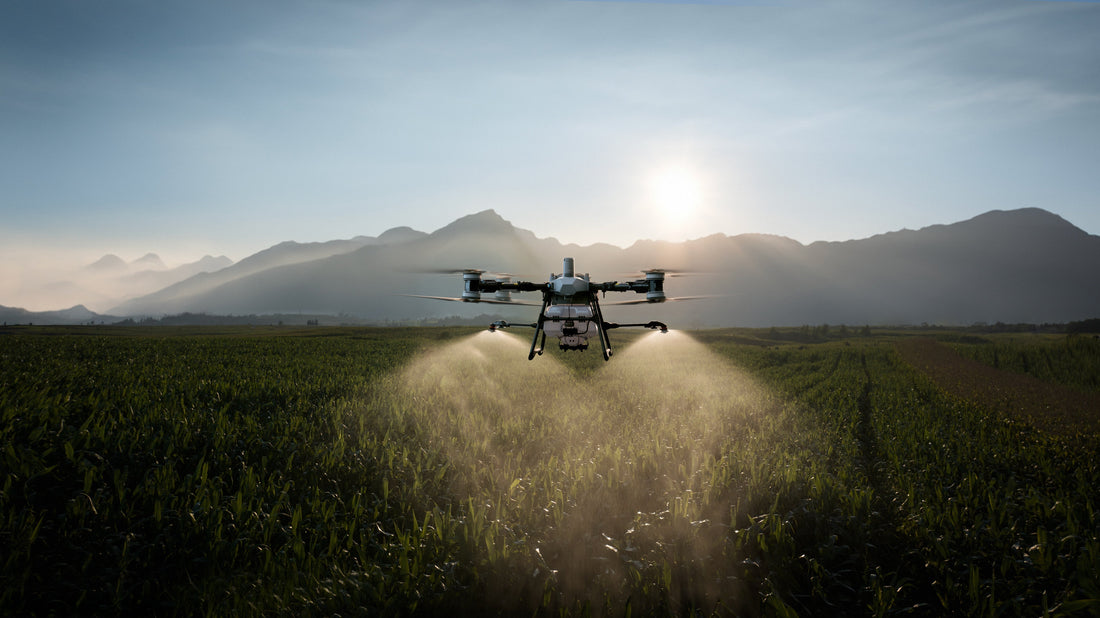
Official DJI manufacturer visual for the Agras T100 agricultural platform.
Verified DJI specification
The table below prioritizes DJI’s current official T100 specifications. Configuration-dependent values are kept separate so buyers do not mistakenly combine standard, optional and dual-battery figures.
| Model | DJI Agras T100 |
|---|---|
| Product class | Professional agricultural spraying, spreading and lifting drone |
| Spraying aircraft weight | 75 kg with standard two nozzles; 77 kg with optional four-nozzle configuration |
| Spreading aircraft weight | 75 kg with spreading system |
| Lifting aircraft weight | 65 kg standard lifting; 90 kg dual-battery lifting |
| Maximum takeoff weight — spraying | 175 kg standard; 177 kg optional four-nozzle configuration |
| Maximum takeoff weight — spreading | 175 kg |
| Maximum takeoff weight — lifting | 165 kg standard; 170 kg dual-battery configuration |
| Diagonal wheelbase | 2330 mm |
| Fully unfolded dimensions | 3220 × 3224 × 975 mm |
| Arms unfolded / propellers folded | 1820 × 1840 × 975 mm |
| Fully folded dimensions | 1105 × 1265 × 975 mm |
| Propellers | 62-inch carbon-fiber composite |
| Maximum configurable flight radius | 2 km |
| Maximum operation speed | 20 m/s under DJI test conditions |
| Maximum wind resistance | <6 m/s |
| Operating temperature | 0°C to 40°C |
| RTK hovering accuracy | ±10 cm horizontal / ±10 cm vertical with strong GNSS signal |
| Non-RTK hovering accuracy | ±0.6 m horizontal / ±0.3 m vertical with strong GNSS signal |
| Spray tank | 100 L HDPE |
| Standard spraying operating payload | 100 kg |
| Sprinklers | 2 standard / 4 optional |
| Droplet size | 50–500 μm |
| Effective spray width | 5–13 m depending on operating conditions |
| Maximum spray flow | 30 L/min standard two-nozzle; 40 L/min optional four-nozzle |
| Dual-battery spraying system | LS100-DB; 100 L tank / 90 kg operating payload |
| Spreading tank | 150 L |
| Maximum spreading material load | 100 kg |
| Maximum spreading discharge | 400 kg/min with compound fertilizer under DJI test conditions |
| Effective spreading width | 3–10 m |
| Standard lifting capacity | 100 kg including applicable rope/hook weight considerations |
| Dual-battery lifting capacity | 80 kg |
| Standard lifting cable | 10 m; DJI recommends 10–15 m |
| Safety system | LiDAR + millimeter-wave radar + multi-camera vision / Penta-Vision architecture + FPV imaging |
| Safety measurement range | Up to 60 m under specified conditions |
| Effective safe obstacle-avoidance speed | ≤13.8 m/s |
| Remote controller | DJI RC Plus 2 / model TKPL 2 |
| Controller display | 7-inch LCD, 1920 × 1200, 1400 cd/m² |
| Controller internal runtime | Approximately 3.8 hours |
| Optional external controller battery runtime | Approximately 3.2 hours |
| Controller charging | USB-C fast charging up to 65 W; approx. 2 hours when powered off under DJI conditions |
| DB2160 battery capacity | 41,000 mAh |
| DB2160 voltage | 52 V nominal |
| DB2160 weight | 14.7 ± 0.3 kg |
| C12000 rated power | 12,000 W with three-phase 380 V input; 3,000 W with single-phase 220 V input |
| Published DB2160 charging benchmark | Approx. 8–9 minutes from 30% to 95% under DJI test conditions |
| Processor | Not publicly specified by DJI in the current T100 specification table |
| Public ROS / general-purpose robotics SDK | Not advertised as a standard T100 capability in current DJI product documentation |
DJI specifications are configuration- and condition-dependent. Payload recommendations can change with altitude, aircraft condition, environment and task. Follow the current DJI Agriculture App guidance and current manufacturer documentation.
100 L spraying system
The defining agricultural capability of the DJI Agras T100 is its LS100 high-capacity spraying system.
The standard platform uses a 100 L HDPE tank with a 100 kg operating payload at the manufacturer-defined reference conditions. Two atomizing centrifugal sprinklers provide adjustable droplets across a 50–500 μm range.
Standard maximum liquid flow is 30 L/min. Buyers requiring additional flow can specify the optional four-nozzle configuration, which increases published maximum flow to 40 L/min.
This distinction matters commercially because many reseller pages simply advertise “40 L/min” without clearly telling the customer that this is the optional four-nozzle configuration rather than the standard two-nozzle system.
High liquid capacity reduces refill frequency when the mission and application rate can make efficient use of the larger tank.
The standard two-nozzle configuration is rated for up to 30 L/min maximum liquid flow.
The optional four-nozzle configuration raises maximum flow to 40 L/min for high-flow applications such as demanding orchard work.
Adjustable atomization allows the system to cover a wide range of application strategies subject to chemical-label and agronomic requirements.
Effective width depends on height, application requirements, wind and other operating conditions.
Two impeller pumps support high flow while DJI’s updated liquid architecture is designed for demanding agricultural environments.
DJI also documents an LS100-DB dual-battery spraying system. It retains the 100 L tank but specifies a 90 kg operating payload because the second battery changes the aircraft’s mass and payload balance.
Buyers should therefore identify whether the quotation is for the normal spraying configuration or the dual-battery system. Battery redundancy or endurance requirements should be assessed against the reduction in available operating payload.
Spreading System 4.0
The T100 Spreading System 4.0 is a major upgrade over smaller Agras platforms. DJI specifies a 150 L hopper, centrifugal spreading disc and screw-feeder delivery architecture.
The most important specification to understand is that 150 L is tank volume, not material mass. DJI specifies a maximum 100 kg load inside the spreading operation box.
Maximum published discharge reaches 400 kg/min when tested with compound fertilizer, and effective spreading width is approximately 3–10 m.
This is one of the most common reseller specification errors. The hopper volume is 150 L, while DJI’s maximum stated material load is 100 kg. Granular density varies, so volume and weight cannot be treated as interchangeable.
DJI provides feeder options for different particle ranges. The standard configuration includes extra-large and medium feeders, while additional feeder sizes support smaller or different granular materials.
Buyers should specify what will actually be spread—fertilizer, rice, wheat, seed, feed or another compatible material—because particle diameter and required application rate influence the correct feeder selection.
Aerial lifting
Unlike smaller agricultural drones that focus almost exclusively on spray and spread missions, the T100 can be configured as a substantial aerial lifting platform.
DJI specifies a 100 kg standard lifting capacity, including the applicable rope and hook considerations defined in its documentation.
The standard lifting cable is 10 m. DJI recommends a 10–15 m cable range because cables that are too short can increase the risk of swinging cargo reaching the propellers, while excessively long cables increase the possibility of ground or obstacle entanglement.
DJI also documents a dual-battery lifting configuration rated for 80 kg. The second battery reduces maximum payload but supports longer endurance and includes an emergency cable fuse/disconnection function.
DJI’s FAQ lists regulated-use examples such as saplings, fruit, fertilizer and building materials. These examples do not mean every load is automatically legal or safe. Cargo shape, windward surface, center of mass, local aviation rules and local lifting restrictions remain important.
Safety System 3.0
DJI combines multiple sensing technologies on the T100 because agricultural environments contain obstacles that are difficult for one sensor type to handle consistently.
The manufacturer markets the system as LiDAR + Penta-Vision + millimeter-wave radar. In its technical specification, DJI describes laser radar, multiple radar directions, a quad vision system and FPV imaging. In practical terms, the camera array plus FPV view forms the broader multi-camera visual architecture DJI markets as Penta-Vision.
High-density spatial sensing supports obstacle recognition and real-time point-cloud visualization around structures including poles, trees and wires under appropriate conditions.
Radar provides another sensing layer and is useful across varying agricultural lighting and environmental conditions.
Visual sensing supplements LiDAR and radar for close obstacle perception, takeoff/landing awareness and environmental understanding.
DJI publishes a 20 m/s maximum operation speed, but the Safety System’s published effective safe obstacle-avoidance speed is ≤13.8 m/s.
These specifications should not be merged. The first describes maximum aircraft operation speed under manufacturer conditions; the second describes the stated sensing/avoidance performance envelope.
DJI also notes that obstacle-sensing performance varies with environmental light, rain, fog, obstacle material, position and shape. Moving objects cannot simply be treated like static marked obstacles.
Battery and charging
Current commercial T100 packages commonly use the DB2160 Intelligent Flight Battery. DJI specifies this battery at 41,000 mAh, 52 V nominal voltage and approximately 14.7 kg.
DJI’s current specifications also list a DB2212 Intelligent Flight Battery at 41,000 mAh and 52 V for applicable configurations/markets. Buyers should therefore confirm the exact battery model in the written quotation rather than assuming every regional T100 package uses precisely the same battery SKU.
DJI’s current T100 specification sheet does not publish one universal maximum aircraft flight-time figure.
That omission is important. An aircraft carrying no working payload, a T100 transporting 100 L of liquid, a spreader carrying granular fertilizer and a heavy-lift aircraft all have very different power requirements.
Some reseller pages publish their own approximate flight-time numbers, but AI Robot Supplier should not present those numbers as an official universal DJI specification.
For commercial planning, the more useful questions are:
DJI specifies the C12000 at 12,000 W when used with three-phase 380 V input. With single-phase 220 V input, rated power falls to 3,000 W.
Under DJI’s stated conditions, a DB2160 can be charged from approximately 30% to 95% in 8–9 minutes.
The 8–9 minute number should not be advertised as a universal charging time. DJI states that charging speed varies with input power, altitude above sea level, battery temperature and initial state of charge.
For locations without suitable grid power, DJI documents the D14000iE Multifunctional Inverter Generator. The T100 specification lists up to 11,500 W DC recharge output for this power system and the same 8–9 minute DB2160 30–95% benchmark under defined conditions.
DJI’s FAQ states that buyers using a third-party generator with the C12000 should use a three-phase generator rated at 15,000 W or above.
Control and positioning
The DJI Agras T100 uses the DJI RC Plus 2, identified as model TKPL 2 in DJI’s technical specifications.
The controller uses a 7-inch 1920 × 1200 touchscreen rated at 1400 cd/m², giving it a high-brightness interface for outdoor agricultural use.
DJI publishes approximately 3.8 hours of runtime for the internal controller battery and approximately 3.2 hours for the optional external battery.
USB-C fast charging up to 65 W is supported, with approximately two hours quoted for charging the internal battery or internal + external battery while the controller is powered off under DJI’s stated conditions.
DJI’s own FAQ explicitly says the RC Plus 2 high-precision RTK positioning module is not a standard accessory.
This matters because product pages often discuss centimeter-class operation in a way that makes the buyer assume every positioning component is inside every package.
Ask for RTK hardware to be identified clearly in the quotation.
DJI publishes D-RTK 3 AG support with GPS, BeiDou, Galileo, GLONASS and QZSS compatibility. Under network-RTK calibration conditions, DJI lists 0.8 cm + 1 ppm horizontal and 1.5 cm + 1 ppm vertical positioning accuracy.
A relay is available for more challenging communications environments. Published range varies by radio region and operating environment, so the correct regional version and legal frequency configuration should be verified before deployment.
Agricultural software ecosystem
The T100 is built around DJI Agriculture’s professional operating ecosystem rather than a general-purpose open robotics stack.
DJI SmartFarm provides agricultural device and spraying/spreading operation management. DJI also maintains DJI Assistant 2 for MG for supported aircraft maintenance and software workflows.
As of September 2026, DJI’s T100 download center remains actively maintained. DJI Assistant 2 for MG version 2.2.0.3208 and the T100 User Manual v1.0 were released on July 2, 2026, while the D14000iE generator manual was updated September 7, 2026.
DJI separately publishes documentation for:
DJI does not currently market the Agras T100 as a general-purpose ROS 2 development platform in the way a research robot is marketed.
Buyers requiring a particular third-party API, SDK, fleet integration or custom automation interface should confirm that exact integration before ordering rather than assuming that generic DJI or ROS tooling applies.
Commercial applications
High-capacity liquid application where 100 L loads can materially reduce refill cycles and increase productive field time.
The optional higher-flow sprinkler configuration, adjustable atomization and advanced terrain/obstacle sensing support demanding orchard workflows.
150 L hopper volume and up to 100 kg material load support large-scale compatible granular applications.
Multiple feeder sizes expand the range of compatible granular materials when configured correctly.
The lifting configuration can move suitable cargo in remote or difficult terrain where legal and operationally appropriate.
High-throughput contractors can benefit when battery, refill, chemical handling and charging logistics are engineered around continuous operations.
Limitations
Agras comparison
T100 is not automatically the right choice simply because it has the largest capacity. The best aircraft is the one whose payload, flow rate, transport footprint and charging requirements match the operation.
| Specification | DJI Agras T100 | DJI Agras T70P | DJI Agras T50 |
|---|---|---|---|
| Spray tank | 100 L | 70 L | 40 L |
| Spraying payload | 100 kg | 70 kg | 40 kg |
| Standard max spray flow | 30 L/min | 30 L/min | 16 L/min |
| Optional max spray flow | 40 L/min | 40 L/min | 24 L/min |
| Effective spray width | 5–13 m | 4–11 m | 4–11 m |
| Spreader tank | 150 L | 100 L | 75 L |
| Maximum spread load | 100 kg | 70 kg | 50 kg |
| Maximum spreading flow | 400 kg/min | 400 kg/min | 108 kg/min manufacturer reference |
| Lifting capacity | 100 kg | 65 kg | Not a primary manufacturer-defined T50 mission |
| RTK hover accuracy | ±10 cm | ±10 cm | ±10 cm |
| Best fit | Maximum capacity and large-scale workloads | High capacity without moving to the full T100 class | Established 40 L commercial spraying platform |
Choose T100 when its 100 L spray capacity, 100 kg spread load or heavy-lift capability can genuinely improve throughput.
Choose T70P when 70 L spraying is sufficient but you still want 30/40 L/min spraying capability, 400 kg/min maximum spread discharge and a smaller capacity class.
Choose T50 when 40 L spraying and 50 kg spreading are enough for the fields, fleet and transport system you already operate.
Package configuration
There is no one universal DJI Agras T100 package across every market and seller.
Public listings range from aircraft-focused packages to complete ready-to-fly spraying systems with three batteries and charging hardware.
DJI Agras T100 airframe in the confirmed destination-compatible regional configuration.
LS100 sprayer, optional four-nozzle system, Spreading System 4.0 or lifting hardware depending on the quoted package.
Battery quantity, C12000, generator, RC Plus 2, RTK and relay hardware must be confirmed in the written quotation.
Do not assume that every accessory visible in marketing photography is included in the commercial offer.
International procurement
AI Robot Supplier can coordinate international B2B delivery for approved destinations subject to the exact T100 configuration, battery transport requirements, insurance, customs and agreed commercial terms.
DJI itself states that the T100 is available only in selected countries and regions.
This means buyers should not assume that an aircraft sourced for one market can automatically be activated, supported and legally operated in another.
Before shipment, confirm:
A lower-priced aircraft intended for a different region can become substantially more expensive if activation, support or compliance problems appear after arrival.
Warranty and support
DJI publishes dedicated T100 Warranty Periods Information rather than one simple universal warranty statement covering every component.
Buyers should confirm the exact warranty applicable to the aircraft, battery, charger, remote controller and mission hardware being purchased, particularly for cross-border transactions.
The AI Robot Supplier commercial quotation should separately define the warranty and after-sales terms that apply to the supplied unit.
For professional agricultural operations, after-sales planning should also include access to consumable and wear components such as spray filters, nozzles, pump parts, spreading components, propellers and battery support.
Buying checklist
Send your delivery country, quantity, farm/application type, spraying or spreading requirements, battery quantity and available charging power so the correct T100 package can be confirmed.
Official field video
This 2026 video from DJI Agriculture shows the Agras T100 being evaluated in Australian broadacre farming. It is useful real-world manufacturer context, but performance on any individual farm will depend on application rate, field layout, weather, regulations, refill strategy and operator workflow.
Official and technical resources
Buyer questions
High-intent buyer questions about DJI Agras T100 price, specs, payload, battery, controller, spreading, lifting and international procurement.
DJI Agras T100 price depends heavily on the package. Current public U.S. market references range from approximately $21,818 for an airframe-focused listing to around $34,200–$40,000 for more complete packages with batteries and charging equipment. AI Robot Supplier confirms the exact configuration and destination-specific price by quotation.
The DJI Agras T100 is listed through AI Robot Supplier on a quotation basis. Submit your delivery country, quantity and required spraying, spreading or lifting configuration to confirm current availability and commercial terms.
DJI specifies a 100 kg operating payload for the standard 100 L spraying configuration, a maximum 100 kg material load for the 150 L spreading system and up to 100 kg standard lifting capacity.
The LS100 spraying system uses a 100 L HDPE tank.
Standard maximum flow is 30 L/min with two nozzles. The optional four-nozzle configuration increases maximum flow to 40 L/min.
The T100 Spreading System 4.0 uses a 150 L hopper with a maximum 100 kg material load. DJI specifies up to 400 kg/min discharge with compound fertilizer under its test conditions.
No. 150 L is hopper volume. DJI specifies a maximum material load of 100 kg. Volume and material mass should not be treated as equivalent.
DJI specifies up to 100 kg for the standard lifting system and 80 kg for the dual-battery lifting system.
Current commercial packages commonly use the DB2160 Intelligent Flight Battery, rated at 41,000 mAh, 52 V and approximately 14.7 kg. DJI’s current specifications also list a DB2212 41,000 mAh battery for applicable configurations.
DJI’s current T100 public specification sheet does not publish one universal maximum aircraft flight-time figure. Actual endurance varies significantly with payload, mission type, wind, temperature, altitude, speed, route geometry and reserve level.
DJI publishes approximately 8–9 minutes to recharge a DB2160 from 30% to 95% with compatible high-power charging equipment under its stated test conditions. Charging time depends on input power, battery temperature, initial charge level and altitude.
No. DJI rates the C12000 at 12,000 W using three-phase 380 V input. On single-phase 220 V input, its rated power is 3,000 W.
DJI specifies the RC Plus 2 / TKPL 2 controller with a 7-inch 1920 × 1200 display rated at 1400 cd/m².
DJI publishes approximately 3.8 hours for the internal controller battery and approximately 3.2 hours for the optional external battery.
No. DJI specifically says the RC Plus 2 high-precision RTK positioning module is not a standard accessory. Confirm the RTK configuration in the final quotation.
DJI publishes a maximum operating speed of 20 m/s. The separate effective safe obstacle-avoidance speed for Safety System 3.0 is ≤13.8 m/s.
DJI’s Safety System 3.0 combines LiDAR, millimeter-wave radar and multi-camera vision/FPV sensing to support terrain awareness and obstacle detection.
Choose the T100 when 100 L spraying, 100 kg spreading payload or 100 kg lifting materially improves the operation. T70P provides 70 L spraying, 70 kg spread load and 65 kg lifting in a smaller capacity class while retaining 30/40 L/min spraying capability.
T100 is substantially higher capacity. T50 remains relevant when 40 L spraying and 50 kg spreading already cover the workload, particularly where existing T50 batteries, procedures or transport systems create an economic advantage.
DJI does not advertise the T100 as a general-purpose ROS 2 development robot. Its official software ecosystem centers on DJI Agriculture, SmartFarm and DJI Assistant 2 for MG. Confirm any special API or software-integration requirement before purchase.
International B2B delivery can be arranged for approved destinations subject to configuration, lithium-battery transport, customs, insurance, regional product availability and agreed commercial terms.
Do not assume that a unit intended for another market can automatically be activated, supported or legally operated at your destination. Confirm aircraft region, activation, radio configuration, firmware/support territory and warranty before payment.
AI Robot Supplier
Exact T100 configuration
Aircraft region, spraying/spreading/lifting hardware, batteries, charging, controller and accessories can be confirmed before order approval.
Commercial quotation
Destination-specific pricing can document the exact product package, freight and commercial responsibilities.
International logistics
Export packing, lithium-battery freight, insurance and shipment documentation can be coordinated for approved destinations.
Configuration comparison
Compare T100 against T70P, T50 and different battery or mission configurations before selecting the platform.
DJI agricultural drone quotation
Send your delivery country, quantity, farm size, crop/application type, spraying or spreading requirements, preferred battery quantity and available charging infrastructure to confirm current DJI Agras T100 price, availability and exact supplied package.
Tell us what you need — we respond within one business day.