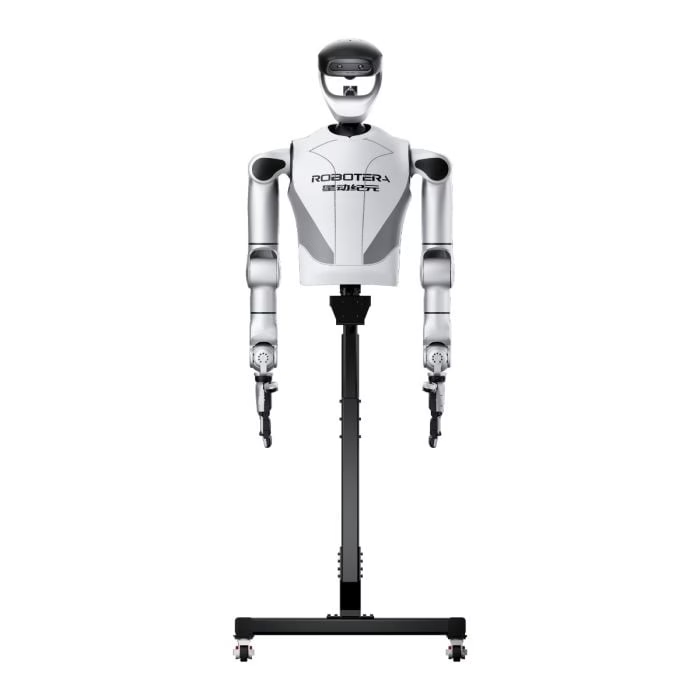
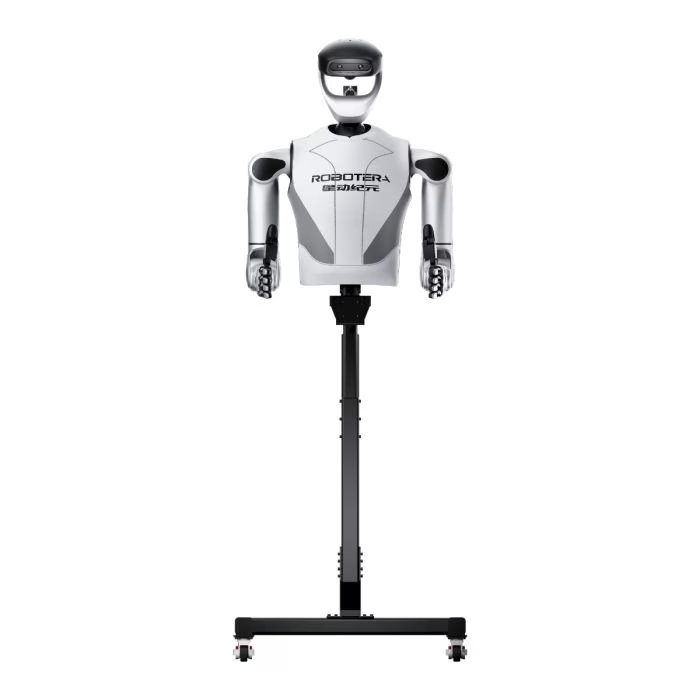
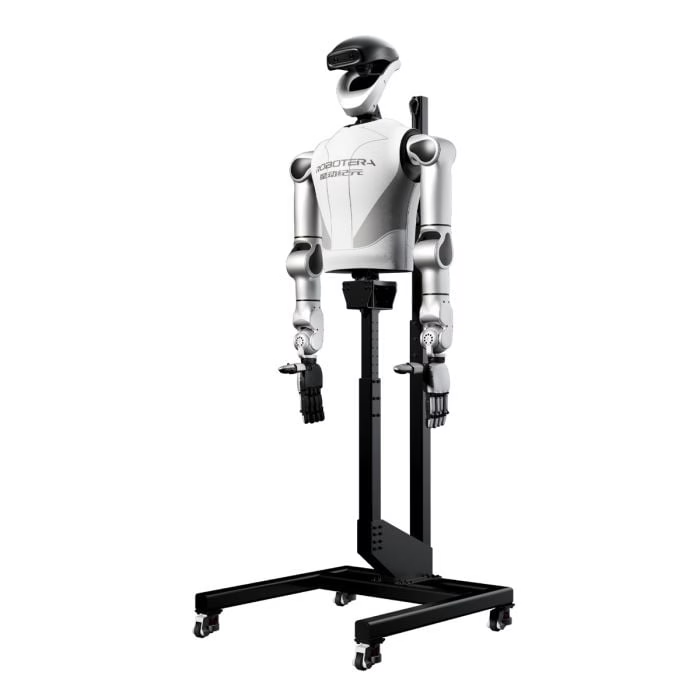
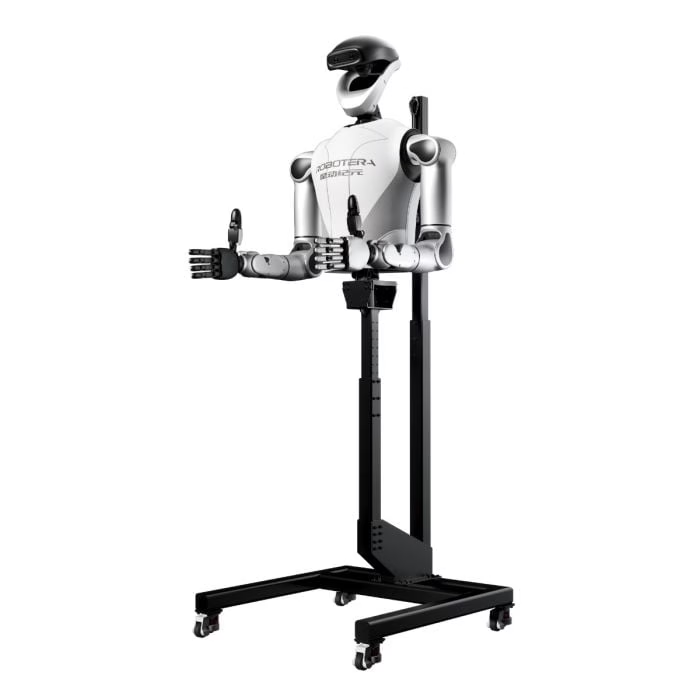
RobotEra M7 Upper Body Wheeled Humanoid Robot
$59,999.99
The RobotEra M7 is an upper-body humanoid for manipulation research, teleoperation and data collection. Its documented 43-DOF baseline includes two articulated arms and dexterous hands.
Confirm the support base, hands, computing options, runtime access and integration scope. A caster base does not establish autonomous navigation.
Explore Related
Related products, categories and research.
RobotEra M7 upper-body humanoid
The RobotEra M7 provides an upper-body platform for studying how two arms and dexterous hands interact with objects. It is distinct from RobotEra’s complete bipedal L7 robot. A torso-based setup lets a research team concentrate on manipulation, perception and coordinated arm motion at a workstation.
The reference configuration shown here uses a support column and caster base. Confirm the supplied support arrangement and its movement controls; a wheeled support does not by itself establish autonomous mobile navigation. Plan the working position and workstation clearance before setting up a task.
RobotEra M7 articulation and configuration
The manufacturer’s M7 specification table and Robotera VLA project identify a baseline with 43 degrees of freedom: seven per arm, three at the waist, two at the neck and twelve per dexterous hand. This count includes both hands. The English manual introduction says 42, while its detailed table and Chinese manual state 43. Use the detailed breakdown and confirm the delivered configuration; do not substitute a body-only count from another robot.
| Platform | RobotEra M7 upper-body humanoid |
|---|---|
| Arm arrangement | Two articulated arms; seven degrees of freedom per arm in the documented baseline |
| Documented joint count | 43 including two twelve-DOF hands |
| Project workflow | Teleoperation, data collection, training and inference examples |
| ROS 2 baseline | Humble in the published Robotera VLA project |
| Documented data interfaces | Ethernet, USB 4.0 and Wi-Fi 6 in the project baseline |
| Computing options | The project describes x86 computing and optional Jetson AGX Orin; verify the delivered build |
The software project records a reference configuration rather than a packing list for this product. Match its hardware requirements and manual revision to the actual equipment before relying on a particular computer, sensor or interface.
RobotEra M7 teleoperation and data collection
Robotera VLA documents a collection workflow using existing Robotera XOS and Meta Quest teleoperation services. Those robot-side runtime services are prerequisites; the public repository does not implement them. Confirm the required software access and operator equipment when defining the research package.
For a RobotEra M7 teleoperation project, define the task, object set and observations before recording demonstrations. Keep the initial robot pose, camera arrangement and object placement consistent enough to interpret the results. Record failed attempts as well as successful actions so that the dataset reflects the task being studied.
RobotEra M7 ROS 2 integration
The repository supplies dataset and interface contracts, a training baseline and an inference-deployment example. These resources can help a team understand the expected observations and commands. They do not establish that every third-party controller or pretrained model will run without adaptation.
Separate the robot’s runtime services from the training and inference computers used by the project. Check network connectivity, software versions, observation timing and command handling before evaluating a learned policy. Agree which components the supplier provides and which the research team must integrate.
RobotEra M7 manipulation studies
A RobotEra M7 research robot hand configuration affects grasp geometry and the actions that can be demonstrated. Specify the hand model, feedback available to the application and supported control interface. Joint count alone does not establish grip force, object tolerance or a guaranteed assembly capability.
Build a representative test using the intended objects and fixtures. Evaluate whether the arm approach, wrist orientation and hand contact can be repeated in the available workspace. Changes to the end effector or support position can require changes to calibration and the recorded task.
Workspace, compute and supplied scope
The M7 v1.11.0 manual lists a 650 × 675 mm base, adjustable height of 1585–1810 mm and approximately 70 kg mass. Use the exact delivered dimensions for receiving access and workstation layout. Check support stability and arm clearance in the intended working posture, including the space needed by staff during setup.
The manual describes a 10 kg single-arm load. Apply the supplied configuration’s load guidance with tool mass, reach and posture included. Do not treat this figure as a guaranteed grasping load for every hand or as proof that a moving support is suitable for loaded operation.
The onboard computing section marks Jetson AGX Orin as optional. A RobotEra M7 upper-body humanoid order should specify the installed computer, additional inference or training machines, cameras and operator equipment. A public project’s compute baseline does not establish what is included at the listed product price.
Commissioning and quotation
Define a representative stationary task with the real objects, fixtures and camera positions. Agree the required observations, commands, initial pose and completion criteria. Check calibration and logging before attempting learned-policy execution. Record the delivered software versions so the test can be repeated after a change.
Request RobotEra M7 price with hands, support base, compute options, runtime access, teleoperation authorization, training and delivery scope itemized. Identify who installs the equipment and who resolves interface or dataset problems. Specify the receiving country, freight responsibilities and charger requirements in the written commercial offer.
For handover, request the applicable maintenance instructions, fault-reporting route and spare-parts arrangements. Keep the packing list, configuration record and acceptance results together. These documents help the receiving team distinguish the delivered research platform from optional integration work.
RobotEra M7 buyer questions
Is M7 a walking humanoid?
This listing concerns the upper-body M7 platform. Do not transfer walking, running or balance demonstrations from a complete bipedal RobotEra model to this configuration.
Does the public software include the complete robot runtime?
No. The repository explicitly assumes existing robot-side teleoperation and recorder services. Confirm those deliverables and their compatibility with the supplied revision.
Where can the development baseline be checked?
Read the manufacturer M7 manual, the Robotera VLA project overview and its hardware and software requirements. Use the manufacturer’s product information and unit records to confirm the supplied scope. Compare other humanoid platforms for a different body format.
Related products
-
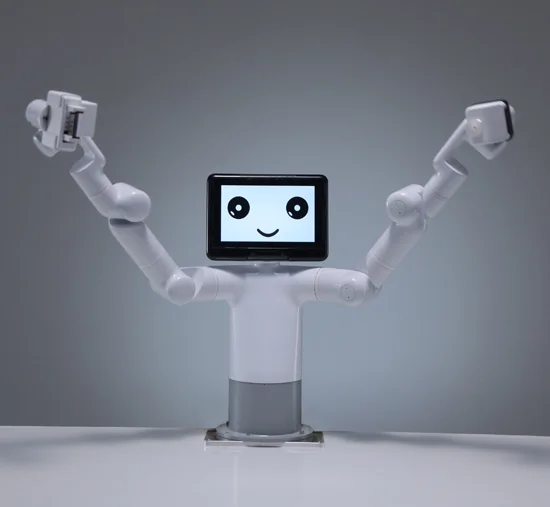 ELEPHANT ROBOTICSAdd to Cart — $7,199.40
Elephant Robotics Mercury Humanoid Robot B1 (4011300002)
-
-
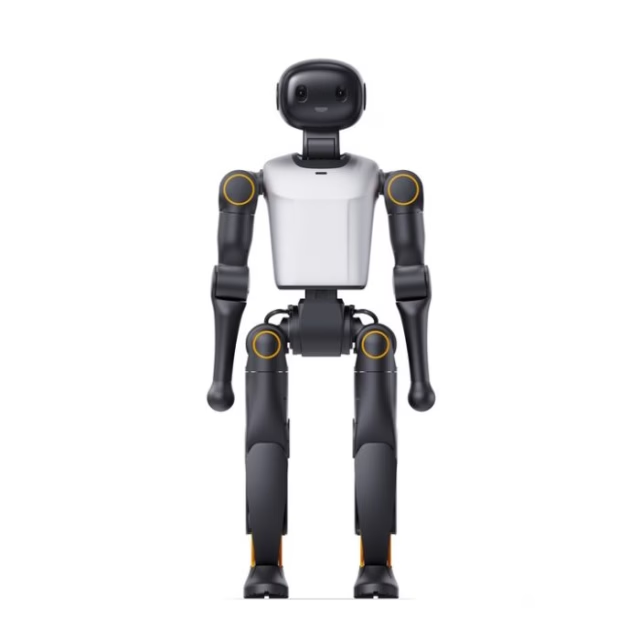 BOOSTER ROBOTICSAdd to Cart — $4,500.00
Booster K1 GEEK Edition Humanoid Robot
-
Recently viewed
Add AI Robot Supplier as a preferred source on Google.