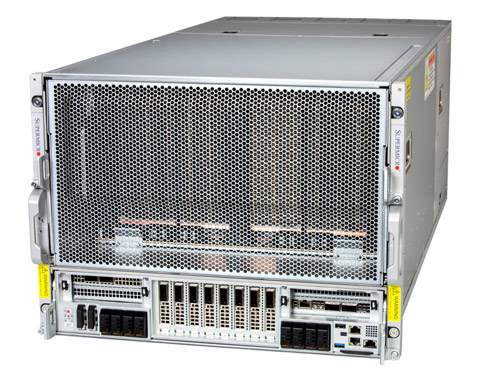
Supermicro SYS-822GS-NBRT 8U GPU Server
$192,000.00
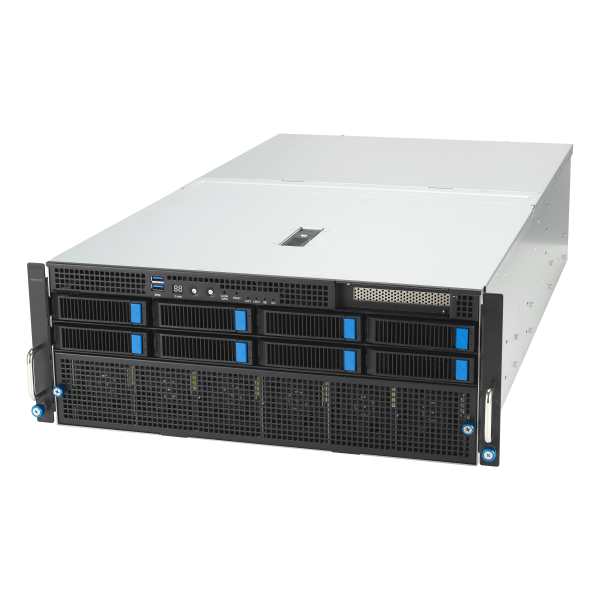
Supermicro SYS-822GS-NBRT is an air-cooled 8U Intel server platform for eight NVIDIA B200 SXM GPUs. It supports 32 DDR5 DIMM slots, front E1.S storage and PCIe fabric-adapter expansion. Confirm installed processors, memory, storage and network cards against the offered system’s component list.
Explore Related
Related products, categories and research.
SYS-822GS-NBRT is Supermicro’s front-I/O 8U server platform for NVIDIA HGX B200. It pairs a dual-socket Intel host with an eight-GPU accelerator assembly and air cooling. Its 32-slot host-memory layout distinguishes it from AMD-based systems and from the separate B300 model with a similar name.
SYS-822GS-NBRT reference specifications
| Server class | 8U air-cooled rackmount GPU system, front I/O |
|---|---|
| Processor support | Dual Intel Xeon 6700/6500 series with P-cores; E2 LGA-4710 sockets; up to 350W TDP per CPU |
| Motherboard | Supermicro X14DBG-LC+ |
| Accelerators | NVIDIA HGX B200, eight SXM6 GPUs; manufacturer lists 180GB per GPU and 1000W TDP per GPU |
| GPU connections | PCIe 5.0 x16 CPU-to-GPU connection; NVLink with NVSwitch between GPUs |
| Host memory | 32 ECC DDR5 RDIMM slots; up to 4TB at 6400MT/s in 1DPC or 8TB at 5200MT/s in 2DPC |
| Storage | Eight front hot-swap E1.S NVMe bays and two M.2 NVMe positions |
| PCIe expansion | Eight low-profile and two full-height half-length PCIe 5.0 x16 slots |
| Base networking | Two Intel X710 10GbE RJ45 ports plus dedicated 1GbE BMC LAN |
| Power | Six 6600W Titanium supplies, 3+3; full redundancy depends on configuration and load |
Identify the B200 system before choosing components
The model belongs to the Intel platform with B200 accelerators. It should not inherit AMD EPYC specifications from an AS-prefixed system, or B300 memory and networking details from a NB3RT model. Those are materially different configurations even when their chassis photographs look similar.
Request the manufacturer’s full system identifier and component list. Record the CPU models, GPU assembly, DIMM population, drive part numbers and installed network cards. A platform capability table establishes supported choices, while the component record establishes what is supplied.
Host memory capacity versus memory speed
The 32 DIMM slots enable different capacity and population choices. The manufacturer’s one-DIMM-per-channel and two-DIMMs-per-channel specifications have different maximum capacities and rates. The higher capacity and higher speed figures therefore should not be combined into a single unsupported headline.
Choose the host-memory arrangement around the CPU-side workload and data pipeline. Data preparation, caching and orchestration can consume substantial host memory independently of model execution on the accelerators. Confirm the installed modules and actual operating rate rather than assuming every configuration reaches the platform maximum.
The supported Xeon 6700 and 6500 families contain different processor options. Core count, power limit and memory support must be checked for the exact CPU selected. The maximum family core count is not a statement about the installed processors in this offer.
HGX B200 and the internal GPU fabric
The eight devices form the accelerator subsystem. GPU memory and host DDR5 are distinct resources, and memory distributed across GPUs is not automatically one application allocation. The framework, numerical format and parallelism strategy determine how a model or simulation uses the available devices.
NVSwitch supports communication inside the server. It does not establish the external network needed for a job spread across multiple machines. Keep the local topology, fabric-adapter placement and inter-server links visible in the architecture plan.
For training, define model size, checkpoint behavior and the intended parallel execution method. For inference, specify context length, concurrency and latency requirements. These describe the actual workload to evaluate; interface specifications alone cannot predict its throughput. No hands-on benchmark or application performance result is claimed here.
Storage form factor and boot design
The front bays take E1.S devices. Verify the supported drive part numbers and physical format rather than treating every NVMe drive as interchangeable. Capacity, endurance and the intended data path should be recorded in the storage specification.
The product page describes two M.2 PCIe 5.0 x4 NVMe positions with M-key 2280/22110 support, and identifies RAID support through the S3808N controller. Confirm the controller and selected boot configuration in the actual build. Available slots do not prove that drives or a mirrored boot arrangement are included.
Separate operating-system recovery from application-data recovery. Preserve the firmware settings, storage identifiers and software image needed to rebuild the host. A training dataset, a checkpoint volume and an inference model repository may need different retention and recovery arrangements.
Network expansion and front I/O access
The onboard 10GbE connections do not establish a high-speed distributed-computing fabric. Specify any additional adapters, port modes, switches and link components for the required topology. Check adapter placement against the server’s supported expansion configuration.
Low-profile and full-height half-length slots impose physical constraints as well as interface requirements. Confirm card dimensions, cooling requirements and the manufacturer’s supported-parts guidance. An x16 electrical interface alone is insufficient evidence that a particular adapter is suitable.
Front I/O changes the cabling and maintenance arrangement in the rack. Plan cable routes so connections can be identified and serviced without obstructing airflow or the required access path. The dedicated BMC connection provides a separate management interface; its presence does not mean monitoring or remote access is configured.
Air-cooled rack installation
The system manual gives chassis dimensions of 356mm high, 449mm wide and 950mm deep. Check rack depth, rail compatibility, equipment handling and service clearance for the complete installation. Reserve space for the cabling arrangement as well as the chassis.
Supermicro specifies a 10°C to 35°C operating temperature range. Facility planning still needs the actual component load and airflow requirements. A room temperature reading alone does not establish the conditions at the server intake.
The six-supply architecture should be reviewed with the intended feed arrangement and configuration load. Power-supply ratings are not measurements of normal consumption, and redundancy must be evaluated for the actual build. Match the documented input requirements to the site’s electrical design.
Configuration questions
Is maximum host memory installed?
The model name does not establish the supplied DIMM capacity or population. Obtain the component list and operating configuration.
Are network optics, software and installation included?
Those items are not established by the platform specifications. Document cable and optic quantities, software versions and licenses, condition, package contents and service responsibilities separately.
Official references
Review the manufacturer product specifications and model-specific manual specifications. Compare related AI Servers when selecting the accelerator and host architecture.
Related products
Recently viewed
Add AI Robot Supplier as a preferred source on Google.