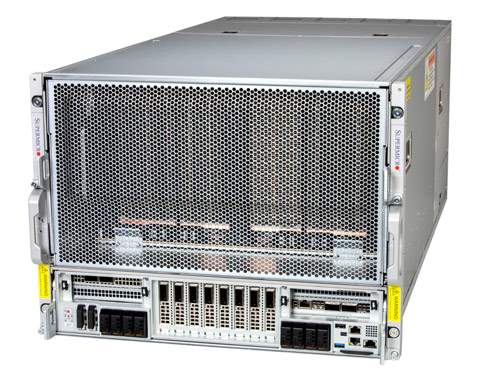
Supermicro SYS-821GE-TNHR-G1 8U H200 Gold Series GPU Server
$190,568.18
Supermicro SYS-821GE-TNHR-G1 is the 8U H200 Gold Series configuration. The manufacturer reference build combines dual Xeon Platinum 8570 processors, eight H200 SXM5 GPUs, 2TB DDR5 memory and two 960GB M.2 drives. Confirm the offered unit matches that component record; manufacturer delivery promotions do not establish this offer’s terms.
Explore Related
Related products, categories and research.
SYS-821GE-TNHR-G1 identifies Supermicro’s 8U Gold Series H200 server configuration. The G1 suffix distinguishes a published component bundle from the wider base-server family. It is an Intel Xeon system with eight SXM5 accelerators, rather than a generic chassis with an unspecified choice of Intel or AMD processors.
SYS-821GE-TNHR-G1 manufacturer reference build
| Series and chassis | Gold Series, 8U rackmount, one node |
|---|---|
| Processors | Two Intel Xeon Platinum 8570, 56 cores each |
| Accelerators | NVIDIA HGX H200, eight 141GB SXM5 GPUs |
| Host memory | 32 × 64GB DDR5-5600-rated ECC RDIMMs, described as 2TB; actual operating rate depends on population |
| Boot storage | Two 960GB M.2 NVMe SSDs |
| High-speed connections | Eight single-port 400G NDR/Ethernet OSFP and one dual-port 200G NDR200/Ethernet QSFP112 arrangement in the Gold Series brochure |
| Additional LAN | Two 10GbE RJ45 ports in the eStore configuration summary |
| Power supplies | Six 3000W Titanium units in the Gold Series brochure |
These are the published Gold Series reference components, not an independently inspected inventory of the offered unit. Match the quotation and serial-number component record to the reference build before treating any quantity or installed option as confirmed.
Preserve the Gold Series identity
The base SYS-821GE-TNHR family supports H100 and H200 configurations. This G1 listing specifically names the H200 bundle. Copying the base family’s H100 memory figure or an unrelated AMD server’s processor specifications would change the product being described.
Supermicro’s eStore also uses a preconfiguration identifier for the bundle. Keep that manufacturer identifier with the chassis model and the component bill of materials. A seller’s internal catalog SKU serves a different purpose and should not be used to infer the installed hardware.
The manufacturer’s own stock display, discount and quick-ship messaging apply to its sales channel. They do not establish this seller’s inventory evidence, delivery schedule, commercial discount or service scope. Confirm those transaction details separately.
H200 memory and application placement
Each documented accelerator has 141GB of memory. Across eight devices that totals 1128GB, but the total is distributed across the GPU subsystem. It is distinct from the host’s DDR5 capacity, and applications need an appropriate placement and execution strategy to use it.
HGX H200 is an integrated SXM accelerator platform. It should not be confused with an eight-card PCIe H200 NVL installation. GPU form factor and interconnection architecture matter when comparing systems or planning service parts.
For a large-language-model deployment, specify the model, numerical format, context length and concurrency target. For training, add the parallelism strategy and checkpoint requirements. Those application inputs determine what needs to be validated; a memory total alone is not evidence of achievable throughput.
Xeon processors and the populated host memory
The reference build uses two Xeon Platinum 8570 processors. Their 56-core designation is per processor. Confirm both installed CPU part numbers and the firmware configuration before comparing this offer with a different member of the same server family.
The memory reference is a fully populated 32-module arrangement. Keep module capacity, quantity and operating rate together when assessing an offered build. A broad base-platform capacity ceiling should not replace the Gold Series bundle’s documented host-memory configuration.
Host memory supports the CPU-side software, dataset preparation, orchestration and caching. Accelerator memory serves a different role. Size both resources for the intended pipeline so a GPU-focused comparison does not overlook the host-side work required to keep the accelerators supplied with data.
Boot storage versus dataset storage
The two 960GB M.2 devices describe the reference boot-storage provision. Their presence does not establish the capacity of a separate dataset or checkpoint tier. Confirm how the drives are configured and which volumes hold the operating system and application files.
If mirrored boot storage is required, request the actual controller and RAID configuration. Two physical SSDs do not prove that a mirror has been configured. Keep a recovery image, firmware record and storage layout with the deployment documentation.
Additional storage should be specified against the actual base chassis and selected options. Avoid assuming that every available drive bay contains a drive. For large training datasets, document the path from shared storage to local processing and the destination for checkpoints.
Fabric ports, cables and cluster topology
The reference bundle includes a mix of 400G and 200G connections. Keep the port count, speed, connector type and intended network mode explicit. Do not add port rates together and present the sum as a measured application bandwidth.
OSFP and QSFP112 identify connection formats, not included cable or optic quantities. Match the selected network mode, link reach and switch ports to supported transceivers or cables. Confirm adapter models and firmware as part of the final component record.
For a multi-server job, record the topology and communication requirements between nodes. The internal GPU interconnection and the external cluster fabric solve different parts of the data-movement problem. A working single-server application does not establish multi-node scaling.
Rated DIMM speed and the populated system
DDR5-5600 identifies the memory modules in the Gold Series reference. The base platform specifies up to 5600MT/s at one DIMM per channel and 4400MT/s at two DIMMs per channel. A 32-module build should therefore not be advertised as guaranteed to operate at the modules’ rated maximum. Confirm the populated system’s actual memory rate in its configuration record.
Rear I/O and rack fit
The base platform uses rear I/O, unlike newer front-I/O systems. Plan the service aisle and cable routing for that arrangement. Adapter access, cable reach and exhaust clearance should be evaluated together when placing the server in a rack.
Supermicro gives the base chassis dimensions as approximately 355.6mm high, 437mm wide and 843.28mm deep. Those dimensions describe the enclosure, not the complete rack installation envelope. Rails, connector clearance and the path needed to service the server remain part of the installation plan.
The base platform has front hot-swap storage expansion options beyond the documented G1 boot drives. Do not convert those bay options into an included data-storage claim. Specify any additional drives, controllers and cables against the chosen build and confirm the resulting usable layout.
Power, cooling and installation scope
The Gold Series brochure lists six 3000W power supplies. Review the actual supply arrangement and configuration load with the facility design. Nameplate ratings do not establish normal consumption, and redundancy should be assessed against the intended feed and operating conditions.
Use the base system’s installation documentation to check rack compatibility, service clearance, airflow and handling. The reference bundle is an 8U system, so rack-space planning must also account for cable access and the supporting network equipment.
Questions for the offered system
Is the published component bundle guaranteed by the title?
No. The manufacturer reference identifies the intended G1 configuration, but the offered unit still needs a matching bill of materials and component record.
Are software licenses, support and accessories included?
Those items are not established by the hardware description. Document software versions and entitlements, condition, package contents and installation or support responsibilities in the transaction scope.
Official references
Compare the manufacturer G1 configuration, Gold Series brochure and base platform specifications. Explore related AI Servers for other accelerator or host configurations.
Related products
Recently viewed
Add AI Robot Supplier as a preferred source on Google.