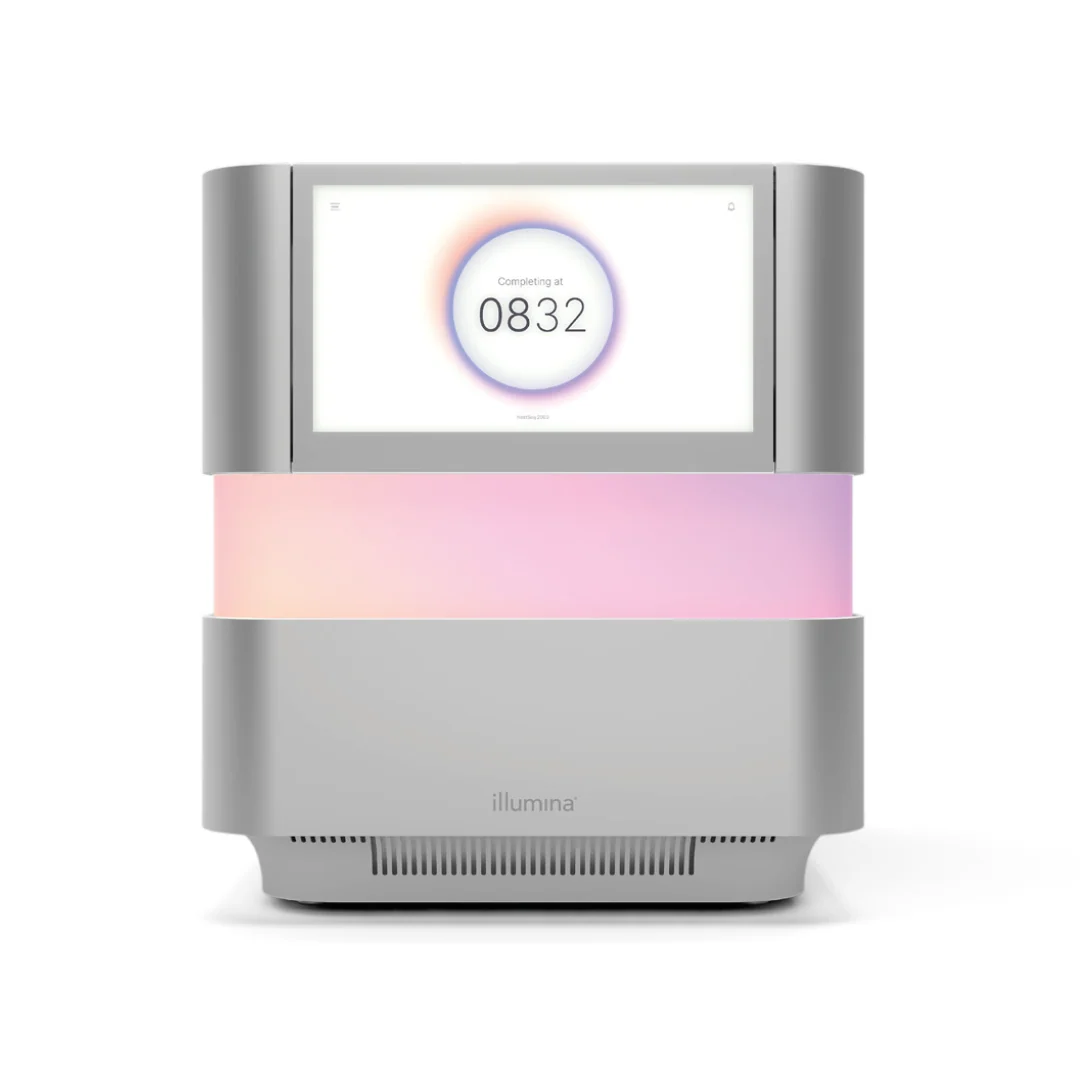
Illumina NextSeq 2000 Sequencing System
$30,000.00
Illumina NextSeq 2000 — The Illumina NextSeq 2000 is a self-contained benchtop next-generation sequencing system for laboratories that need scalable short-read output without moving to a floor-standing NovaSeq platform. Its defining advantage over the NextSeq 1000 is access to P3 and P4 flow cells in addition to P1 and P2, taking supported XLEAP-SBS output as high as 540 Gb at 2 × 150 bp and up to 1.8 billion single reads or 3.6 billion paired-end reads per P4 flow cell. This page is structured for buyers comparing Illumina NextSeq 2000 specifications, price, compatibility and the exact configuration required before a B2B order.
Explore Related
Related products, categories and research.
Illumina NextSeq 2000: premium buying summary
The Illumina NextSeq 2000 is a self-contained benchtop next-generation sequencing system for laboratories that need scalable short-read output without moving to a floor-standing NovaSeq platform. Its defining advantage over the NextSeq 1000 is access to P3 and P4 flow cells in addition to P1 and P2, taking supported XLEAP-SBS output as high as 540 Gb at 2 × 150 bp and up to 1.8 billion single reads or 3.6 billion paired-end reads per P4 flow cell.
Key Illumina NextSeq 2000 specification highlights
- P1, P2, P3 and P4 XLEAP-SBS flow-cell support; P3 and P4 are specific to the NextSeq 2000 within this pair.
- Output spans approximately 10 Gb to 540 Gb depending on flow cell and read length.
- Up to 1.8 billion single reads or 3.6 billion paired-end reads on P4.
- Integrated DRAGEN Bio-IT FPGA secondary analysis in a self-contained dry instrument.
- Instrument dimensions: 55 × 65 × 60 cm; instrument weight: 141 kg.
- 100–240 VAC, 50/60 Hz input; site planning should also account for network, data storage and reagent cold-chain requirements.
Illumina NextSeq 2000 product overview
The key to buying a NextSeq 2000 is matching the instrument to the actual assay mix rather than shopping by maximum output alone. P1 can be efficient for smaller projects and quality-control runs, P2 expands mid-throughput capacity, while P3 and P4 move the platform into substantially higher read counts. Illumina’s current XLEAP-SBS specifications show 2 × 150 bp output of 30 Gb on P1, 120 Gb on P2, 360 Gb on P3 and 540 Gb on P4. Laboratories that need 2 × 300 bp can use supported P1 or P2 workflows, while P3/P4 are designed around shorter high-throughput read configurations.
Illumina NextSeq 2000 price, cost and quotation considerations
The displayed NextSeq 2000 price should be evaluated together with the exact instrument condition, installation scope, flow-cell and reagent requirements, service coverage, data-analysis workflow and destination. Sequencing instruments create recurring consumables and informatics costs, so a procurement comparison should separate instrument acquisition cost from per-run consumables, library preparation, data storage, service and validation expenses.
Core features and capabilities
- Patterned flow-cell technology places clusters in fixed nanowell locations to support high cluster density.
- XLEAP-SBS chemistry supports faster chemistry and current P1/P2/P3/P4 workflows.
- Integrated DRAGEN FPGA analysis reduces dependence on a separate server for supported secondary-analysis pipelines.
- Lossless genomic compression is available on-instrument for supported workflows.
- P4 enables the highest throughput in the NextSeq 1000/2000 family, including up to 540 Gb at 2 × 150 bp.
- The platform can support research areas including exome sequencing, RNA-seq, small whole-genome sequencing, single-cell workflows and targeted sequencing when the library and read-length design are compatible.
Detailed Illumina NextSeq 2000 technical specifications
| Instrument configuration | Self-contained dry sequencer with integrated DRAGEN Bio-IT FPGA secondary analysis |
|---|---|
| Flow cells | P1, P2, P3, P4 with current XLEAP-SBS workflows |
| Maximum stated output | Up to 540 Gb per P4 flow cell at 2 × 150 bp |
| Reads passing filter | P1 100M; P2 400M; P3 1.2B; P4 1.8B single reads; paired-end values are double |
| Supported long paired read | Up to 2 × 300 bp on supported P1/P2 kits |
| Q30 reference | ≥90% for supported reads through 2 × 150 bp; ≥85% for 2 × 300 bp under Illumina reference conditions |
| Run-time range | Approximately 8 to 44 hours depending on flow cell/read length; 2 × 150 bp is ~17h P1, 22h P2, 40h P3, 44h P4 |
| Dimensions | 55 × 65 × 60 cm (W × D × H) |
| Weight | 141 kg; crated weight 232 kg |
| Crated dimensions | 92 × 120 × 118 cm |
| Power | 100–240 VAC, 50/60 Hz |
| Operating environment | 15–30°C; 20–80% RH non-condensing; 0–2000 m altitude; indoor use |
| Network guidance | Illumina specification sheet lists 200 MB/s for internal/BaseSpace uploads and 5 MB/s operational-data uploads |
| Research-use statement | For Research Use Only; not for use in diagnostic procedures unless specifically authorized for a separate use |
Performance and use-case information
For Search Console queries such as “nextseq 2000 specs,” the useful answer is the output matrix rather than a single headline number. A P4 2 × 150 bp run reaches 540 Gb, while P3 reaches 360 Gb, P2 120 Gb and P1 30 Gb. Illumina lists the corresponding single-read counts as 1.8B, 1.2B, 400M and 100M. Run time also changes with flow cell and cycle count, so throughput planning should be based on samples per run and weekly capacity, not only Gb per flow cell.
Compatibility, software, connectivity and site requirements
The NextSeq 2000 is a sequencing workflow, not just an instrument. Confirm library-preparation compatibility, index strategy, required cycle count, reagent storage, expected data volume, local or cloud analysis path, network bandwidth and downstream storage. XLEAP reagents require appropriate instrument software, and the laboratory should follow the current Illumina compatibility matrix rather than assuming every historical kit is interchangeable. The integrated DRAGEN engine can perform supported secondary analyses, but laboratories with custom pipelines should confirm file outputs, compute handoff and data-retention requirements.
Applications for Illumina NextSeq 2000
- Whole-exome sequencing
- mRNA and total RNA sequencing
- Single-cell RNA-seq
- Small whole-genome sequencing
- Targeted resequencing and enrichment panels
- Microbial/amplicon workflows
- Research oncology and translational genomics
Illumina NextSeq 2000 comparison with related models
The most important comparison is NextSeq 2000 versus NextSeq 1000. Both share the same 55 × 65 × 60 cm footprint, 141 kg instrument weight and integrated DRAGEN architecture. The practical difference is throughput range: NextSeq 1000 is limited to P1/P2, while NextSeq 2000 adds P3 and P4. If a laboratory expects regular demand above the P2 ceiling, the NextSeq 2000 provides substantially more headroom without moving to the much larger NovaSeq X Series. For very large population-scale programs, NovaSeq X or X Plus provides a different throughput class.
What is included with Illumina NextSeq 2000?
Do not assume a universal consumables bundle is included with the instrument. The purchase scope should state the sequencer, instrument computer/installed analysis components, installation services, accessories, starter consumables if any, UPS requirements, training, software/service entitlements and any flow cells or reagent kits. Consumables are recurring items and should be itemized separately.
Important limitations and buyer considerations
- P3 and P4 are available on NextSeq 2000, not NextSeq 1000.
- Maximum output figures depend on flow cell, read length and Illumina reference conditions.
- The 141 kg instrument requires proper bench/floor planning and delivery access.
- Sequencing quality and output depend on library quality, loading concentration and assay design.
- This research-use configuration must not be represented as a diagnostic system without the required regulatory basis.
- Service and warranty scope should be confirmed in the written quotation for the destination country.
Who should buy Illumina NextSeq 2000?
The Illumina NextSeq 2000 is best suited to genomics laboratories that need flexible mid-to-high throughput across different study sizes and want P3/P4 headroom while retaining a compact laboratory footprint. A lab that rarely exceeds P2 capacity may be better served by the NextSeq 1000, while very large sequencing programs should compare NovaSeq X Series economics.
Authoritative technical and manufacturer resources
For this sequencing system, verify the current Illumina reagent/software compatibility matrix and destination-specific service coverage before purchase.
Illumina NextSeq 2000 technical quick answers
What are the Illumina NextSeq 2000 specifications buyers search most often?
The most requested figures are up to 540 Gb on P4 at 2 × 150 bp, up to 1.8B single reads, 55 × 65 × 60 cm dimensions, 141 kg instrument weight and integrated DRAGEN analysis.
What is the the NextSeq 2000 system maximum output?
Illumina lists up to 540 Gb per P4 flow cell at 2 × 150 bp under its stated reference conditions.
How long does a NextSeq 2000 run take?
It depends on flow cell and read length; current XLEAP-SBS examples range from about 8 hours to 44 hours.
What is the difference between NextSeq 2000 and NextSeq 1000?
NextSeq 2000 supports P3 and P4 in addition to P1/P2, giving it a much higher maximum output ceiling.
Detailed FAQs
Can I buy the the NextSeq 2000 system without consumables?
The exact commercial package varies. Confirm whether reagents, flow cells, installation, training or service are included rather than assuming they ship with every instrument.
Does the the NextSeq 2000 system include DRAGEN?
Illumina describes the instrument as having integrated DRAGEN Bio-IT FPGA secondary analysis.
What power does the the NextSeq 2000 system require?
The current specification sheet lists 100–240 VAC at 50/60 Hz; site readiness must also cover networking, data storage and environmental limits.
Is the the NextSeq 2000 system for diagnostic use?
Illumina’s current specification sheet labels the platform For Research Use Only and not for use in diagnostic procedures unless a separate authorized configuration or use applies.
What should be confirmed before requesting a NextSeq 2000 quote?
Instrument condition/configuration, flow-cell strategy, software version, installation, service coverage, reagent logistics, destination requirements, training and exact supplied scope.
Relevant internal links
Request a B2B quotation
For a laboratory quotation, provide expected applications, annual sample volume, read length, destination and preferred flow-cell strategy so the supplied scope can be matched to the real sequencing workload.