Unitree G1 EDU Security Alert: CVE-2026-76639 & CVE-2026-76640 Explained
 AI Robot Supplier Editorial Desk Limited
•
Workstation Hardware Research
•
Updated August 31, 2026
•
10 min read
AI Robot Supplier Editorial Desk Limited
•
Workstation Hardware Research
•
Updated August 31, 2026
•
10 min read
Performance intelligence for workstation buyers.
AI Robot Supplier Research Desk | August 31, 2026 The Unitree G1 EDU vulnerability disclosure involving CVE-2026-76639 and CVE-2026-76640 raises important cybersecurity questions for current owners, universities, robotics laboratories and organizations considering a G1 EDU purchase. Both advisories affect certain Unitree G1 EDU firmware versions through…
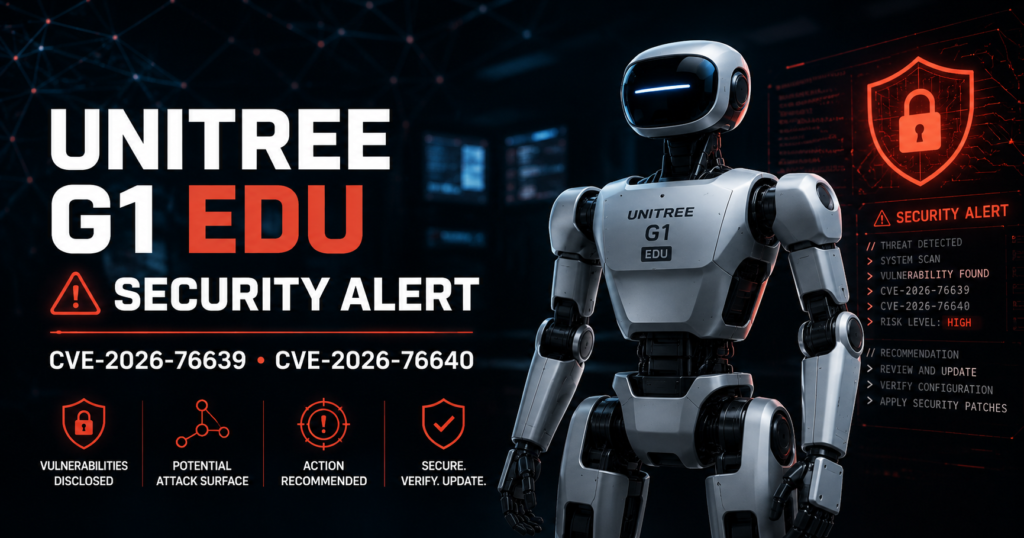
AI Robot Supplier Research Desk | August 31, 2026
The Unitree G1 EDU vulnerability disclosure involving CVE-2026-76639 and CVE-2026-76640 raises important cybersecurity questions for current owners, universities, robotics laboratories and organizations considering a G1 EDU purchase. Both advisories affect certain Unitree G1 EDU firmware versions through 1.5.2.
Key Takeaways
- Two vulnerabilities have been publicly disclosed affecting Unitree G1 EDU firmware through version 1.5.2.
- CVE-2026-76639 carries a CVSS 3.1 score of 8.8 (High).
- CVE-2026-76640 carries a CVSS 3.1 score of 7.5 (High).
- The advisories describe attack chains that could potentially result in root-level code execution under affected conditions.
- Organizations should verify their exact G1 EDU model, firmware version, network configuration and current Unitree security guidance.
- The published CVE records specifically identify the G1 EDU; buyers should not automatically assume that every Unitree G1 or other Unitree platform is affected.
Humanoid robots are moving rapidly from research demonstrations into universities, artificial-intelligence laboratories, development teams and commercial pilot programs. That transition creates a new requirement for buyers: evaluating a robot is no longer only about motors, sensors, artificial intelligence, manipulation and mobility.
Cybersecurity is becoming part of the robotics procurement specification.
Two recently published vulnerabilities affecting the Unitree G1 EDU illustrate why.
The vulnerabilities are tracked as CVE-2026-76639 and CVE-2026-76640 . The published records identify Unitree G1 EDU firmware through version 1.5.2 as affected.
The findings are particularly relevant because the G1 EDU is designed for environments where connectivity and software development are central to the robot’s purpose: universities, robotics laboratories, embodied-AI teams and organizations creating applications on top of humanoid hardware.
For organizations considering a Unitree G1 EDU, these findings should be treated neither as a reason for panic nor as something to ignore. They are a reminder that robot procurement increasingly requires a cybersecurity checklist alongside mechanical, AI and performance specifications.
What Happened?
Security researcher Olivier Laflamme disclosed two attack chains following research into the Unitree G1 platform.
The first vulnerability, CVE-2026-76639 , concerns an unauthenticated remote-code-execution chain involving services operating on affected G1 EDU systems.
Its published vulnerability record assigns it a CVSS 3.1 score of 8.8, rated High, and describes circumstances in which an adjacent-network attacker could potentially execute arbitrary commands with root privileges.
The second vulnerability, CVE-2026-76640 , concerns components associated with the robot’s Bluetooth Low Energy and Wi-Fi provisioning environment.
Its published record describes a vulnerability chain that could potentially permit an unauthenticated attacker within the required proximity to reach root-level code execution. It carries a CVSS 3.1 score of 7.5, rated High.
Readers looking for the researcher’s technical discussion can review Olivier Laflamme’s Unitree G1 security research .
Unitree G1 EDU Vulnerability: Security Advisory Summary
| Advisory | Affected Product | Published Affected Version | Severity |
|---|---|---|---|
| CVE-2026-76639 | Unitree G1 EDU | Firmware ≤ 1.5.2 | High — CVSS 8.8 |
| CVE-2026-76640 | Unitree G1 EDU | Firmware ≤ 1.5.2 | High — CVSS 7.5 |
The distinction between G1 EDU and the broader G1 family is important.
Although related Unitree products can share software components, software similarity alone should not be treated as proof that every Unitree robot is affected by these specific vulnerabilities.
Organizations should therefore rely on confirmed model and firmware information rather than assuming that every G1, H1, H2, R1 or other Unitree platform has the same exposure.
What Is CVE-2026-76639?
CVE-2026-76639 is the higher-scoring of the two newly published vulnerabilities.
The vulnerability record describes several weaknesses within the G1 EDU software environment that can potentially be chained together and permit an unauthenticated attacker with appropriate network proximity to execute commands with root privileges.
For procurement teams, one of the most important aspects is the privilege level involved.
Root access represents the highest administrative privilege on a Linux-based system. Successful compromise at this level could potentially provide extensive control over software operating on an affected computer.
That is already serious for conventional IT equipment. For a network-connected physical robot containing cameras, sensors, wireless communications, computing hardware and physical actuators, cybersecurity consequences deserve even greater consideration.
View the published vulnerability record: CVE-2026-76639 .
What Is CVE-2026-76640?
CVE-2026-76640 concerns another part of the robot’s connectivity architecture.
The advisory describes weaknesses involving Bluetooth Low Energy and Wi-Fi provisioning, with the potential attack originating from physical or wireless proximity rather than requiring normal authenticated access.
The vulnerability record says affected G1 EDU systems through firmware 1.5.2 could potentially be exposed to root-level code execution through the described vulnerability chain.
This is particularly relevant for robotics laboratories, universities, trade shows and public demonstrations.
Robots in these environments may routinely operate near students, visitors, researchers, contractors and other third parties. Security assumptions appropriate for equipment isolated inside a locked server room may therefore be inadequate for mobile humanoid platforms.
View the published vulnerability record: CVE-2026-76640 .
Has Unitree Responded?
The original researcher’s account provides important context.
According to Laflamme, Unitree’s security team engaged during the disclosure process and worked on remediation for the reported issues.
His account also indicates that Unitree introduced an account-to-robot ownership verification mechanism addressing part of an earlier cloud-related attack chain.
That is a positive security-response signal.
However, buyers should distinguish between internal remediation and a publicly verified firmware release that can be independently confirmed for a particular robot.
Organizations operating G1 EDU robots should therefore verify the latest security and firmware information directly through the Unitree Security Center or through their authorized procurement/support channel.
What Should Existing Unitree G1 EDU Owners Do?
Organizations already operating G1 EDU systems should approach the disclosure as part of normal vulnerability and asset-management procedures.
1. Identify the Exact Robot Configuration
Record the exact G1 EDU model, hardware configuration and software environment.
2. Check the Installed Firmware Version
If a system is operating firmware version 1.5.2 or earlier, administrators should review current Unitree security guidance and determine whether an updated firmware release is available for their configuration.
3. Review Network Access
A research humanoid should not automatically receive unrestricted access to sensitive university, laboratory or corporate infrastructure merely because network connectivity is needed.
4. Consider Network Segmentation
Connected robotics equipment can be placed on appropriately segmented networks based on operational requirements and organizational security policies.
5. Review Wireless Interfaces
Determine whether Bluetooth, Wi-Fi and other wireless interfaces are required for the deployment and configure them appropriately.
6. Maintain a Firmware Inventory
Organizations deploying multiple robots should maintain records of firmware versions, update dates and security advisories in the same way they would for other network-connected equipment.
Unitree G1 EDU Vulnerability: What Buyers Should Ask Before Purchasing
The disclosure changes an important part of the humanoid robot buying conversation.
Traditional procurement comparisons often concentrate on payload, degrees of freedom, compute capability, battery life, dexterous hands, SDK support and ROS integration.
Cybersecurity questions should now sit alongside those specifications.
Humanoid Robot Cybersecurity Procurement Checklist
-
Which firmware version will be delivered?
Ask for the current configuration and verify it during commissioning. -
What security updates are currently available?
Obtain current manufacturer guidance rather than relying solely on an older specification sheet. -
How are firmware updates delivered?
Understand the update process and who is responsible for applying updates. -
Which wireless interfaces are enabled?
Bluetooth, Wi-Fi and other communications interfaces should be documented. -
Does the robot require unrestricted internet access?
Network permissions should reflect actual operational requirements. -
What is the post-sale security-support process?
Establish the respective responsibilities of the manufacturer, supplier and customer’s IT or robotics team.
Unitree G1 EDU Configurations for Research and Development
Organizations comparing Unitree platforms can review current research-oriented configurations available through AI Robot Supplier.
Unitree G1 EDU Ultimate E U7 Humanoid Robot
The G1 EDU Ultimate E U7 is positioned for research, embodied-AI development, educational robotics and advanced humanoid experimentation.
View Unitree G1 EDU Ultimate E U7 specifications and availability →
Unitree G1 EDU Ultimate C U5 with Five-Finger Hands
Organizations requiring more advanced manipulation capabilities can also compare the G1 EDU Ultimate C U5 configuration with five-finger dexterous hands and onboard development compute.
View Unitree G1 EDU Ultimate C U5 specifications and availability →
Why This Matters Beyond Unitree
The larger story is not simply that researchers discovered vulnerabilities in one humanoid robot.
The larger issue is that robots are becoming powerful network-connected computers that move through the physical world.
Modern humanoids can combine:
- Linux-based operating environments
- AI accelerators and GPU computing
- RGB and depth cameras
- LiDAR and other sensors
- Microphones and audio systems
- Bluetooth and Wi-Fi
- Cloud-connected services
- APIs and SDKs
- ROS and robotics middleware
- Physical actuators and locomotion systems
As humanoid deployment grows, robotics cybersecurity is likely to increasingly overlap with:
- IoT security
- operational technology security
- endpoint security
- cloud security
- AI security
- wireless security
- and physical safety engineering
Security documentation, software lifecycle policies and update support may therefore become important competitive factors when organizations compare commercial humanoid platforms.
The Unitree G1 EDU Remains an Important Humanoid Development Platform
A responsible vulnerability disclosure does not erase the technical reasons the G1 EDU has attracted interest from robotics developers.
The platform is designed particularly for education, robotics research, embodied-AI development and humanoid experimentation.
AI Robot Supplier currently provides procurement information for multiple configurations, including the Unitree G1 EDU Ultimate E U7 and the Unitree G1 EDU Ultimate C U5 .
Organizations researching Unitree’s broader commercial direction can also read:
Unitree Robotics IPO 2026: G1, H1, H2 & R1 Explained
Buyers comparing Unitree with other humanoid platforms can also review:
Best Humanoid Robots for Warehouses & Factories
The security disclosures reinforce an increasingly important procurement principle:
Robot capability and robot cybersecurity should be evaluated together.
Is the Regular Unitree G1 Affected?
This is one of the most important questions arising from the disclosures.
Based on the currently published vulnerability records, the confirmed affected product is Unitree G1 EDU running firmware through version 1.5.2.
The underlying research involved the G1 platform and potentially shared software components. However, sharing software components does not prove that every Unitree robot has the same vulnerability.
AI Robot Supplier therefore recommends checking the exact model, firmware version and current manufacturer guidance rather than applying the advisory indiscriminately to every Unitree robot.
AI Robot Supplier Perspective
The humanoid robotics market is entering a stage where professional procurement decisions require more than comparing hardware specifications.
Universities, AI laboratories, integrators and businesses purchasing programmable humanoids should increasingly evaluate:
- firmware lifecycle management;
- manufacturer security support;
- network architecture;
- wireless interfaces;
- software update procedures;
- access-control requirements;
- and post-deployment vulnerability management.
AI Robot Supplier will continue monitoring the Unitree security advisories and update this report if additional confirmed information becomes available regarding remediation for CVE-2026-76639 and CVE-2026-76640.
Frequently Asked Questions
Is CVE-2026-76639 serious?
Yes. The published vulnerability record assigns CVE-2026-76639 a CVSS 3.1 score of 8.8, rated High, and describes the potential for unauthenticated root-level code execution from an adjacent network under affected conditions.
Is CVE-2026-76640 a Bluetooth vulnerability?
Bluetooth Low Energy is an important component of the attack surface described by CVE-2026-76640. The published advisory concerns a chain involving BLE and Wi-Fi provisioning components.
Which Unitree G1 EDU firmware versions are affected?
The currently published CVE records identify G1 EDU firmware through version 1.5.2 as affected.
Has Unitree fixed the vulnerabilities?
The security researcher reports that Unitree worked on remediation for the reported issues. Organizations should nevertheless verify the latest publicly available firmware and security guidance directly with Unitree before assuming that a particular deployed system has been remediated.
Check the Unitree Security Center →
Should organizations stop buying the Unitree G1 EDU?
A vulnerability disclosure alone does not determine whether a platform is suitable for an organization. Professional buyers should evaluate current firmware, manufacturer remediation, intended deployment, network architecture, security policies and ongoing technical support.
Where can I compare Unitree G1 EDU configurations?
AI Robot Supplier provides detailed procurement information for several Unitree G1 EDU configurations, including:
 ZOTAC GAMING GeForce RTX 5090 AMP Extreme INFINITY
 PNY GeForce RTX 5070 Ti 16GB ARGB EPIC-X RGB Overclocked Triple Fan
 NVIDIA GeForce RTX 3090 Founders Edition 24GB
 Sapphire NITRO+ Radeon RX 7800 XT 16GB