Humanoid Machine Tending: What Mitsubishi’s CNC Announcement Means
 airobot_admin
•
Robotics Research
•
Updated October 25, 2026
•
13 min read
Automation intelligence for serious technology buyers.
Manufacturing robotics / October 2026 analysis Humanoid machine tending: move from the announcement to a testable factory task Humanoid machine tending is receiving fresh attention after Mitsubishi Electric announced a system connecting humanoid robots and CNC machine tools through physical AI. The development raises a practical…
Manufacturing robotics / October 2026 analysis
Humanoid machine tending: move from the announcement to a testable factory task
Humanoid machine tending is receiving fresh attention after Mitsubishi Electric announced a system connecting humanoid robots and CNC machine tools through physical AI. The development raises a practical question for manufacturers: which tasks need a humanoid, and which can already be addressed by an integrated robot arm?
This guide examines the announcement, compares equipment approaches and explains eight checks before purchasing a research platform or commissioning a production application.
Read the news analysis Discuss your manufacturing taskWhat Mitsubishi announced about humanoid machine tending
On 21 October 2026, Mitsubishi Electric announced a machining system combining an AI task planner, a CNC machine tool equipped with physical AI and a general-purpose humanoid robot.
The company described coordination using natural-language information and identified tasks including setup, cleaning, finished-part transport, inspection and troubleshooting. It stated that a demonstration was planned at JIMTOF 2026 from 26 October.
Read Mitsubishi Electric’s official announcement.
As of this article’s research date, that demonstration was still scheduled. The announcement should be assessed as a manufacturer-described development, with commercial scope and application evidence confirmed separately.
For buyers, humanoid machine tending creates an opportunity to reconsider tasks around existing machines. It does not establish that a catalogue humanoid automatically includes the announced planning system, CNC interface or validated manufacturing workflow.
Start with your current process
Send the machine type, workpiece range, operator task sequence and current bottleneck. Ask for a practical comparison of research platforms, robot arms and integration requirements.
Request robotics application guidanceCNC automation: separate machining from material handling
CNC automation involves more than moving a workpiece into a machine. A project can include part presentation, identification, loading, process coordination, unloading, inspection and routing the finished component.
A humanoid machine tending proposal should identify which of those activities is included. If the robot handles only loading and unloading, the remaining operator tasks still belong in the staffing and operating model.
Map the current process before selecting hardware. Record what the operator checks, which decisions depend on experience and which exceptions interrupt the normal sequence. This helps distinguish repetitive transfers from tasks requiring additional perception or planning.
Keep machining performance and handling performance separate in the acceptance criteria. A correctly transferred part can still be unsuitable if the wrong job was selected or inspection was incomplete. Conversely, a handling delay should not automatically be attributed to the machining process.
The useful purchase specification describes completed, acceptable work and assigns responsibility for each stage. A robot demonstration is only one part of that evidence.
Humanoid robots: decide whether the body solves a real constraint
Humanoid robots may be relevant when a project needs to investigate interaction with spaces, tools or task sequences designed around people. The proposed body and hands still need to be evaluated against the actual work.
For humanoid machine tending, identify the constraint that makes the chosen form useful. It might concern access to several work areas, manipulating particular objects or studying a sequence of different tasks. Define that purpose before comparing general demonstrations.
Check reach, useful hand configuration, payload, development access and operating environment for the exact supplied model. A platform appropriate for education or manipulation research is not automatically suitable for a production machining environment.
Research objective
A laboratory may need access to observations, control interfaces and repeatable tasks. Its first milestone can be a bounded experiment with a small set of parts.
Production objective
A factory needs a supported application that meets agreed output, quality, operating and recovery requirements. Define who owns that integrated result.
Keep these objectives separate when requesting quotations. The equipment and engineering needed to answer a research question can differ substantially from a commissioned production system.
Robotic machine tending: compare established arm-based options
Robotic machine tending already includes arm-based applications for loading, unloading and part handling. These provide a useful comparison when deciding whether the proposed task requires a humanoid platform.
Universal Robots describes machine-tending applications and associated tooling on its official application page. ABB also presents integrated and configurable approaches on its machine-tending page.
For humanoid machine tending studies, compare both approaches against the same task definition. The comparison should include the required part range, access, changeovers, machine interfaces and remaining human work.
| Approach | Relevant evaluation | Commercial check |
|---|---|---|
| Robot arm and application tooling | A defined loading, unloading or handling task. | Robot, tool, fixtures, machine integration and commissioning. |
| Humanoid research platform | Development of a bounded manipulation or task-coordination experiment. | Development interfaces, supplied hands, software access and engineering scope. |
| Integrated production system | The complete process under agreed operating conditions. | Acceptance criteria, service ownership, training and supported configuration. |
An interesting new capability and an appropriate first purchase are not necessarily the same decision. Select the approach that answers the task and provides evidence the project team can assess.
Physical AI manufacturing: connect instructions to verified outcomes
Physical AI manufacturing brings planning and physical action into the same workflow. For a buyer, the key question is how an instruction becomes a valid, observable task with a defined completion condition.
A humanoid machine tending proposal should explain how work is identified, which machine and robot states are used and how the system confirms completion. The interface and acceptance requirements remain important even when the operator interaction uses natural language.
Ask for examples of ambiguous requests, unavailable equipment and incomplete information. Define when the application asks for clarification or assistance rather than proceeding with an uncertain interpretation.
Keep the engineering discussion grounded in the actual production record. The team should be able to identify which workpiece was handled, which task was attempted and what result was recorded.
Specify the boundary between planning software and machine control. A supplier should identify the supported integration route and the party responsible for validating the complete installation.
Machine interfaces can determine the humanoid machine tending scope
Begin with the exact CNC machine, controller, software and available integration options. Similar-looking machines may require different engineering, and a demonstration on one machine does not establish compatibility with another.
For humanoid machine tending, ask who owns the robot-to-machine interface and how its behaviour is documented. Include ordinary states such as ready, busy, complete, paused and faulted in the specification discussion.
Agree what the application does when information is missing or contradictory. The project needs an understandable recovery process, with machine and robot manufacturers involved where their systems require it.
Record responsibilities across the machine supplier, robot supplier and integrator. Otherwise, an interface fault can leave each party reporting that its own component is working while the overall process remains unavailable.
Request interface validation as a deliverable. A communication connection alone does not demonstrate that the integrated task is complete, repeatable or supported.
Workpiece presentation and gripping need their own evidence
Supply the actual raw and finished parts for an assessment. Include dimensions, mass, surface condition, fragility and any variation between batches. Identify the features that can be used for gripping and the surfaces that must remain unmarked.
A humanoid machine tending trial should examine the difficult examples as well as the most convenient part. Oily surfaces, awkward geometry or a changing centre of gravity can affect a transfer even when the nominal mass remains unchanged.
Confirm the supplied hands or grippers rather than selecting from the appearance of the robot. A platform with non-actuated hands, different fingertips or limited development access may not support the experiment the buyer has in mind.
For arm-based systems, include the complete tool and workpiece in the load assessment. Ask how the proposed tooling affects access, orientation and changeover work.
Define where parts are presented and how successful placement is established. Consistent staging can be an important part of the solution and should appear in the quotation where required.
Research humanoids are separate from a complete factory solution
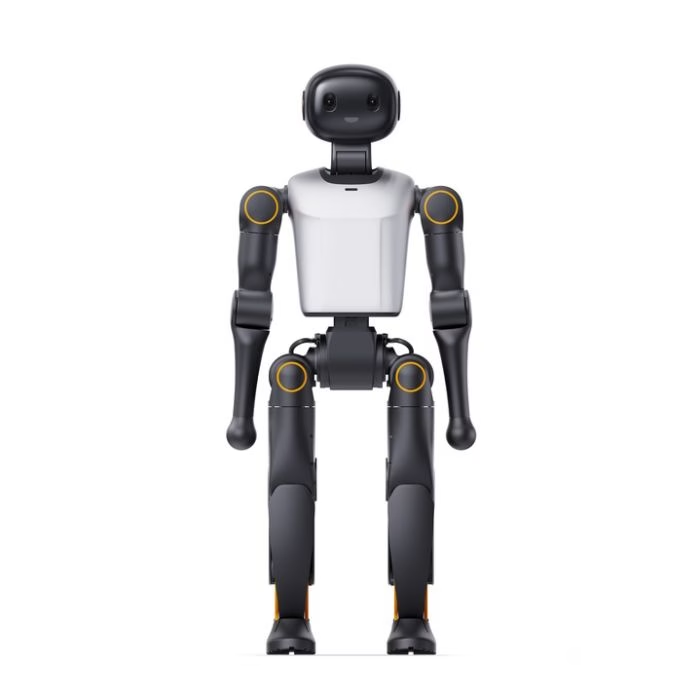
The Booster K1 EDU is a research and education platform to assess against its own documentation and development scope. It is not presented here as the robot in Mitsubishi Electric’s announcement.
Likewise, the Unitree G1 EDU Plus configuration needs an exact assessment of hands, interfaces and intended tasks. Its commercial name alone does not establish suitability for a particular grasp or machine interaction.
For humanoid machine tending research, write the first experiment before ordering. Specify the object, required movement, observations, control access and pass condition. This makes missing accessories or software capabilities easier to identify.
Budget separately for fixtures, perception, integration and engineering. A research platform purchase does not automatically include a validated manufacturing application or the support commitments of a commissioned production cell.
8 essential humanoid machine tending checks for success
- Define the included tasks. Separate handling, inspection, cleaning, setup and exception work.
- Identify the exact machine. Record the CNC model, controller, software and supported integration route.
- Check the robot configuration. Confirm reach, load, hands or grippers, development interfaces and environment.
- Validate representative parts. Include difficult surfaces, awkward geometry and production variation.
- Assign interface ownership. Define responsibility for machine states, task coordination and recorded outcomes.
- Plan the complete installation. Include fixtures, access, services and application-specific safeguarding assessment.
- Agree acceptance and recovery. Measure acceptable completed work and the human effort needed for exceptions.
- Price lifecycle support. Include commissioning, training, spares, software maintenance and change validation.
These checks make a humanoid machine tending proposal reviewable before a purchase. Use the same requirements across competing approaches so differences in scope and evidence remain visible.
Request an equipment and integration shortlist
Provide the task sequence, machine details, part samples, current layout and target outcome. Ask which assumptions need a feasibility test before a complete system can be specified.
Discuss machine-tending equipmentAcceptance testing for CNC automation
CNC automation should be evaluated using representative work, agreed quality criteria and clear definitions of completion. Counting transfers alone can miss incorrect part routing, failed inspection or additional operator preparation.
A humanoid machine tending acceptance plan should include normal operation, changeovers and representative exceptions. Keep the current manual or automated baseline so the team can evaluate what changed.
| Test area | Include | Record |
|---|---|---|
| Part handling | Actual raw and finished components. | Successful transfers, marking, drops and manual preparation. |
| Task coordination | Machine and robot handovers. | Waiting conditions, faults and incomplete tasks. |
| Quality | The required inspection and routing process. | Accepted parts, rejected parts and traceability gaps. |
| Changeovers | Representative part and job changes. | Adjustment, validation and restart effort. |
| Recovery | Agreed interruption scenarios. | Operator involvement, recovery time and required skills. |
Agree the operating window and permitted exclusions before the run. Retain the robot, tooling, software and machine configuration with the results so that later changes can be evaluated against the same reference.
Keep technical performance and commercial acceptance aligned. If the process relies on human help for a particular exception, that support should remain visible in the agreed result.
Evaluate quality and traceability alongside humanoid machine tending speed
A fast transfer has little value if the part cannot be associated with the correct work order or inspection result. Define the record that identifies each completed task and the route for an uncertain outcome.
For humanoid machine tending, ask which information is retained when the application pauses or a job is interrupted. The team needs to know what was attempted, what was confirmed and what still requires review.
Separate task failure from product rejection. A component may be handled correctly but fail inspection, while another may require manual review because the handling result is uncertain. Those events should not be combined into one unexplained success percentage.
Request reports that production staff can use. A detailed engineering log can support diagnosis, but operators also need a clear indication of the current state and the next authorised action.
Compare the installed cost of robotic machine tending
Robotic machine tending proposals can include very different supplied scopes. An arm-only price, a research humanoid and a commissioned production application should be compared only after their included equipment and engineering are understood.
The installed scope may include tooling, staging, fixtures, perception, machine integration, application-specific safeguarding, commissioning and training. Ongoing software and support requirements can also affect the decision.
A humanoid machine tending business case should start with the work the proposed application can reliably complete. Include remaining operator duties, changeovers, recovery, inspection and maintenance rather than treating every scheduled hour as productive output.
Stage the commitment where evidence is incomplete. A part-handling trial, interface review and bounded integrated demonstration can answer different questions before the project expands.
Ask for responsibility and documentation as well as hardware. The customer should understand who maintains the application and how changes to parts, software or equipment are validated.
Internal equipment links for humanoid machine tending enquiries
These AI Robot Supplier products support separate equipment discussions. They are not presented as components of Mitsubishi Electric’s announced system or as a prevalidated bundle.
- Booster K1 EDU humanoid robot for configuration-specific education and research enquiries.
- Unitree G1 EDU Plus humanoid robot for an independently assessed development project.
- RealMan DAP-D-65 development platform for a separately scoped manipulation research environment.
- Universal Robots UR20 collaborative robot for an application-specific arm and tooling assessment.
- Universal Robots UR30 collaborative robot for a separately checked load and working-envelope requirement.
- ABB GoFa CRB 15000 collaborative robot with the exact variant, controller and integration scope confirmed.
For humanoid machine tending enquiries, provide the machine, workpiece, task sequence, delivery country and target date. Request written confirmation of supplied equipment, compatibility assumptions and support responsibilities.
Humanoid machine tending frequently asked questions
What is humanoid machine tending?
It is the use of a humanoid platform within a defined machine-related workflow. The included tasks can vary, so specify handling, inspection, coordination and exception responsibilities rather than assuming the robot performs every operator activity.
What did Mitsubishi Electric announce?
The company described a machining system connecting an AI task planner, a CNC machine tool and a general-purpose humanoid. Its official release is the source for the announced scope; equipment availability and application evidence require separate confirmation.
Has the JIMTOF demonstration already taken place?
As of the research date, 25 October 2026, Mitsubishi Electric’s release described a demonstration scheduled from 26 October. This article does not claim to have attended or independently tested that demonstration.
Can any humanoid robot tend a CNC machine?
No universal capability is implied. Assess the exact robot, hands, interfaces, environment and task. A research-platform listing does not establish a complete machine interface or a validated production application.
When should I compare a cobot with humanoid robots?
Compare them when both are proposed approaches to the same task. Use identical part, access, quality, integration and operating requirements. A bounded transfer task and a broader research objective may lead to different equipment choices.
Does natural-language control remove integration work?
The proposed operator interface does not eliminate the need to confirm supported machines, robot interfaces, task states and acceptance criteria. Ask the supplier to identify which integration is delivered and which conditions remain to be validated.
Is a humanoid research platform a production solution?
A research platform and a commissioned production application have different scopes. Confirm development access, accessories and engineering for research, then define separate evidence and support requirements for any production deployment.
What should a CNC automation trial measure?
Measure acceptable completed work, handling quality, task coordination, changeovers and recovery. Include remaining human work and retain the exact hardware and software configuration used in the test.
How much does humanoid machine tending cost?
Request an itemised application-specific proposal. Include robot hardware, tooling, fixtures, machine integration, commissioning, training and ongoing support. This article supplies no unverified installed price or performance promise.
What should I send with a machine-tending enquiry?
Provide the CNC machine and controller, representative parts, task sequence, layout, current bottleneck and required outcome. Include the delivery country, target date and whether the objective is research or production.
Official humanoid machine tending and CNC automation sources
- Mitsubishi Electric’s 21 October 2026 humanoid and CNC announcement .
- Universal Robots machine-tending application information .
- Universal Robots’ WST Fab machine-tending case study .
- ABB machine-tending applications and system approaches .
- ABB GoFa official product information .
Research checked on 25 October 2026. Manufacturer announcements are attributed to official sources. Planning examples are not claimed hands-on tests, completed deployments or guarantees of compatibility.
Turn the announcement into a defined project
Plan your humanoid machine tending assessment
Send the machine details, part range and task sequence. Ask AI Robot Supplier to discuss research platforms, robot-arm options and the equipment scope that needs validation.
 JAKA Zu 7 Collaborative Robot
 JAKA Zu 12 Collaborative Robot
 JAKA Pro 16 Collaborative Robot
 JAKA Zu 3 Collaborative Robot