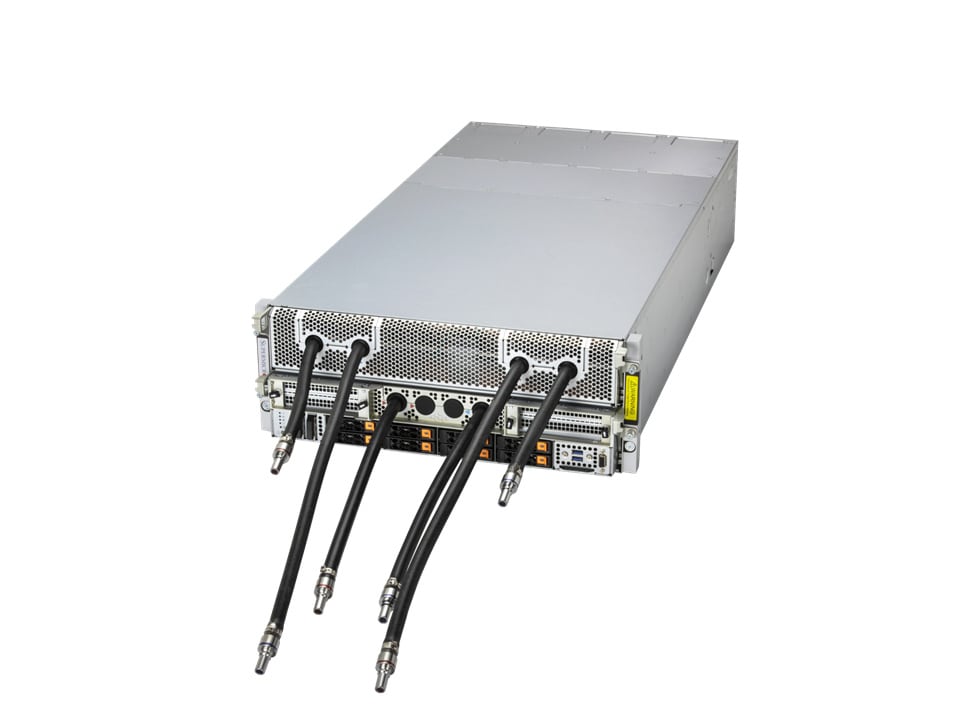
Supermicro AS-4126GS-NMR-LCC-G1 4U GPU Server
$179,032.68
Supermicro AS-4126GS-NMR-LCC-G1 is a 4U liquid-cooled Gold Series server. Supermicro’s published G1 build uses eight MI325X GPUs and dual EPYC 9575F processors. The base family’s MI355X support does not establish a MI355X G1 configuration. Confirm the offered bill of materials and liquid-cooling installation scope.
Explore Related
Related products, categories and research.
AS-4126GS-NMR-LCC-G1 is Supermicro’s 4U liquid-cooled Gold Series configuration for AMD accelerator workloads. The manufacturer brochure names an eight-GPU MI325X build with dual EPYC 9575F processors. That specific bundle should be distinguished from the broader base platform, which also lists a newer accelerator option.
AS-4126GS-NMR-LCC-G1 reference configuration
| Chassis class | 4U rackmount with direct-to-chip liquid cooling |
|---|---|
| Reference CPUs | Two AMD EPYC 9575F processors |
| Reference GPUs | Eight AMD Instinct MI325X accelerators |
| Host memory | 2.3TB DDR5-6400 in the Gold Series brochure; actual installed modules and operating rate require confirmation |
| Boot storage | One 480GB M.2 NVMe device in the G1 brochure |
| Reference networking | Eight single-port 400GbE QSFP112 connections plus dual 10GbE RJ45 |
| Power supplies | Four 6600W Titanium units in the brochure |
These are manufacturer reference-build details. They are not an independently inspected inventory of the offered unit. Match the manufacturer configuration code and complete component list before treating any installed quantity as confirmed.
G1 bundle versus base-family options
The base AS-4126GS-NMR-LCC platform lists MI325X and MI355X support. The Gold Series brochure specifically identifies the former for this G1 bundle. A base-family capability should not silently replace the named bundle’s accelerator generation.
Obtain the exact GPU assembly and module part numbers, CPU models and DIMM population. Keep the full G1 identifier on the configuration record. Similar chassis names do not establish identical accelerator memory, thermal requirements or supplied components.
The base platform’s upper limits describe possible supported configurations. They do not establish the installed CPU core count or host-memory capacity of this particular offer. A family maximum and a reference bundle are different kinds of information.
Direct Liquid Cooling and installation scope
Supermicro identifies direct-to-chip cold plates for the platform and states that onsite service is required for liquid cooling. That manufacturer requirement is not a promise that installation service, a cooling distribution unit or facility connections are included in this offer.
Define the boundary between server-side cooling hardware and the facility loop. Confirm the required coolant specification, supply conditions, flow and pressure limits, connectors and commissioning procedure against the applicable installation documentation. Do not infer those values from the 4U size or GPU count.
List included hoses, fittings and any manifold or distribution equipment separately. Agree on who supplies, installs and commissions each part of the cooling path. Record the applicable maintenance and leak-response procedures with the system handoff.
Liquid cooling does not remove every airflow requirement. The base platform also includes fans for components served by air. Plan rack airflow and service access alongside the liquid connections rather than treating a cold-plate system as independent of room cooling.
Processor and host-memory planning
The reference processors belong to the EPYC 9005 generation. The underlying H14DSG-OD platform also lists EPYC 9004 support, but that does not change the specific CPU selection in the published G1 build.
The base system has 24 DIMM slots. Its documented one-DIMM-per-channel maximum is up to 6TB, with up to 6400MT/s for the newer CPU generation or 4800MT/s for the preceding generation. Those limits should not be advertised as installed G1 capacity.
Request module part numbers and the populated memory map. Host memory supports the operating system, data preparation, caching and orchestration. It should be sized separately from accelerator memory and checked against the actual workload pipeline.
GPU communication and workload suitability
Infinity Fabric links connect the accelerator subsystem, while PCIe Gen5 x16 connections serve CPU-to-GPU transfers. The internal fabric and the external network have different roles. Keep both topologies visible when planning a multi-server installation.
For model inference, specify numerical format, context length and concurrency. For training, add optimizer state, checkpoint behavior and the intended parallelism strategy. Those requirements determine how memory and communication resources are used across the accelerators.
A GPU count or peak interface rate is not a measurement of application throughput. Validate the intended software stack and application on the actual configuration. No benchmark, hands-on test or guaranteed model capacity is asserted for this offered system.
Storage and network connections
The brochure’s single M.2 device describes boot storage, not a large training-data tier or a redundant boot mirror. Confirm how the operating system, application files, datasets and checkpoints will be stored and recovered.
The base platform provides eight front 2.5-inch NVMe bays and two M.2 positions. Available bays do not establish included drives. Verify drive part numbers, controllers, cabling and usable capacity for any proposed storage additions.
The published 400GbE QSFP112 arrangement requires matching switches and link components. Specify adapter models, firmware, port mode, optics or cables and link reach. Connector type and nominal rate do not establish that the required connection components are included.
Rack fit, power and commissioning
The base enclosure measures approximately 174mm high, 449mm wide and 895.35mm deep. Check mounting, handling, cable bend clearance and cooling-hose routing against the complete rack plan. Four rack units alone do not establish a suitable installation location.
The base power arrangement is four supplies in a 2+2 configuration, with full redundancy dependent on configuration and application load. Evaluate the actual build and input requirements against the facility design. Adding supply nameplate ratings does not give normal operating consumption.
Keep firmware, operating-system, accelerator runtime and framework versions with the final configuration record. Commissioning should distinguish host boot, accelerator discovery, local communication and the intended application run. Preserve actual results rather than substituting reference specifications for acceptance evidence.
Questions before purchase
Does G1 mean any supported accelerator can be assumed installed?
No. The published G1 reference is an MI325X build. Any different supplied accelerator configuration needs explicit component evidence.
Are software licenses, cooling installation and accessories included?
Those items are not established by the model name. Document licenses, condition, package contents and installation or support responsibilities separately.
Manufacturer references
Consult the Gold Series configuration brochure, base platform specifications and system manual. Compare related Networking & AI Infrastructure for the wider deployment.
Related products
Recently viewed
Add AI Robot Supplier as a preferred source on Google.