Best fit: ready-to-use R1
Choose the standard R1 when your priority is humanoid mobility, demonstrations, interaction and platform evaluation rather than custom secondary development.
$5,994.00
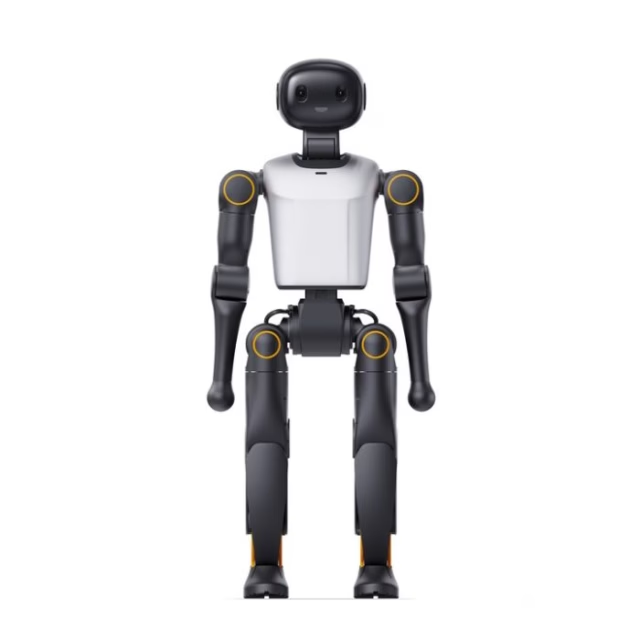
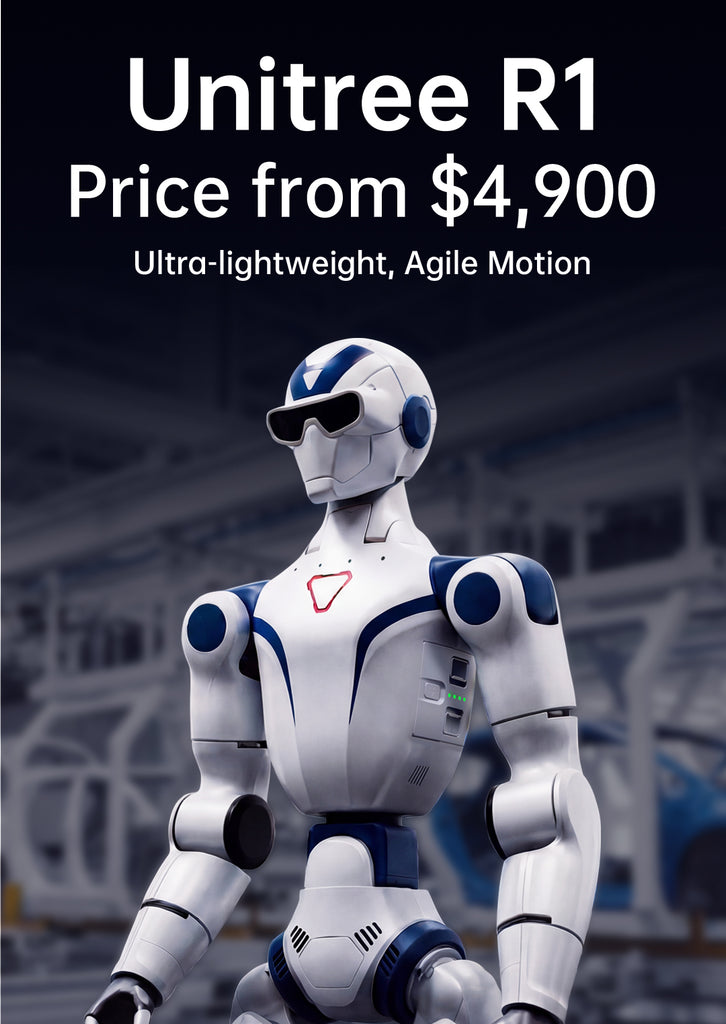
Unitree R1 Basic Humanoid Robot — Unitree R1 Humanoid Robot (R1 / R1 Basic) is the current standard 26-DOF R1 platform: approximately 1.23 m tall, about 29 kg with battery, with binocular vision, an 8-core processor, Wi-Fi 6, Bluetooth 5.2 and roughly one hour of runtime. It is the R1 configuration for buyers who want an agile, ready-to-use humanoid robot without the secondary-development package of the R1 EDU line. Manufacturer model / part number: R1-Basic. Looking for a Unitree R1 for sale ? Use this page to compare the current Unitree R1 price, specifications, standard-versus-EDU differences and international ordering options before purchase.
Related products, categories and research.
Unitree R1 Basic Humanoid Robot is the standard 26-DOF R1 configuration for buyers seeking a compact Unitree humanoid for demonstrations, education, interaction and platform evaluation. This page separates the standard R1 from R1 Air and R1 EDU, with verified mechanical specifications, compute limitations, battery information, included-system guidance and model comparisons.
The Unitree R1 humanoid robot is the standard model in Unitree’s compact R1 family. It stands 1,230 mm tall, weighs about 29 kg with battery and uses 26 actuated body joints: six per leg, five per arm, two at the waist and two at the head. That combination gives the R1 a noticeably more articulated upper body than the lower-cost R1 Air while keeping the platform small enough for laboratories, exhibitions, classrooms and controlled indoor demonstrations.
You may also see the standard model described as R1 Basic by distributors. Unitree’s current manufacturer page names the three main configurations R1 Air, R1 and R1 EDU. This listing therefore uses “R1 / R1 Basic” to help buyers match both naming conventions without confusing the standard 26-DOF robot with R1 Air or an EDU development model.
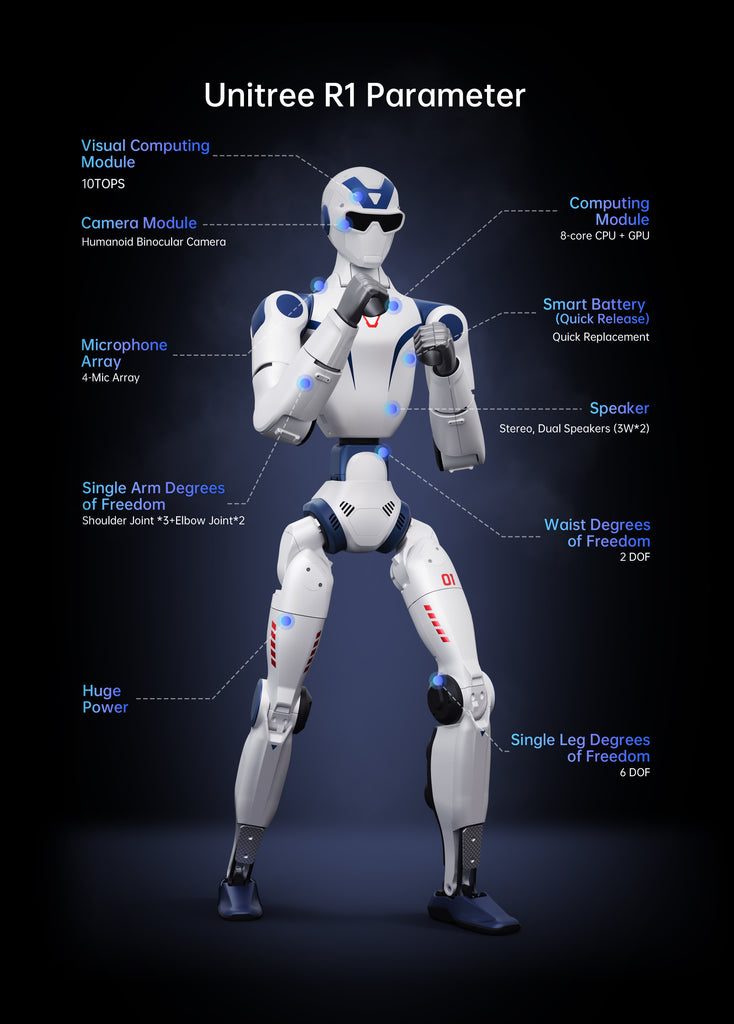
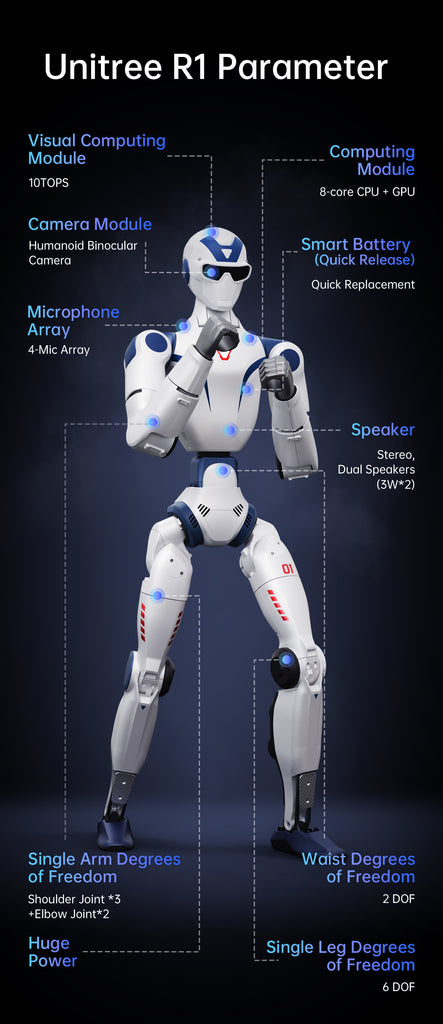
The R1 is built first around mobility, interaction and whole-body humanoid movement. Its binocular camera provides visual input, while a four-microphone array and speaker support audio interaction. Wireless connectivity includes Wi-Fi 6 and Bluetooth 5.2. The core computer is an 8-core high-performance processor.
The important limitation is development access. The standard R1 does not include the secondary-development support offered on R1 EDU. If your project requires custom SDK workflows, higher-performance NVIDIA Jetson compute, ROS-oriented integration or dexterous-hand research, compare this model with R1 EDU Standard U1, R1 EDU Smart U2 and R1 EDU Pro A U3.
For buyers searching “buy Unitree R1” or “Unitree R1 for sale,” that distinction matters more than simply comparing headline price. The lowest-cost configuration is not automatically the right one if your intended work depends on software access or manipulation hardware.
The current Unitree R1 price for this listing is displayed above by WooCommerce. Unitree’s own product page publishes manufacturer reference pricing before tax and shipping; destination freight, import charges, accessories and selected configuration can change the final landed cost.
Choose the standard R1 when your priority is humanoid mobility, demonstrations, interaction and platform evaluation rather than custom secondary development.
If you need SDK-level work, additional AI compute or dexterous hands, move to an R1 EDU configuration instead of buying the standard R1 and expecting EDU functionality.
AI Robot Supplier can quote destination-specific shipping and multi-unit procurement. Confirm the exact model, packing scope and delivery country before payment.
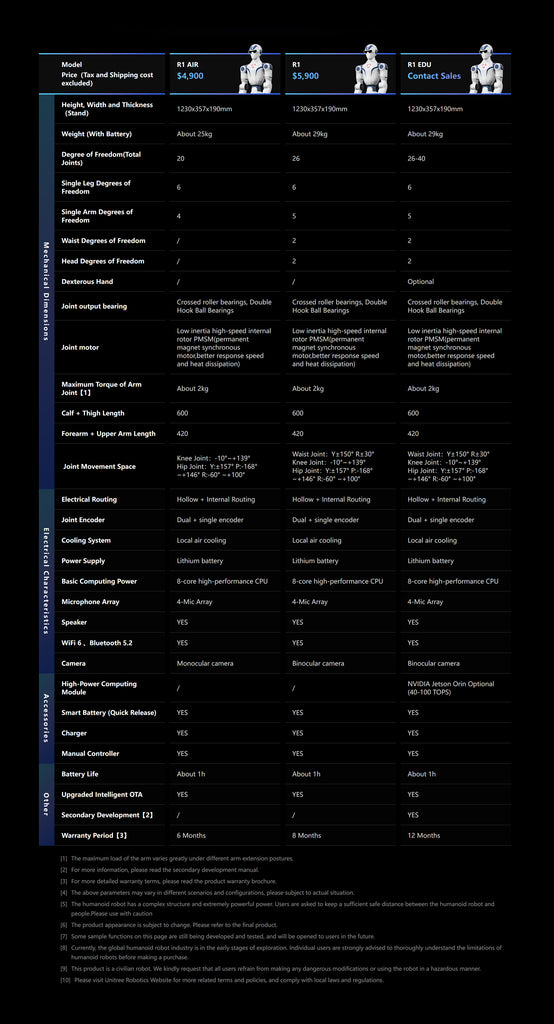
These core figures follow Unitree’s current standard R1 manufacturer specification. Configuration-sensitive accessories should still be confirmed on the final quotation.
| Manufacturer model / part number | R1-Basic |
|---|---|
| Product / configuration | Unitree R1 / commonly called R1 Basic |
| Standing dimensions | 1230 × 357 × 190 mm |
| Weight with battery | About 29 kg |
| Total body-joint DOF | 26 |
| Leg DOF | 6 per leg |
| Arm DOF | 5 per arm |
| Waist DOF | 2 |
| Head DOF | 2 |
| Maximum arm load | About 2 kg; posture dependent |
| Vision | Humanoid binocular camera |
| Primary compute | 8-core high-performance processor |
| Audio | 4-microphone array + speaker |
| Connectivity | Wi-Fi 6 + Bluetooth 5.2 |
| Battery | Quick-release lithium battery |
| Battery life | About 1 hour; workload dependent |
| Secondary development | Not included on standard R1 |
| Manufacturer warranty reference | 8 months |
Battery duration, payload and dynamic performance depend on motion, posture, software and operating conditions. Use the final supplied configuration as the controlling specification.
The compact body and expressive whole-body motion make the R1 suitable for exhibitions, showrooms, robotics demonstrations and controlled public engagement.
Useful for introducing students and teams to bipedal locomotion, humanoid kinematics, sensing and human-robot interaction without requiring a full research configuration.
Organizations comparing humanoid form factors can use the standard R1 to assess mobility, transportability, runtime and interaction before moving to an EDU development platform.
The R1’s smaller footprint can be easier to position and transport than full-size humanoids such as H2, subject to venue safety and operating requirements.
Teams can evaluate operational fit, maintenance needs, charging cycles and human-space interaction before committing to larger fleets or higher-specification variants.
Camera, microphones and speaker provide a practical base for controlled visual and voice-driven experiences using supported factory functions.
Choose the R1 when compact size and ready-to-use humanoid movement matter most. Choose R1 EDU U1 for entry-level secondary development, R1 EDU U3 when dexterous hands are required, or R1 EDU U6 for tactile five-finger manipulation. If you want a larger platform with roughly two hours of runtime and 3D LiDAR plus a depth camera, compare the Unitree G1 humanoid robot.
This separation is deliberate: the standard R1 is a different purchase from a programmable R1 EDU. Buyers should not assume that every video or developer demo made with an EDU robot is available on the standard R1.
| Feature | R1 | R1 EDU U1 | G1 Basic |
|---|---|---|---|
| Height | 1.23 m | 1.23 m | 1.32 m |
| Weight | ~29 kg | ~29 kg | ~35 kg |
| Actuated DOF | 26 | 26 | 23 |
| High-power AI compute | Not included | Jetson Orin, 40 TOPS | Not included |
| Secondary development | No | Yes | No |
| Hand configuration | Fixed / non-dexterous | Fixed / non-dexterous | Fixed / non-dexterous |
| Primary sensing | Binocular vision | Binocular vision | Depth camera + 3D LiDAR |
| Battery reference | ~1 hour | ~1 hour | ~2 hours |
For the standard R1 configuration, the commonly supplied system includes the humanoid robot, one quick-release smart battery, battery charger, handheld remote controller and transport case. Exact packing can vary by supply channel, so the written quotation and packing list remain the final authority.
Standard 26-DOF Unitree R1 with fixed non-dexterous hand-shaped end effectors.
Quick-release battery, compatible charger and handheld controller for supported factory operation.
A transport case is commonly supplied with the standard R1 package; confirm the exact case and packing format before dispatch.
The Unitree R1 Basic Humanoid Robot uses the current standard R1 mechanical layout published by Unitree: 26 actuated joints distributed as six per leg, five per arm, two at the waist and two at the head. The 600 mm combined calf-and-thigh length and 420 mm combined forearm-and-upper-arm length help explain why the platform can remain compact at 1.23 m while still providing a useful human-like reach envelope.
Unitree specifies crossed-roller and double-hook ball bearing arrangements at the joint outputs, low-inertia high-speed internal-rotor permanent-magnet synchronous motors, dual plus single joint encoders, hollow internal electrical routing and local air cooling. These details matter to buyers comparing a Unitree R1 humanoid robot with lighter demonstration robots because they describe the actual motion hardware, not only the headline DOF count.
| Knee motion range | -10° to +139° |
|---|---|
| Hip yaw | ±157° |
| Hip pitch | -168° to +146° |
| Hip roll | -60° to +100° |
| Waist yaw / roll | ±150° / ±30° |
| Electrical routing | Hollow + internal routing |
| Joint encoder | Dual + single encoder |
| Cooling | Local air cooling |
The Unitree R1 Basic Humanoid Robot uses an 8-core high-performance processor, binocular camera, four-microphone array, speaker, Wi-Fi 6 and Bluetooth 5.2. Unitree markets the R1 family around multimodal voice-and-image interaction and OTA software updates, but its current specification table marks formal secondary development support only for R1 EDU.
That distinction is important. A buyer searching for a programmable Unitree R1 should not assume that every R1 demonstration or developer workflow applies to the standard model. For SDK-level development, custom low-level control, high-power Jetson compute or dexterous-hand research, choose an R1 EDU configuration instead.
The Unitree R1 Basic Humanoid Robot is the strongest fit when the requirement is a compact, transportable humanoid for demonstrations, education, controlled interaction, platform evaluation or procurement pilots. It is not the correct configuration when the project depends on formal secondary development or functional dexterous hands.
For buyers comparing Unitree R1 price options, the standard R1 should be judged on the complete delivered system: robot, battery, charger, controller, transport case, freight, import responsibilities and any destination-specific support. The lowest advertised chassis price is not always the final landed project cost.
Unitree R1 Basic Humanoid Robot should be selected by exact configuration rather than by family name alone, because compute, hand hardware, development access and supplied accessories can materially change between variants.
For procurement teams, the key advantage of this Unitree R1 Basic Humanoid Robot page is configuration clarity: the technical specification, included system, limitations and related alternatives are separated so buyers can compare like-for-like.
When evaluating Unitree R1 Basic Humanoid Robot price and availability, confirm the final destination, quantity, supplied accessories and model code on the written order rather than relying only on a headline price.
The Unitree R1 Basic Humanoid Robot specification should be read together with the model-specific warranty, battery-runtime caveats and safety requirements because real performance varies with motion, payload, software and operating conditions.
Buyers comparing the Unitree R1 Basic Humanoid Robot with another Unitree humanoid should prioritize the exact body DOF, compute tier, perception hardware, hand configuration and secondary-development status that their application actually requires.
A typical standard R1 package includes the robot, quick-release battery, charger and handheld controller; transport packaging may vary by shipment. Treat the written quotation and packing list as the final authority for included items.
Unitree R1 official specifications
AI Robot Supplier is operated by ARTI – Autonomous Robot Technology GmbH in Austria. Product configuration, availability, included accessories, applicable warranty and delivery terms are stated on the listing or confirmed where required before order acceptance.
Review our Shipping Policy, Return & Refund Policy and company information before purchase. For multi-unit, institutional or destination-specific procurement, request a written quotation so the exact model, quantity, accessories, lead time and freight scope can be confirmed.
For model-level procurement, Unitree R1 Basic Humanoid Robot should be matched to the exact configuration and accessories stated on the written quotation.
The Unitree R1 Basic Humanoid Robot information on this page separates verified platform specifications from configuration-dependent features so buyers can compare the correct model.
These quick answers summarize configuration-specific points that buyers commonly need before comparing price or requesting a quotation.
The Unitree R1 Basic Humanoid Robot measures 1230 × 357 × 190 mm when standing and weighs about 29 kg with the battery installed.
Unitree lists roughly one hour of battery life for the standard R1. Actual runtime varies with motion, compute load, temperature and operating conditions.
The standard R1 does not include Unitree’s formal secondary-development package. Buyers who need SDK-level development should compare the R1 EDU configurations.
The standard R1 uses binocular vision together with a four-microphone array and speaker for visual and voice-based interaction.
Unitree publishes an arm-load reference of about 2 kg, with usable payload depending on arm extension, posture and the task being performed.
The current manufacturer warranty reference for the standard R1 is 8 months, subject to the applicable Unitree warranty terms and supplied configuration.
A typical R1 Basic package is commonly supplied with the robot, smart battery, charger, handheld controller and transport case. Confirm the final packing list before dispatch.
The Unitree R1 Basic Humanoid Robot is best suited to demonstrations, education, controlled interaction and platform evaluation when secondary development is not required.
The current standard Unitree R1 has 26 actuated body-joint DOF: six per leg, five per arm, two at the waist and two at the head.
“R1 Basic” is a reseller naming convention often used for the standard R1. Unitree’s current manufacturer page names the standard 26-DOF model simply “R1,” alongside R1 Air and R1 EDU.
The standard R1 does not include the secondary-development support of the R1 EDU line. For custom development and higher onboard AI compute, choose an R1 EDU configuration.
Unitree lists approximately one hour of runtime. Actual duration depends on movement, compute load, temperature and operating conditions.
The current AI Robot Supplier listing price is shown above. Final landed cost can vary with destination, freight, taxes, accessories and configuration.
International delivery can be quoted for supported destinations. Provide the delivery country and required quantity so freight and import responsibilities can be confirmed.
Yes. “R1 Basic” is a common distributor model designation for the standard 26-DOF R1. Unitree’s current manufacturer page labels the model simply “R1,” between R1 Air and R1 EDU.
R1 Air is lighter at about 27 kg and has 20 DOF, while the standard R1 is about 29 kg and has 26 DOF including additional arm, waist and head articulation.
Tell us what you need — we respond within one business day.