Best for articulated manipulation
U3 is well matched to labs studying grasping, reaching and coordinated hand-arm motion without requiring tactile sensing.
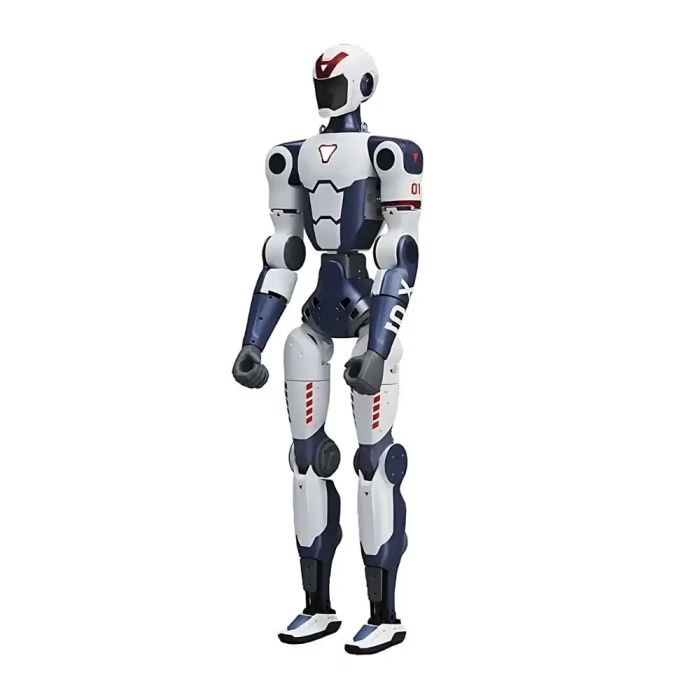
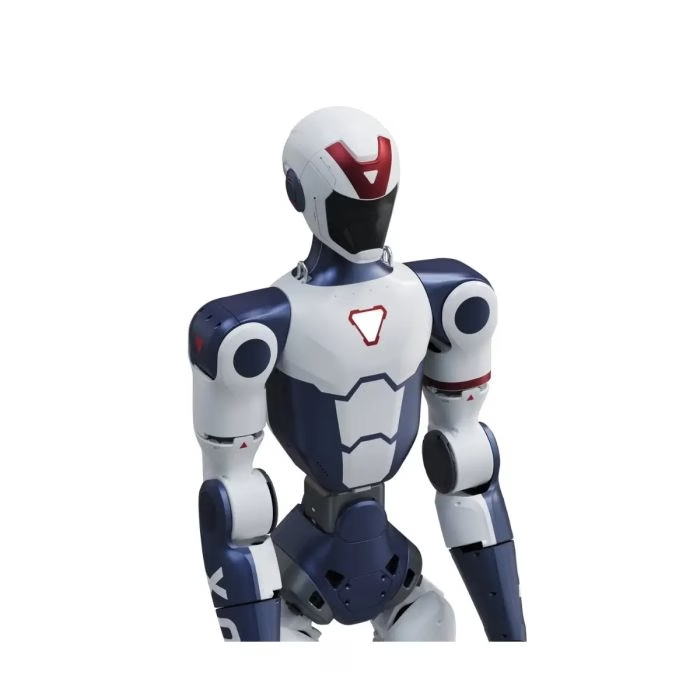
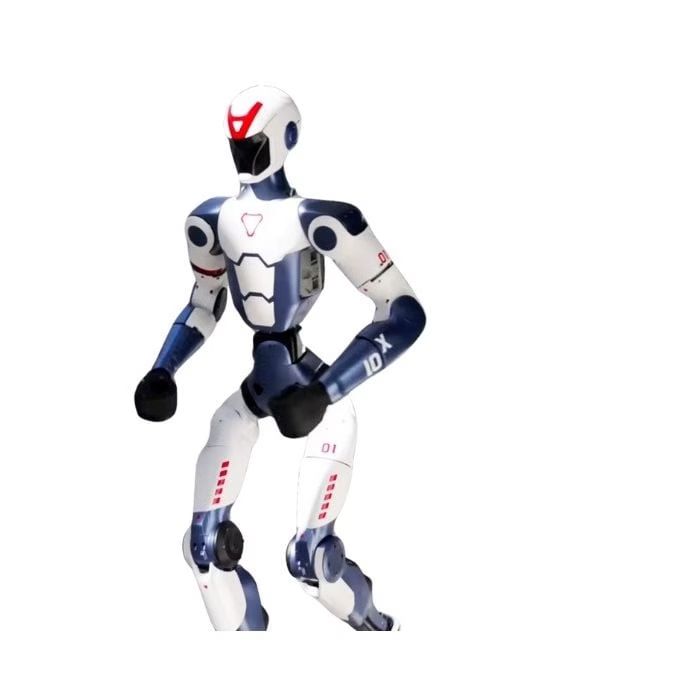
$18,540
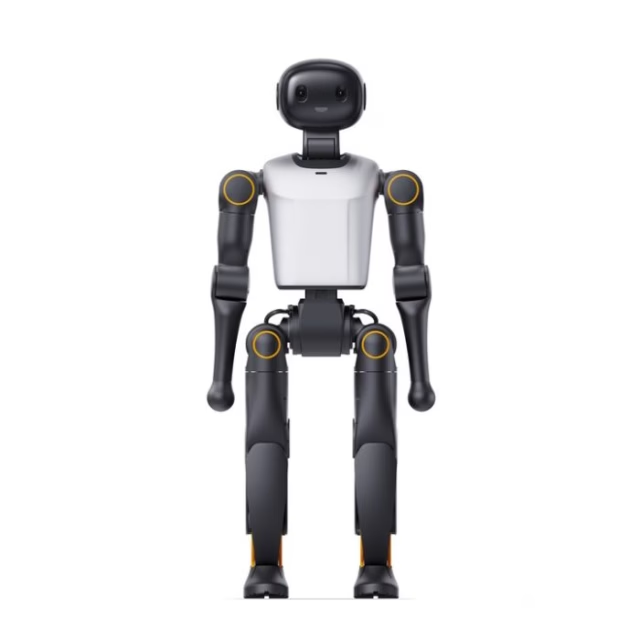
Unitree R1 EDU Pro A (R1 EDU U3) adds articulated manipulation to the 100-TOPS R1 development platform. U3 combines the 26-DOF R1 body with two Dex3 three-finger hands, each with 7 actuated DOF, for 40 actuated DOF in the full configuration. The hands are dexterous but do not include tactile sensing on this U3 tier. Manufacturer model / part number: R1-EDU-U3.
With secondary-development support, binocular vision and NVIDIA Jetson Orin compute specified at 100 TOPS, U3 is designed for robotics labs, manipulation research, embodied AI and advanced education.
Related products, categories and research.
Unitree R1 EDU Pro A U3 is where the R1 family moves from locomotion-and-perception development into articulated object manipulation. The base R1 body contributes 26 actuated joints, while two Unitree Dex3 three-finger hands add 7 actuated DOF per hand. The result is a 40-actuated-DOF configuration designed for grasping, coordinated arm-hand control and embodied-AI research.
U3 also uses the higher R1 EDU compute tier, specified with NVIDIA Jetson Orin at 100 TOPS, and supports secondary development. Unlike tactile variants, the U3 Dex3 configuration does not include tactile arrays, which makes it a useful choice when articulated motion is required but touch sensing is not.
Fixed-hand humanoids can demonstrate locomotion and interaction, but they cannot perform meaningful grasping experiments. U3 changes that equation by adding articulated hands while retaining the compact R1 chassis. Researchers can explore coordinated whole-body movement, reaching, grasp planning, tool interaction and hand-arm trajectories without moving to a much larger robot.
The Unitree R1 U3 is therefore a different purchasing decision from R1 EDU U2. Both use the 100-TOPS development tier, but U2 keeps fixed hands while U3 introduces Dex3 articulation. If tactile sensing is essential, compare R1 EDU U6 instead.
Two three-finger Dex3 hands, 7 actuated DOF per hand, no tactile sensors on U3. This distinction should be confirmed in the written quotation because hand options materially change capability and price.
The listing price shown above applies to the U3 configuration on AI Robot Supplier. For dexterous robots, compare the complete scope—not only the chassis price. The hand pair, compute module, protective gantry, transport case, spare batteries and development support can materially affect the delivered system cost.
U3 is well matched to labs studying grasping, reaching and coordinated hand-arm motion without requiring tactile sensing.
The higher compute tier supports real-time perception, AI inference and manipulation-control workloads.
At roughly 1.23 m and 29 kg, R1 is physically easier to accommodate than full-size humanoids while still offering whole-body articulation.
| Manufacturer model / part number | R1-EDU-U3 |
|---|---|
| Product / configuration | R1 EDU Pro A / U3 |
| Standing dimensions | 1230 × 357 × 190 mm |
| Weight with battery | About 29 kg |
| Body-joint DOF | 26 |
| Total actuated DOF | 40 including hand joints |
| Leg DOF | 6 per leg |
| Arm DOF | 5 per arm |
| Waist DOF | 2 |
| Head DOF | 2 |
| Dexterous hands | 2 × Unitree Dex3 three-finger hands |
| Hand DOF | 7 actuated DOF per hand |
| Tactile sensing | Not included on U3 |
| Maximum arm load | About 2 kg; posture dependent |
| AI compute | NVIDIA Jetson Orin configuration specified at 100 TOPS |
| Vision | Humanoid binocular camera |
| Wireless | Wi-Fi 6 + Bluetooth 5.2 |
| Battery life | About 1 hour |
| Secondary development | Supported |
| Warranty reference | 12 months |
Develop grasping and object-interaction routines using two articulated three-finger hands.
Study hand positioning, reaching and coordinated manipulation for tools and structured objects in controlled settings.
Combine perception, 100-TOPS onboard compute and physical manipulation in end-to-end robotics experiments.
Explore how locomotion, waist motion, arms and hands work together during reaching or object-transfer tasks.
A strong platform for advanced courses covering kinematics, controls, manipulation, planning and AI.
Use voice, vision and dexterous motion for research into collaborative or assistive interaction patterns.
R1 EDU U2 gives you the same 100-TOPS compute tier with fixed hands, making it more economical for perception and locomotion work. U3 adds two 7-DOF Dex3 hands but no tactile sensing. R1 EDU U6 moves to a five-finger tactile-hand configuration for contact-rich manipulation. The U1 remains the lower-compute 40-TOPS entry EDU option.
For buyers comparing “40 DOF humanoid robot” listings, check how the total is counted. U3’s 40 figure is straightforward: 26 actuated body joints plus 14 actuated hand joints.
| Feature | U2 | U3 | U6 |
|---|---|---|---|
| R1 body DOF | 26 | 26 | 26 |
| Published total actuated DOF | 26 | 40 | 48 |
| AI compute | 100 TOPS | 100 TOPS | 100 TOPS |
| Hands | Fixed | 2 × Dex3, 7 DOF each | 2 × Revo 2 Touch, 11 DOF each |
| Tactile sensing | No | No | Yes |
| Best fit | AI/perception | Articulated grasping | Contact-aware manipulation |
A typical U3 system includes the R1 EDU U3 robot, two Unitree Dex3 three-finger hands, quick-release battery, charger, handheld controller, transport case and protective gantry. The two Dex3 hands provide 7 actuated DOF each and are non-tactile on this configuration.
Articulated three-finger hands add 14 actuated joints to the 26-DOF R1 body.
Supports perception, manipulation policies and other custom development workloads.
Transport case and protective gantry are commonly part of the research-oriented U3 package; verify final packing.
U3 provides articulated grasping but does not include tactile sensors in the Dex3 hand configuration described here. If your research depends on contact sensing, grip feedback or multimodal touch data, U6 is the more appropriate R1 variant. Manipulation performance also depends on the chosen control stack, object geometry and whole-body posture.
Unitree R1 EDU Pro A combines the standard 26-DOF R1 body with two Unitree Dex3 three-finger hands. Each Dex3 hand contributes seven actuated joints, so the complete U3 configuration is counted as 26 body joints + 7 left-hand joints + 7 right-hand joints = 40 actuated DOF.
That simple calculation is worth stating because “40 DOF” is sometimes presented without explaining where the additional movement comes from. On Unitree R1 EDU Pro A, the extra articulation is specifically in the two dexterous hands.
Unitree R1 EDU Pro A uses two Dex3 hands with seven actuated DOF per hand and no tactile sensors on the U3 configuration described here. This creates a useful manipulation platform for reaching, grasp planning, coordinated hand-arm control, tool interaction and whole-body manipulation research without adding the tactile sensing complexity of U6.
Because the hand system is non-tactile, contact-aware tasks must rely on vision, joint state, control models or other instrumentation rather than fingertip tactile arrays.
Unitree R1 EDU Pro A is currently documented with NVIDIA Jetson Orin at 100 TOPS, Unitree SDK2 with CycloneDDS, ROS 2 workflows including rosbag2 and MoveIt2, and NVIDIA Isaac Sim support. That combination is relevant to manipulation teams because perception, trajectory generation and dexterous control can be compute intensive.
The usual U3 research package is commonly listed with two Dex3 hands, smart battery, charger, handheld controller, transport case and protective gantry. Confirm the exact U3 model code and supplied accessories in the final quotation.
Unitree R1 EDU Pro A should be selected by exact configuration rather than by family name alone, because compute, hand hardware, development access and supplied accessories can materially change between variants.
A typical U3 system is expected to include the R1 EDU U3 robot, two Dex3 hands, smart battery, charger, handheld controller, transport case and protective gantry. Final inclusion is determined by the quotation and packing list.
Unitree R1 official platform specifications
AI Robot Supplier is operated by ARTI – Autonomous Robot Technology GmbH in Austria. Product configuration, availability, included accessories, applicable warranty and delivery terms are stated on the listing or confirmed where required before order acceptance.
Review our Shipping Policy, Return & Refund Policy and company information before purchase. For multi-unit, institutional or destination-specific procurement, request a written quotation so the exact model, quantity, accessories, lead time and freight scope can be confirmed.
These quick answers summarize configuration-specific points that buyers commonly need before comparing price or requesting a quotation.
The Unitree R1 EDU Pro A has 40 actuated DOF in total: 26 body joints plus seven actuated joints in each of the two Dex3 hands.
U3 uses two non-tactile Dex3 three-finger hands, each providing seven actuated DOF for articulated manipulation research.
The U3 development tier is specified with NVIDIA Jetson Orin compute rated at 100 TOPS.
Current documentation lists Unitree SDK2, CycloneDDS, ROS 2, MoveIt2 and NVIDIA Isaac Sim support for custom development workflows.
U3 has 40 actuated DOF when the 26 body joints and 14 actuated Dex3 hand joints are counted together.
U3 uses two Unitree Dex3 three-finger dexterous hands with 7 actuated DOF per hand.
No. The U3 Dex3 configuration is articulated but non-tactile. Tactile hand configurations are available higher in the R1 EDU Pro range.
This catalog U3 configuration is specified with NVIDIA Jetson Orin at 100 TOPS, in addition to the platform’s primary 8-core processor.
R1 EDU models support secondary development. Review Unitree’s current SDK2 repository and validate the exact APIs needed for your project.
Choose U3 when articulated grasping is required but tactile sensing is not. Choose U6 when contact sensing in the hands is important to the research.
The R1 body contributes 26 actuated joints and the two Dex3 hands add seven actuated joints each, producing 40 total actuated DOF.
No. The U3 Dex3 configuration is articulated but non-tactile. U6 is the R1 variant in this cluster designed around tactile five-finger hands.
Tell us what you need — we respond within one business day.