U1: compute without dexterous hands
U1 is the sensible starting point when 40 TOPS development compute and secondary-development access matter more than robotic-hand manipulation.
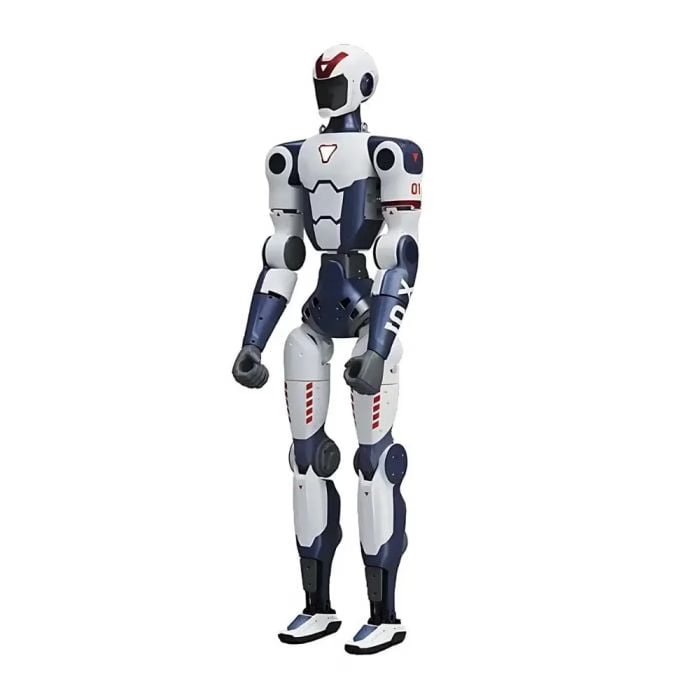
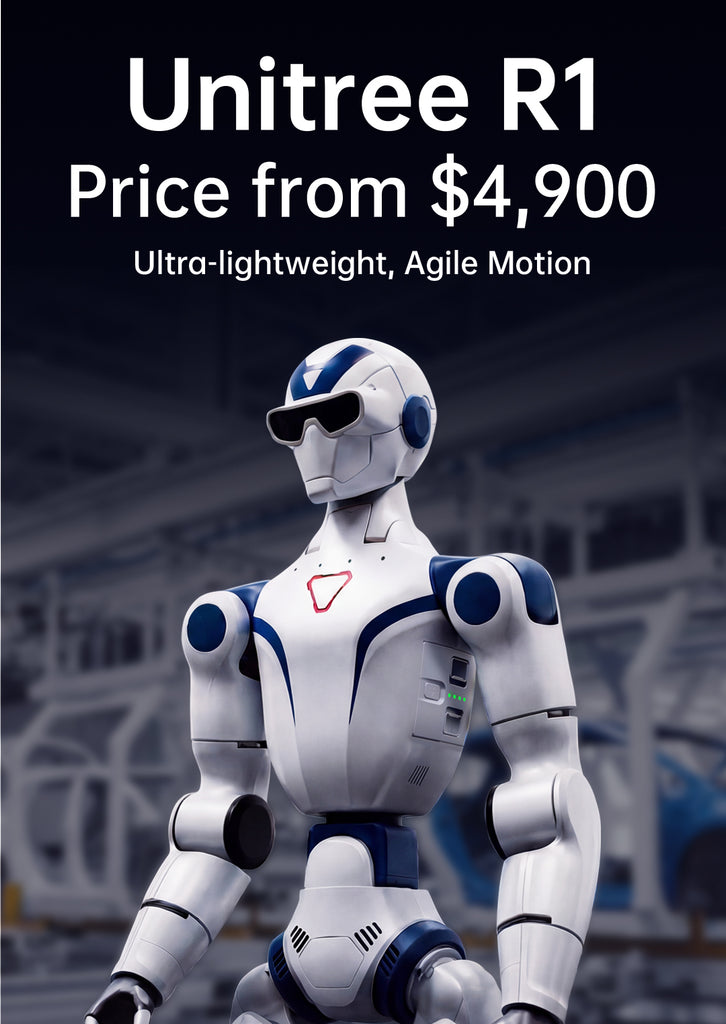

$9,570.00
Unitree R1 EDU Standard (R1 EDU U1) turns the compact R1 into a development-oriented humanoid robot. This catalog configuration combines the 26-DOF R1 body with secondary-development support and an NVIDIA Jetson Orin module specified at 40 TOPS, while retaining binocular vision, Wi-Fi 6, Bluetooth 5.2 and approximately one hour of battery runtime. Manufacturer model / part number: R1-EDU-U1.
For universities, robotics labs and embodied-AI teams comparing a Unitree R1 EDU for sale, U1 is the entry EDU tier before the 100-TOPS U2 and dexterous-hand U3/U6 variants.
Related products, categories and research.
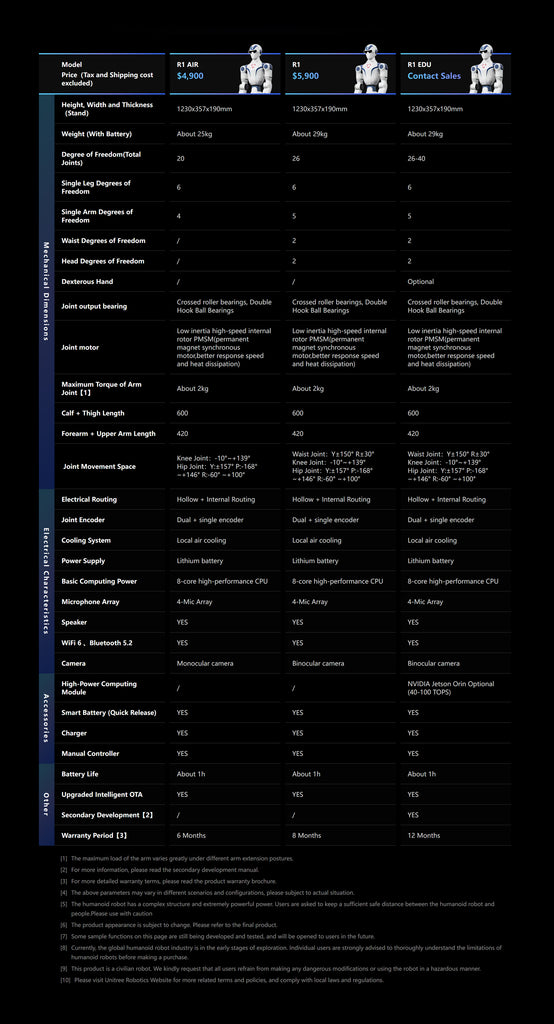
Unitree R1 EDU is the development branch of the compact R1 family. The U1 configuration keeps the standard R1’s 1,230 mm height, approximately 29 kg operating weight and 26 body-joint DOF, then adds secondary-development capability and a dedicated NVIDIA Jetson Orin compute module specified at 40 TOPS for robotics workloads.
That changes the purpose of the robot. U1 is not simply a more expensive standard R1; it is intended for developers who need to work with robot interfaces, custom control software and research workflows rather than only factory-provided behaviors.
The standard Unitree R1 humanoid robot is suited to demonstrations, interaction and evaluation, but Unitree does not position it as the secondary-development model. R1 EDU U1 is for teams that need development access and additional onboard AI compute while keeping the same compact physical platform.
For a university or robotics team, the important search terms are not only “Unitree R1 EDU price” or “R1 EDU for sale.” You should also ask whether the selected configuration has the compute, hand hardware, development access and software ecosystem your project needs. U1 is the 40-TOPS entry tier; R1 EDU Smart U2 moves to the 100-TOPS tier, while R1 EDU Pro A U3 adds articulated Dex3 hands.
University robotics, embodied-AI prototyping, controls research, perception experiments, human-robot interaction and teams learning the Unitree SDK environment without paying for dexterous-hand hardware they do not need.
The current listing price is shown above. For R1 EDU, total project cost can change with the selected compute module, hand configuration, spare batteries, protective gantry, transport case, development accessories, freight and destination taxes. Comparing only the headline robot price can therefore be misleading.
U1 is the sensible starting point when 40 TOPS development compute and secondary-development access matter more than robotic-hand manipulation.
U2 keeps the compact R1 body but is sold as a 100-TOPS configuration for more demanding onboard inference and perception.
Choose U3 for Dex3 articulated hands or U6 for a five-finger tactile-hand configuration when object interaction is central to the project.
The R1 body specifications below follow Unitree’s R1 platform data. The U1 compute tier is configuration-specific and should be confirmed on the final order.
| Manufacturer model / part number | R1-EDU-U1 |
|---|---|
| Product / configuration | R1 EDU Standard / R1 EDU U1 |
| Standing dimensions | 1230 × 357 × 190 mm |
| Weight with battery | About 29 kg |
| Body-joint DOF | 26 |
| Leg DOF | 6 per leg |
| Arm DOF | 5 per arm |
| Waist DOF | 2 |
| Head DOF | 2 |
| Hand configuration | Fixed / non-dexterous on U1 |
| Maximum arm load | About 2 kg; posture dependent |
| Primary processor | 8-core high-performance processor |
| AI compute | NVIDIA Jetson Orin configuration specified at 40 TOPS |
| Vision | Humanoid binocular camera |
| Audio | 4-microphone array + speaker |
| Wireless | Wi-Fi 6 + Bluetooth 5.2 |
| Battery life | About 1 hour |
| Secondary development | Supported |
| Warranty reference | 12 months |
Use a compact physical platform to study balance, locomotion, joint control and whole-body behaviors within the supported development interfaces.
Pair binocular vision and onboard AI compute with custom perception and inference pipelines for research prototypes.
A useful platform for courses that move beyond observing humanoid motion into software, sensing, controls and AI integration.
Microphone, speaker and visual sensing support experiments combining voice, visual input and motion in controlled environments.
Developer teams can use Unitree’s SDK ecosystem and supported simulation approaches to prepare and validate behaviors before physical deployment.
The 40-TOPS tier is suitable for teams that need onboard acceleration but do not yet require the 100-TOPS or dexterous-hand configurations.
R1 EDU U2 is the logical step up when 100 TOPS of onboard compute is required while keeping fixed hands. R1 EDU U3 adds two Dex3 articulated hands for manipulation. R1 EDU U6 targets contact-rich manipulation through a five-finger tactile-hand configuration. If you do not need development access at all, the standard R1 is the simpler purchase.
Keeping these configurations separate prevents a common buying mistake: assuming all R1 EDU pages describe identical hardware. Compute and end-effector choices materially change what the robot can do.
| Feature | U1 | U2 | U3 | U6 |
|---|---|---|---|---|
| R1 body DOF | 26 | 26 | 26 | 26 |
| Published total actuated DOF | 26 | 26 | 40 | 48 |
| AI compute | 40 TOPS | 100 TOPS | 100 TOPS | 100 TOPS |
| Hands | Fixed | Fixed | 2 × Dex3 | 2 × Revo 2 Touch |
| Tactile sensing | No | No | No | Yes |
| Secondary development | Yes | Yes | Yes | Yes |
| Best fit | Entry development | Higher-compute AI | Dexterous manipulation | Tactile manipulation |
A typical U1 package includes the R1 EDU U1 robot, quick-release smart battery, charger, handheld remote controller, transport case and protective gantry. This configuration uses fixed/non-dexterous hands. Confirm each item on the written quotation before ordering.
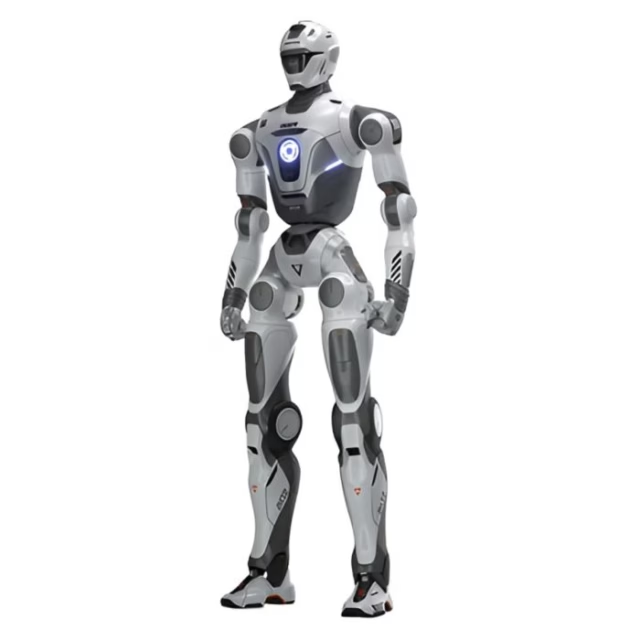
R1 EDU U1 with the 40-TOPS Jetson Orin development tier and secondary-development access.
Protective gantry and transport case are commonly supplied for safer lab setup and movement between work areas.
Quick-release battery, charger and handheld controller support setup, testing and controlled operation.
U1 is the entry development configuration. Choose U2 when 100-TOPS onboard AI compute is required, U3 when articulated Dex3 hands are essential, or U6 when the project specifically needs five-finger tactile sensing. Development teams should validate current SDK, ROS 2 and simulation requirements against the exact software release used in their project.
Unitree R1 EDU Standard is the entry development configuration in this R1 EDU ladder. Current specialist documentation pairs the 26-DOF R1 body with NVIDIA Jetson Orin compute rated at 40 TOPS and Unitree SDK2 using CycloneDDS. Development workflows are documented around ROS 2, including rosbag2 and MoveIt2, with NVIDIA Isaac Sim support for simulation-oriented work.
That makes Unitree R1 EDU Standard materially different from the standard R1 even though the body dimensions, weight and 26 body joints are similar. The U1 value is development access and onboard AI acceleration, not a different chassis.
High-level and low-level development interfaces through Unitree’s current SDK2 ecosystem.
Current specialist documentation lists rosbag2 and MoveIt2 integration paths for research development.
Simulation support gives teams a route to test and prepare workflows before transferring them to physical hardware.
The Unitree R1 EDU Standard uses 26 actuated body joints: six per leg, five per arm, two at the waist and two at the head. Unitree specifies crossed-roller and double-hook ball bearings, low-inertia PMSM actuators, dual plus single encoders, hollow internal cable routing and local air cooling. The binocular camera, four-microphone array and speaker provide the base perception and interaction hardware.
The fixed non-actuated hand shape on U1 is intentional. Buyers who need manipulation should move up the R1 EDU ladder rather than treating U1 as a dexterous-hand platform.
Unitree R1 EDU Standard is well matched to university labs, embodied-AI teams and robotics courses that need formal development support but do not yet need the higher 100-TOPS compute tier or articulated hands. The usual supplied research package is commonly listed with a quick-release battery, charger, controller, transport case and protective gantry; the final quotation should control the delivered scope.
Choose U2 when onboard AI compute is the bottleneck, U3 when articulated Dex3 manipulation is required, and U6 when tactile five-finger interaction is central to the research objective.
Unitree R1 EDU Standard should be selected by exact configuration rather than by family name alone, because compute, hand hardware, development access and supplied accessories can materially change between variants.
For procurement teams, the key advantage of this Unitree R1 EDU Standard page is configuration clarity: the technical specification, included system, limitations and related alternatives are separated so buyers can compare like-for-like.
When evaluating Unitree R1 EDU Standard price and availability, confirm the final destination, quantity, supplied accessories and model code on the written order rather than relying only on a headline price.
The quotation and packing list should control the final supplied scope.
Unitree R1 official platform specifications
AI Robot Supplier is operated by ARTI – Autonomous Robot Technology GmbH in Austria. Product configuration, availability, included accessories, applicable warranty and delivery terms are stated on the listing or confirmed where required before order acceptance.
Review our Shipping Policy, Return & Refund Policy and company information before purchase. For multi-unit, institutional or destination-specific procurement, request a written quotation so the exact model, quantity, accessories, lead time and freight scope can be confirmed.
For model-level procurement, Unitree R1 EDU Standard should be matched to the exact configuration and accessories stated on the written quotation.
These quick answers summarize configuration-specific points that buyers commonly need before comparing price or requesting a quotation.
The Unitree R1 EDU Standard uses the same compact R1 chassis: 1230 × 357 × 190 mm and approximately 29 kg with the battery.
The U1 development tier is specified with NVIDIA Jetson Orin compute rated at 40 TOPS.
Current specialist documentation lists Unitree SDK2 with CycloneDDS, ROS 2 workflows, MoveIt2 support and NVIDIA Isaac Sim integration.
U1 uses fixed, non-actuated hand shapes. Teams that require articulated or tactile manipulation should move to a higher R1 EDU configuration.
Battery life remains approximately one hour per charge on the R1 platform, with actual runtime depending on motion and compute workload.
The current specialist warranty reference for U1 is 12 months, subject to the final supplier and manufacturer terms.
U1 is an entry R1 EDU development configuration built around the compact 26-DOF R1 body, with secondary-development support and a catalog-specified 40-TOPS NVIDIA Jetson Orin compute module.
It is better for development work, but not automatically better for every buyer. If you only need ready-to-use R1 movement and demonstrations, the standard R1 may be sufficient.
Unitree’s SDK2 ecosystem is used by developers building integrations around supported Unitree robots. Project-specific ROS 2 packages and workflows should be validated by your engineering team against the current SDK release.
No. U1 is the fixed-hand entry EDU configuration in this catalog. Choose a higher Pro configuration such as U3 or U6 for articulated hands.
Approximately one hour is the platform reference. Real runtime varies with movement, AI workload and operating conditions.
Specify the exact U1 configuration, quantity, destination, required compute, spare batteries, development accessories and any support or integration requirements.
Current specialist documentation for U1 lists Unitree SDK2 with CycloneDDS and ROS 2 workflows including rosbag2 and MoveIt2. Engineering teams should still validate the exact software release used by their project.
Choose U1 when 40 TOPS is sufficient and you want the lower entry point into formal R1 secondary development. U2 moves to the 100-TOPS compute tier.
Tell us what you need — we respond within one business day.